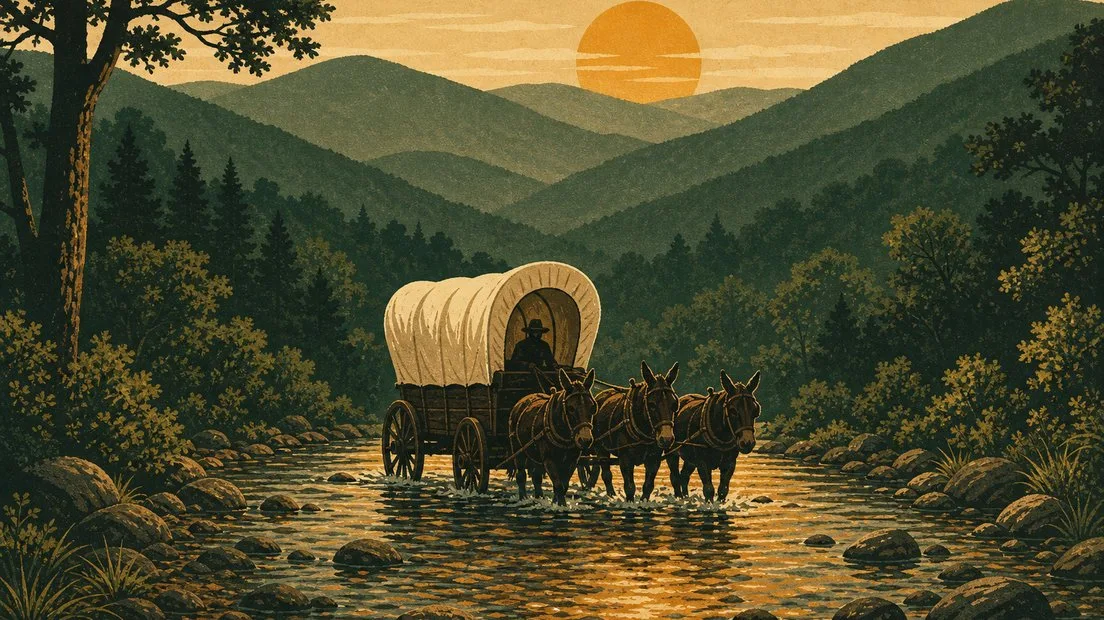
Forty-three ounces of gold left Dahlonega for Atlanta on August 4, 1958, in a covered wagon. Six more wagons went along to keep it company. A Georgia Humanities history lists the rest of the party as "33 adults, 18 children, 15 mules, six horses, one dog, and two State Patrol cars." They averaged about three miles an hour, with a police escort that could have done the whole trip before lunch.
The gold was for the state Capitol, whose dome was covered in deteriorating tin. An architect and a Dahlonega-born engineer proposed rebuilding it and gilding it with Georgia gold. The state fretted about the cost, so Dahlonega and Lumpkin County offered to donate the metal. Twenty ounces were pledged within a week. The local Jaycees organized a day for people to go pan the creeks themselves, and they asked around for pieces people still had from decades earlier.
The wagons were pure theater. They restaged the 1807 wagon move of the state treasury from Louisville to Milledgeville. The gold rode in a chest said to have belonged to William Few, one of Georgia's two signers of the Constitution. Atlanta did not fully rise to the occasion. When the wagons reached Piedmont Park for the night, they were directed to a patch of mud. Someone eventually found them a drier spot, and by 9:30 that evening people trying to get a look at them had jammed traffic around the park. On August 7, Gov. Marvin Griffin accepted the gold on the Capitol steps.
The theater had a reason. People were digging gold in these mountains about 20 years before California's rush, and Georgia has never quite gotten over it. How they came to be digging there is a less cheerful story than a parade of mules.
Nobody knows who found it
Georgia has several tidy discovery stories and no proof of any of them. One has John Witheroods pulling a three-ounce nugget out of Dukes Creek, about 10 minutes from Helen. Another has a North Carolina prospector named Jesse Hogan on Ward's Creek near Dahlonega. In the best known, a young Benjamin Parks kicks up an odd-looking stone in 1828 while looking for deer. The New Georgia Encyclopedia is blunt: "no one is really certain who made the first discovery or when."
A historical marker put up in 1962 is more confident. It says gold was found on Dukes Creek in 1828 by two people: Witheroods, and a man it identifies only as "a Negro servant of Major Frank Logan of Louisville, Georgia." It gives no name. In Georgia in 1828, "servant" may well have meant an enslaved person, though the marker doesn't say, and neither does anything else we found. The same marker claims one Nacoochee Valley merchant bought and shipped $1 million to $1.5 million worth of gold over 30 years, which is a lot of gold for one shopkeeper.
The earliest paperwork is a notice in the Georgia Journal of Milledgeville, dated August 1, 1829, quoting a letter from Habersham County: "Two gold mines have just been discovered in this county, and preparations are making to bring these hidden treasures of the earth to use." Things moved fast from there. Parks, in his nineties, described it to the Atlanta Constitution in 1894:
"The news got abroad, and such excitement you never saw. It seemed within a few days as if the whole world must have heard of it, for men came from every state I had ever heard of. They came afoot, on horseback and in wagons, acting more like crazy men than anything else."
If you want the plain timeline, our history of the Georgia gold rush lays it out year by year.
The doorstop
Georgia can't comfortably claim to be first in the country, though plenty of Georgia sources do. In 1799, 12-year-old Conrad Reed was fishing in Little Meadow Creek in North Carolina when he came up with a 17-pound yellow rock. The family used it as a doorstop for years. In 1802 a merchant in Fayetteville paid them $3.50 for it, and John Reed later learned the merchant had sold it for $3,600. It's the best argument we know for getting your doorstops looked at.
Reed recovered. By 1803 he had gone into a partnership to buy enslaved people to dig for more, and a 28-pound nugget followed. North Carolina had its own rush from there. Georgia State Parks calls Dahlonega's "America's first major gold rush," and the word "major" is doing honest work in that sentence.
Whose land it was
Georgia's gold country lay in the Cherokee Nation, and the people who lived there saw what was coming before the gold news broke. In February 1829, months before that Milledgeville notice, the editor of the Cherokee Phoenix wrote that settlers from Georgia were moving onto Cherokee land: "Right or wrong they are determined to take the country."
Then the gold news spread. By late 1829 thousands of prospectors were in the Nation, and Niles' Register reported 4,000 miners on Yahoola Creek alone by the spring of 1830. People called it the Great Intrusion even then. "Our neighbors who regard no law and pay no respects to the laws of humanity are now reaping a plentiful harvest," one writer said in the Phoenix. "We are an abused people." The encyclopedia's summary is grim: the louder the Cherokee protested, the more eagerly the miners came.
Georgia handed out the land by lottery, including a separate 1832 drawing for 40-acre gold districts at $10 each. The Supreme Court ruled that Georgia's encroachment on Cherokee sovereignty was illegal. According to the Digital Library of Georgia, President Jackson ignored the ruling and Georgia went on enforcing its claim. In November 1832 the Phoenix put the Cherokee position plainly: "To this confiscation of our property, we will not submit." In the bitter winter of 1838 to 1839, the U.S. Army drove the Cherokee west to present-day Oklahoma on the Trail of Tears. At least 4,000 died, about one-fifth of the Cherokee population, and we have nothing funny to say about that.
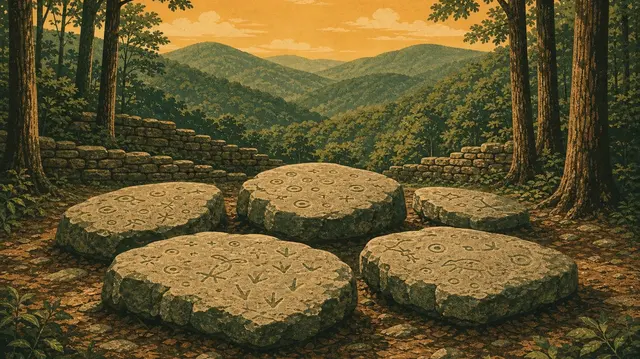
The town still carries a Cherokee word for yellow or golden, talonega. Our guide to Cherokee history around Helen covers who lived in these valleys before any of this, and it's worth your time.
Licklog, and the neighborhood mint
The boomtowns came up fast and rough. Auraria had about 1,000 people by 1832 and has nearly vanished since. The county seat began life as Licklog and took the name Dahlonega in 1833, which we consider a real improvement. W. P. Price recalled in 1897, in a book about a Baptist church of all things, that "Gambling houses, dancing houses, drinking saloons, houses of ill fame, billiard saloons, and tenpin alleys were open day and night."
Some of the miners had no say in being there, including those enslaved at the mine owned by John C. Calhoun of South Carolina. And there was James Bosclair, known in town as Free Jim, a free Black man from Augusta whose mine paid well enough to fund the largest general store in Dahlonega, plus an icehouse and a very popular saloon. He went west after the California news and was killed there in a dispute over a mining claim.
Congress chartered a branch mint in 1835. Getting materials and machinery into town took many weeks, and locals who wanted jobs were never in short supply, qualified or not. The director of the Mint in Philadelphia complained that Dahlonega's was a "neighborhood mint." By the time the first half eagles were struck, on April 17, 1838, the encyclopedia says the region's mines were nearly exhausted. The coins were too valuable to spend locally, so most went into overseas trade, and the mint did little for the money shortage it was meant to help.
It had one more odd chapter. Georgia seceded in January 1861 and took the building, but the Confederacy couldn't supply dies, so the half eagles struck from the gold on hand still said United States of America. The Confederate Congress shut the place down that June, after almost 1.5 million coins worth more than $6 million. The building burned in 1878, and a college hall went up on the same site, its steeple leafed with Georgia gold.
"Why go to California?"
In 1849 the California news reached the miners, who by then were struggling to make a living from the creeks. As the story goes, the mint's assayer, Dr. Matthew Stephenson, called a meeting, climbed the courthouse steps in front of about 200 miners and waved toward Findley Ridge, just south of town. "Why go to California? In that ridge lies more gold than man ever dreamt of. There's millions in it."
They went anyway, in droves. The details wobble depending on who's telling it. One local telling has him on the balcony, pointing at Crown Mountain. A Gainesville cemetery manager's version says the crowd gave no response, so Stephenson said it again, which is the most believable detail of the bunch. We found no transcript from 1849, so treat the wording as what people remembered.
The speech does have a punch line. Some of the Georgians who left came back and brought their California gold home to be coined at the local mint, and the encyclopedia says that's when business there boomed. Stephenson is buried in Gainesville. In 1876 a local paper reported that he had walked to Cumming and back at 75, adding that "he says he would not give a cent for a horse to ride if the distance were less than 50 miles." We assume he'd have had notes on the wagon train.
The line that isn't there
Notice what's missing from that speech: "Thar's gold in them thar hills." The Digital Library of Georgia says only that his words "may have inspired" it. Word researcher Barry Popik goes further and says there's no evidence the Dahlonega story produced the phrase at all. He finds "There's gold in them hills" in print by 1906, and "There's gold in them thar hills" called an old-time line by 1922. The Lumpkin County Historical Society says the speech started it all and that "thar" crept in around the 1930s. Those two can't both be right, and the Society has the home-field advantage.
Then there's Mark Twain. The local version has Georgia miners carrying "There's millions in it" to a California camp, where a man named Sellers picked it up and passed it to Twain, who gave it to his character Colonel Mulberry Sellers. The trouble starts with the man's name: he's William in one telling and James in another. So we went and searched the novels. In the Project Gutenberg text of The Gilded Age (1873), the closest we find is Si Hawkins raving about "millions upon millions in it" and another character saying "There's millions in the job." In The American Claimant (1892) someone does say "there's millions in it" to Colonel Sellers, who corrects him: "Billions in it." Neither book has "them thar." We didn't check the stage version, so we won't swear the line never crossed Sellers's lips, but we'd stop short of printing it on a T-shirt.
Under the Walmart
Miners brought hydraulic mining back from California in the 1850s, blasting hillsides with water under pressure, and the same technique tore up the land along Dukes Creek that is now Smithgall Woods. Stephenson's ridge got its turn too. By 1878 a Findley Gold Mining Company was courting investors with a prospectus and paying its miners 80 cents a day. Around 1899 investors went bigger. The Dahlonega Consolidated Gold Mining Company, which listed a Findley mine among its holdings, built what's said to be the largest gold mining plant ever put up east of the Mississippi: four stories, 100 by 300 feet, with 120 stamps.
It could not make the math work. Getting the gold out cost more than the market price of about $21 an ounce, and most of the big plants had closed by 1906, at a heavy loss to investors. So there may well have been millions in it, just not millions more than it cost to get out. The Consolidated mine now does underground tours. According to the AJC, it sits under land where Dahlonega's Walmart stands.
The dome, again
Back to the wagons, because it didn't end well. The gold was milled into leaf about as thin as a gum wrapper in Philadelphia and applied by Massachusetts steeplejacks in January 1959. It was supposed to last 30 or 40 years. Nobody involved understood that gold leaf doesn't bond properly in cold weather, and by 1977 almost half of it had come off.
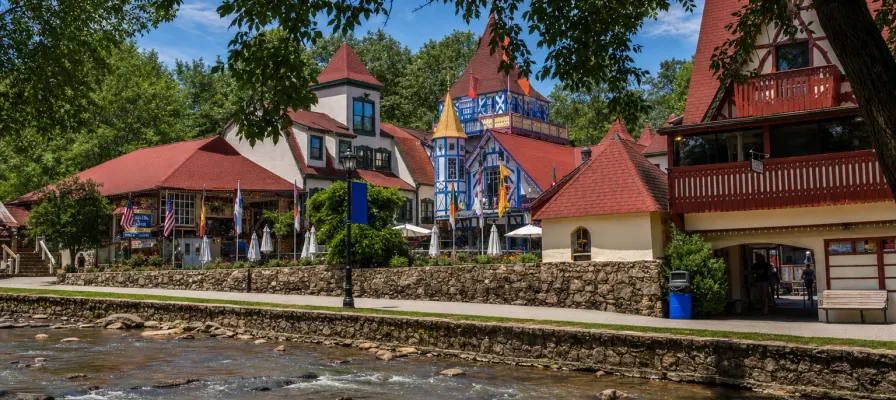
Georgia's response was to hitch up the wagons again. A fundraising wagon train crossed the state in 1979, visiting all the former capitals, with Gov. George Busbee taking the reins of the lead wagon for the last few miles into Dahlonega. That November, somewhere between 50 and 75 wagons set off for Atlanta with 60 ounces of gold, in the same chest, with a bluegrass band in one of the lead wagons and a downpour waiting at the end. The gold was refined in Kennesaw and milled in Bavaria, a fact we find delightful given what a lumber town up the road had decided to look like by then. The new leaf went on in the spring of 1981, a warmer plan.
Dahlonega stepped up again in 2024, when Crisson Gold Mine and Consolidated each donated gold for another regilding, at the Gold Rush Days festival. Reports disagree on how much. Reenactors dressed as the 1958 wagon party. The gold itself, the AJC reports, was framed and handed to a state trooper and a Capitol police officer for the trip to Atlanta. The paper didn't mention a mule.