Before the reactor ever switched on, the woods outside Dawsonville gave the neighbors a scare. In the late 1950s, crews clear-cut thousands of trees to make room for a top-secret Air Force lab, and then they hit a snag. "You couldn't be on the property unless you had a security clearance and logging truck drivers didn't have security clearances," nuclear engineer James Mahaffey told the Dawson County News.
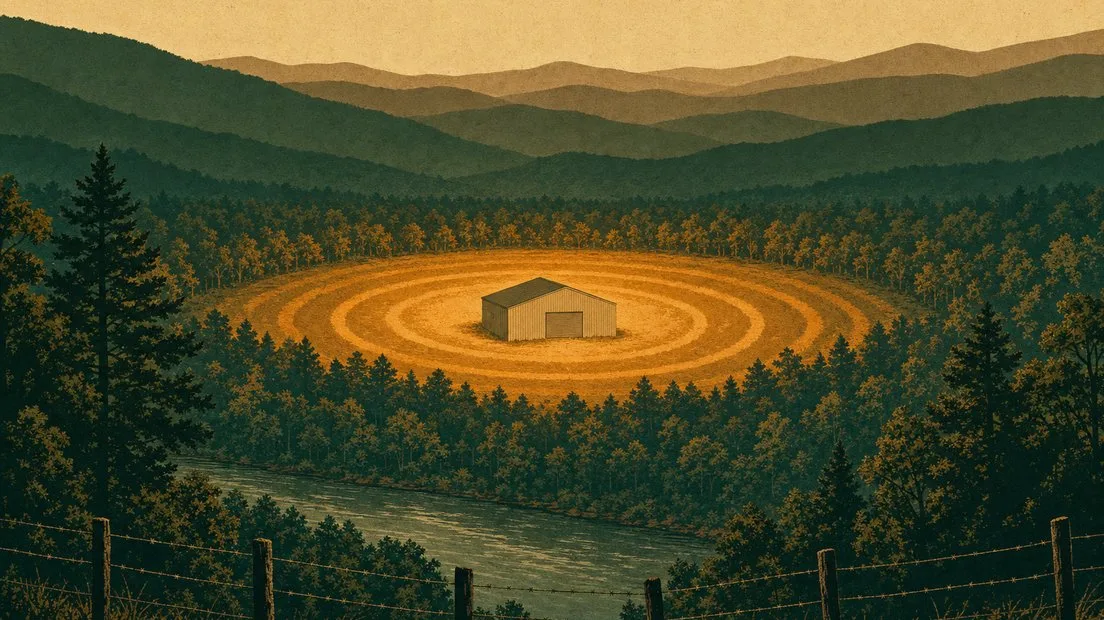
So the dead trees went into one enormous pile in the exact center of the site, and somebody set it on fire. People Mahaffey later interviewed remembered red and orange skies spreading over Dawsonville. "People in the area within miles of the place would see that and they were thinking this very secretive atomic place, this is the end of the world," he said.
It was only a bonfire. The actual project was weirder.
A bomber with a reactor in it
The Air Force wanted a nuclear-powered bomber. On paper the appeal was obvious, since fission packs a ridiculous amount of power into very little space. "You could have a thing that's the size of basketball that gives you a billion watts of power," Mahaffey said. The catch is what a reactor normally has to wear.
"Any nuclear reactor on this earth has shielding," Mahaffey explained. "It's got lead, concrete, steel, you know, heavy things to keep it from killing everybody, but you put it in an airplane and you can't have concrete and steel and lead. It's got to be naked."
The Air Force did get a reactor off the ground. Starting in September 1955, a converted B-36 bomber flew over west Texas and New Mexico with a working one-megawatt reactor in its bomb bay. According to the Smithsonian's National Air and Space Museum, that reactor never moved the plane or powered anything on it. It was along to test shielding, and the crew rode in a lead- and rubber-lined cockpit section weighing nearly 12 tons. A transport plane followed with parachutists, nicknamed the "glow in the dark squad," who were ready to jump onto any crash site.
Weight never stopped being the problem. Some of the program's diehards proposed crewing the bombers with older aviators, who, in the museum's words, "would likely die of natural causes long before succumbing to radiation poisoning," so the planes could carry less shielding. We are not making that up, and as far as we can tell, neither is the Smithsonian.
Georgia's job was the other half of the question: if you take the shielding away, what does a reactor do to everything around it? Mahaffey says you had to test that for real, and "it has to be somewhere where you're not potentially going to wipe out a city." Jim Johnson, a retired Georgia DNR wildlife technician, told the University of North Georgia's student paper it was the only site in the United States designed to test radiation's effects in the open air. Dawson County got the call.
What Dawson County was promised
Lockheed and the Air Force made it official on April 9, 1956, at Gainesville's Civic Building, with Gov. Marvin Griffin on hand. Months of rumor had gotten there first, including a guided missile plant and 15,000 jobs. Lockheed vice president Dan Haughton offered some comfort: "In case of an accident at the reactors, which is highly improbable, there will be no danger to the people living in the vicinity of the site."
What the county got, according to retired Gainesville Times editor Johnny Vardeman, was about 500 jobs, most of them for scientists and technicians rather than local folks. The lab shrank too. It was pitched as a $100 million complex and opened in 1958 as a $15 million one, according to a 1991 investigation by Karen Kirkpatrick of the Gainesville Times, which we'll lean on a lot from here. It went by two names, Air Force Plant No. 67 and the Georgia Nuclear Aircraft Laboratory.
Since nobody would say much about what went on inside, rumor kept working. One popular version had the lab studying flying saucers that had fallen in New Mexico and been brought to Georgia. Mahaffey says the Air Force didn't do enough to squash that one, because it was completely off and gave nothing away.
The monster
The main reactor put out 10 megawatts, and lab employees called it the monster. Between runs it sat 30 feet underground in a concrete shaft full of water. That water was its shield, and it only worked while the reactor stayed down there.
For a test, a remote-controlled hydraulic ram lifted it 10 feet above the ground, inside an aluminum building the 1991 investigation compared to a warehouse. Mahaffey's book says it would then "blast everything within a circle 1,000 feet around the reactor with a lethal dose of radiation." The investigation puts the reactor 750 feet from the Etowah River. You can do that math yourself.
Then they put things in front of it. Rubber tires melted or turned to rock, depending on the radiation. Hydraulic fluid turned into something like chewing gum, and radio transistors died immediately. Irradiated parts rode an on-site railroad across the river to an outdoor cooling-off area, then back over another bridge to the hot-cell building, where workers examined them by remote control. Neither the rail cars nor the cargo were covered.
The woods were part of the experiment too. The lab studied what the reactor did to plants, animals, groundwater and the Etowah itself, with wells dug all over the site and rafts built to track radiation in the river. "What does flying over a farm with a nuclear aircraft do to the farm?" Mahaffey asked. "Well, it kills everything on the ground. It kills trees, grass, crops, insects, birds, anything. It might even kill the farmer if he's out looking at it."
Some of the data hopped. A toad passing by when the reactor came up would die, and so would the bacteria in and around it, so it wouldn't rot. You could, Mahaffey said, put it on your mantel. He calls this "instant taxidermy."
Mrs. Lockheed
People had regular office jobs out here, which may be the strangest part. Barbara Thompson started as a secretary when the plant opened in 1958. She drove up Highway 9 with no homes in sight, passed a sign reading "Plant No. 67" and a guard shack, and picked up a small badge to wear on her clothes. It measured radiation. She turned it in at the end of the day so it could be checked that night.
In 1959 she became the first Mrs. Lockheed Georgia Division, at a contest held at Lakewood Amusement Park in Atlanta. She told the Dawson County News in 2020 that she was scared to death, "a little ol' country hick like me down there on that stage in a bathing suit, of all things." She came home with a crown, a sash, a trophy and two dozen red roses. As queen she also posed in front of a four-foot-deep glass window that separated scientists from the robot arms handling radioactive material, which isn't a backdrop you see at most pageants.
One day the secretaries asked to see the reactor. Their bosses waited until it had cooled down, then let them ride out on the little train, which had no seats. She didn't enjoy it. "I felt like it was sort of an unknown monster that they kept in a cage," she said. That's the same word the lab's employees used. She also said she was never afraid to go to work, and that she was still proud of having worked there. She left in 1963 and opened The Barbara Shoppe in Cumming, which she ran until she retired in 2009.
Canceled, then nine more years
In 1961 President Kennedy looked over the program and ended it. He put it this way in a national security report: "Nearly 15 years and about $1 billion have been devoted to the attempted development of a nuclear-powered aircraft; but the possibility of achieving a militarily useful aircraft in the foreseeable future is still very remote." No nuclear-powered plane ever flew.
The monster outlived the reason it was built by nine years. After 1961 the lab took on other radioactive experiments, and the hot-cell building later turned out large quantities of radioactive substances for industry and universities. In 1967, according to a former lab health physicist, fans in that pressurized building reversed and pulled radioactive particles into the lab, which had to be cleaned up. The reactor ran until July 16, 1970, when Lockheed ran out of contracts for it. Lockheed files obtained from the state showed that even after shutdown it was putting out up to 500 rems an hour, a dose that could swiftly kill a person. It was dismantled and moved to the Savannah River Plant in South Carolina in 1971.
Atlanta buys a forest
Atlanta was scouting for a possible airport, and it paid Lockheed $5.1 million for the 16-square-mile site. The contract wanted the land fit for public use by June 23, 1972, so Lockheed and its contractors spent months digging up tons of contaminated earth and shipping it to waste sites in South Carolina and Tennessee. Lockheed also destroyed the huge concrete lab, for reasons it didn't disclose. The hot-cell building, former employees said, was too hot and too solid to tear down.
On June 22, 1972, the state health department ruled the land fit for any use. The next day it belonged to Atlanta. (Some accounts, Wikipedia's among them, run the 1971 closing and the sale together. The 1991 investigation gives the exact contract dates, so that's what we're using here.)
Nobody has built the airport.
The picnic tables
Once Atlanta had the land, the public could wander the old lab freely. Then, in 1976, a representative of the Natural Resources Defense Council started asking questions, and the state's Environmental Protection Division surveyed the site. It found five contaminated areas, four years after the state had declared the place fit for any use. One spot in the old cooling-off area measured 8,760 millirems a year. The federal standard for nuclear plants, as the 1991 investigation reported it, was 100. The state later said hot spots in that area were "believed to be due to a tornado, which scattered a drum of waste materials over several acres of this area." That's a real sentence from a state radiation report.
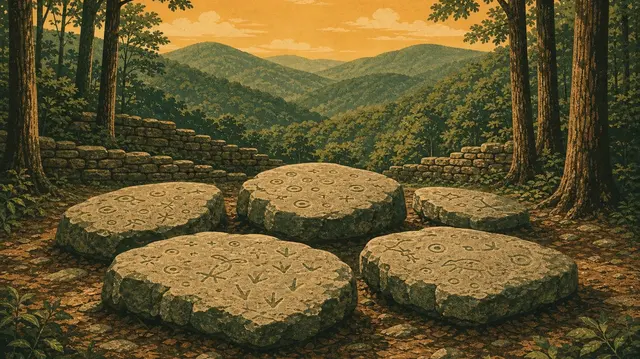
Then came the fences, in 1977: four feet of hogwire with barbed wire on top, around the hot-cell building and the cooling-off area. Workers also carried the radioactive slabs visitors had been using as picnic tables back inside the hot-cell building, and boarded it up.
None of this held for long. By 1991 the fences had holes big enough for a person. "They fight their way through the barbs," said Winston West of the Georgia Forestry Commission. A former lab administrator said someone once used dynamite to blast into the hot-cell building. John Braden, speaking for Atlanta's aviation department, described the city's own line of defense: "We've even planted roses hoping the thorns would keep them out."
James Setser, the state's top nuclear watchdog, told the reporter, "There's no way I can defend what went on there." Ivan White of the National Council on Radiation Protection and Measurement was shorter about it: "A gross failure of the state of Georgia." After the investigation ran, the magazine that reprinted it says, the state tightened security and ordered an independent task force to look at the health risks.
So is it safe?
We write about waterfalls and schnitzel, so we'll stick to the record. The newest state report we could find covers 2000 to 2002. It put man-made radiation from the soil by the reactor site at less than 10 millirems a year for continuous exposure, and it found no man-made radionuclides in Etowah River water or grass samples. It also projected no more than 4 millirems a year for a hypothetical person living and farming on the old reactor site.
The same report says that estimate only holds while the underground structures stay sealed, because the state hadn't surveyed them. It draws no conclusions about levels inside the fences, and it expects the fences and barriers to stay until the land's use changes.
Mahaffey, talking in 2020 about the cobalt-60 traces around the hot-cell building, said, "You can still detect it if you have sensitive equipment but is it dangerous? Probably not. I mean, you'd have to eat the dirt to get it into your system." Jim Johnson's bigger worry was physical: tunnels full of floodwater and concrete that could crumble someday. That's an old report and two men's opinions, not an all-clear from us. Stay out of anything fenced or sealed, and don't eat the dirt.
Still no airport
The legends have outlasted the lab. Locals still whisper about two-headed deer and oak leaves the size of elephant ears. Asked whether any of that was true, Johnson chuckled. "No. These are just old wives tales."
The state manages the woods as part of the 25,500-acre Dawson Forest Wildlife Management Area, and Georgia DNR's page lists the City of Atlanta as owner of the lower 10,000 acres. That page covers hunting seasons and horse trails and doesn't mention the lab at all. In February 2025, the Atlanta Journal-Constitution reported that the city had spent more than a year weighing a state offer of nearly $100 million for this tract and a second one in Paulding County, to put both into permanent conservation. We couldn't find out how that ended.
The Dawson County News reported in 2020 that some of the old building foundations had become a parking area for campers and hikers. Nobody built the airport, but the place did finally get some parking.