The night before the walk, a preacher in a revival tent in the north Georgia hills took up the subject of the man who was about to cross Tallulah Gorge. Mark Kram of Sports Illustrated was there, among the moths. "God is swift!" the preacher cried, and the crowd agreed. The man who was going walking, he said, "knows how swift the Lord is." He told the congregation to pray that the Lord wouldn't be so swift about it.
The professionals were taking a more practical view. "When he falls off," a photographer asked an engineer, "what's the best way to get down to the bottom?"
"The same way he went," said the engineer.
The man in question was Karl Wallenda, 65 years old, with a mouth full of jokes and size-seven feet. He had been hired to save a town. To explain why anybody would think that was a good plan, you have to go back to when Tallulah Falls had no need of him.
The Niagara of the South
The Cherokee lived around this gorge long before anyone sold tickets to it. They called the falls Ugunyi, and according to the New Georgia Encyclopedia they viewed them with trepidation and largely stayed away. White settlers arrived around 1820 and did the opposite. They named the place Tallulah, wrote it up in newspapers and travel books, and took to calling it the "Niagara of the South."
What they were looking at was four main cataracts and a run of smaller rapids dropping about 350 feet over a mile. Many early visitors wrote about the noise. For decades, getting there meant days on mountain trails, and then in 1882 the railroad cut the trip from Atlanta to a matter of hours.
Hotels went up fast. The encyclopedia counts nearly twenty hotels and boardinghouses around the falls, and the town's own history says seventeen. Nobody seems to have gone door to door. Guests bowled and played tennis by day and danced at night. The Cliff House, which the encyclopedia calls the first of them, opened the same year the trains came.
The woman who fought the dam
The power company showed up in the early 1900s. Georgia Power bought a large tract from hotel owner Rufus Moss in 1909 for $108,960 and started on a dam. Helen Dortch Longstreet, the widow of Confederate general James Longstreet, saw what that meant for the falls. In 1911 she organized the Tallulah Falls Conservation Association to stop construction and turn the place into a state park, one of the first conservation fights in Georgia.
She was good at it. Her lobbying pushed the legislature into making the attorney general sue the company in 1912. The company won anyway, before a Rabun County jury in 1913 and again at the state supreme court.
The dam was finished that year, 116 feet tall. A tunnel 6,666 feet long took the river away through solid rock to a powerhouse, where it dropped 608 feet and came out as electricity for Atlanta. The same company soon went looking for more valleys, which is how the town of Burton ended up under a lake.
The dam had help finishing off the resort. The railway pushed on north to Clayton, and the town stopped mattering much as a rail hub. Then in December 1921 a fire burned for several days and took much of the town. "Very little that was destroyed was rebuilt," the town's history says. The Cliff House lasted until a kitchen fire in 1937. The only hotel still standing from that era, according to the town, is the Glenbrook, which the same sentence describes as in ruins.
Hire a daredevil
So 57 years after the dam, somebody in Tallulah Falls had an idea. The Rabun County Historical Society sums it up nicely: "How do you revive interest in a resort town featuring spectacular waterfalls plunging through a 750-foot-deep gorge? Why, obviously, you would hire a 65-year-old daredevil to walk across the gorge on a tightrope."
Sports Illustrated reported the budget, and it wasn't small. The event cost its promoters more than $60,000. The wire and its construction ate $50,000 and Wallenda got $10,000. Adults paid $5 and children $2, and the money was supposed to go toward an amphitheater for regional historical drama. The publicity, Kram wrote, would hopefully resurrect Tallulah as a summer resort. He also ranked it, "aside from madness," as the second greatest walk of all time. Apollo 11 had landed the year before, and the promoters gave the moon top billing, in his words, "reluctantly after lengthy debate."
It came with a carnival. Kram describes poster paste and gum-chewing dancers, and 200 reporters and photographers, some of them from Europe. The Atlanta Journal-Constitution says Wallenda arrived with security guards dressed as clowns, in red noses and face paint. Gov. Lester Maddox came, got in free according to the historical society, and said he was praying real hard. The Rev. James Turpin of Tallulah Falls United Methodist gave the invocation. "We prayed him across, we just prayed him across," he said later.
What everybody there knew
The crowd wasn't only there for the balance. Kram says it came "sensing tragedy," and the reason had a name. On January 30, 1962, in Detroit, at the Shrine Circus, the Wallendas' seven-person pyramid came apart on the wire. Dieter Schepp, Karl's nephew, and Richard Faughnan, his son-in-law, were killed. His adopted son Mario was paralyzed from the waist down. By Karl's own account, Jana Schepp came down on his back, and he held on to her until he could drop her to safety.
"I went back up again two days later," he told Kram. Eight years on, he still kept his eyes off the ground. "If I look down once I know I will see it again...those boys. If I look I go mad. I don't look." In 1963 his sister-in-law Yetta fell to her death in Omaha.
His brother Herman came to the gorge too, and he wasn't sentimental about any of it. "My brother Karl is insane," he said. "He does not need this...but the applause, ah, the applause.... It is his whole life...it is like a fine wine." He had a darker line for the crowd, who had come from all over the country. "You see, my friend," he said, "death has become good business for the Wallendas."
Darling, are you there?
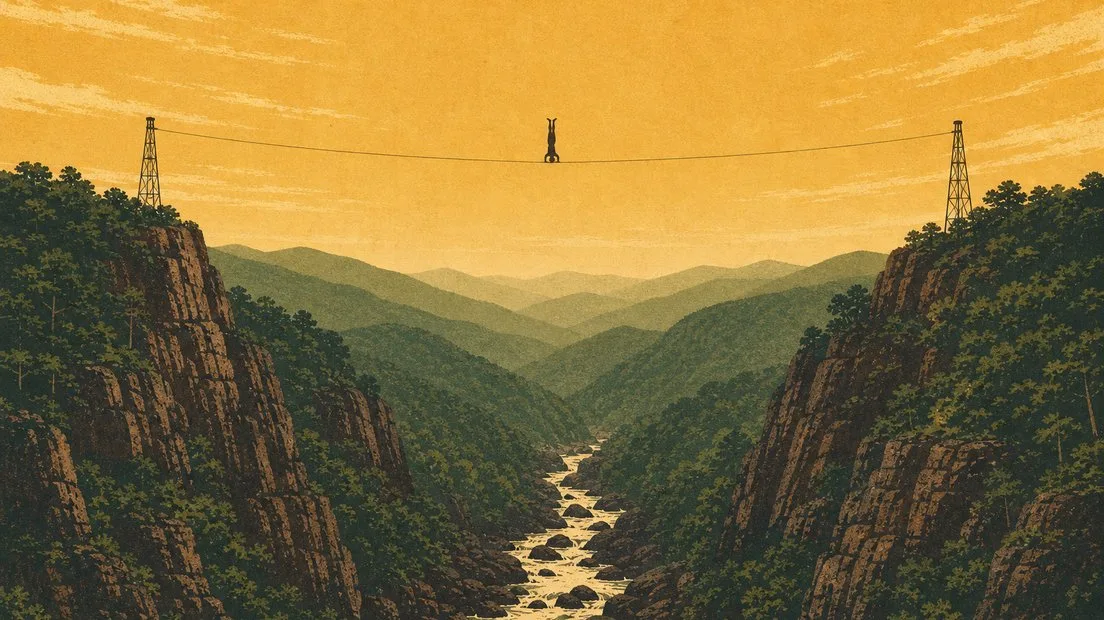
He started from the north rim, near what the state now marks as North Rim Overlook 1, and headed for his tower on the south side. The state gives the gorge a depth of 750 feet at that overlook, and the Atlanta papers put him 700 feet above the jagged bottom. He carried a 35-pound pole on a steel cable that the historical society says was 5/8 of an inch thick (Sports Illustrated printed a heavier figure). Kram counted 821 feet of that wire as sloping downhill.
He wore a microphone, and the tapes, the Atlanta papers reported, showed he joked most of the way. At one point he spoke to his wife over it. "Darling, are you there? I am coming." Then: "It's martini time. I'd better hurry." He had said the night before that he wanted one as soon as he finished, so this was less a joke than a schedule.
Near the middle a gust hit him and he staggered, the one moment the Atlanta reporters thought he might go. "Only once did Wallenda seem in danger of falling," they wrote. Somewhere out over all that air, he stopped and put his head on the wire. Then he did it again. The record doesn't say how far apart, and we wish it did. A 2017 Atlanta Journal-Constitution piece says the headstands were a salute to soldiers in Vietnam, and that's the only place we found it. For all his confidence in public, the Atlanta paper reports, he told himself out there, "Karl, you're going to make it."
Now the numbers, which refuse to agree. The Atlanta papers clocked 17.7 minutes and "541 fast but careful steps," and said he beat the prediction by 22.3 minutes. Sports Illustrated says 20 minutes and 616 steps. The historical society says about 18 minutes, the Georgia Historical Society says 19, and the wire has been reported at 1,000 feet, more than 1,000, 1,200 and 1,250. The Atlanta reporters and Kram do agree on one thing: he beat the estimate by about 20 minutes.
Martini time
Accounts of the finish don't line up either. Through field glasses, Kram wrote, you could see a smile growing on that rubbery face. He says doctors put Wallenda on a stretcher to check his heartbeat, only briefly. He then walked to the grandstand with the press trailing behind and had "a mammoth martini." The historical society has his wife handing it to him where he got off the cable, in a county that was officially dry. The park's assistant manager gave the Atlanta paper a third version in 2017, and labeled it: "The legend is when they laid him down, he asked for a martini." Either way he got his drink. "I've had two a day for 20 years," he told Kram.
Helen Wallenda had her own experience of the day. Sports Illustrated says she had refused to watch him perform for eight years, which counts back to Detroit, and that she hid her face in her hands and sobbed when she looked up. The Atlanta reporters have her car leaving for the far tower as he started out. Afterward she said, "When I drove up here alone, I thought I might be driving back alone." And: "Now I have someone to go back with me. I am so happy."
Only a technocrat, Kram wrote, would call the whole business frivolous and useless. Karl had an answer for that. "Why, it cannot ever be useless. To perform is to live, and everything else is waiting."
He wasn't even first
This was a rerun. On July 24, 1886, while the resort was booming, a performer named J.A. St. John, billed as Professor Leon, crossed from north rim to south rim. The state's trail guide and the town both record it, and the historical society says a hotel owner put him up to it to drum up business, which means Tallulah had been buying this particular idea for 84 years. The society's retelling has a manila rope, about 6,000 people, a wife begging him not to go and a guy wire that broke during the crossing, with talk of a gambler who had cut it. It quotes a reporter: "Like a drunken man, he staggered on." It's a great story. We couldn't trace it to a paper from 1886, so take it as a retelling.
Even Leon's spot may not be safe. Wikipedia names a Professor Bachman crossing in 1883, with no citation. The Gainesville Times says Leon "might have been the first." Georgia State Parks just says tightrope walkers have crossed twice, and declines to get into it.
San Juan
Wallenda kept working for eight more years. On March 22, 1978, at 73, he tried a walk between two towers of the 10-story Condado Plaza Hotel in San Juan, Puerto Rico, on a wire 121 feet above the pavement, in high winds. He fell and did not survive. "It was a walk in the park, if you will, and that was the one that took his life," his great-grandson Nik Wallenda told a Sarasota TV station in 2019. The family blames the rigging. "The cable was put up improperly," said Nik's father, Terry Troffer. "Not a family member."
Did it work?
We'd love to tell you. We couldn't find hotel numbers from before and after, or anything showing that amphitheater got built. Kram himself left the question open in 1970. In 2014, though, Nik Wallenda said he wanted to repeat the walk, and the county's tourism administrator told the Associated Press, "It would put the Tallulah Gorge and Tallulah Gorge State Park back on the map." That's more or less the same pitch, 44 years on.
Nik planned to do it in sync with projected footage of Karl, then put it off in 2015 because the technology, he said, "isn't there yet." "Apparently, Nik is still waiting," the historical society wrote in 2020. We found no announced date as of late 2026.
Helen Longstreet's park came eventually, 81 years after she asked. The state and Georgia Power created Tallulah Gorge State Park in 1992, by the encyclopedia's date, and the trail around the gorge got her name in 1999. She had died in 1962, eight years before Wallenda came.
The wire came down, and the towers stayed, more or less. One on the north rim was reportedly laid on its side for safety, an idea nobody had tried on Wallenda. The state's marker went up beside the ruins on the north rim. It says he did two headstands, and it's about a tenth of a mile from the parking lot, so you can get there without a pole.