Fort Mountain State Park
A mysterious ancient stone wall, a mountain-top lake, and miles of Cohutta Wilderness trails
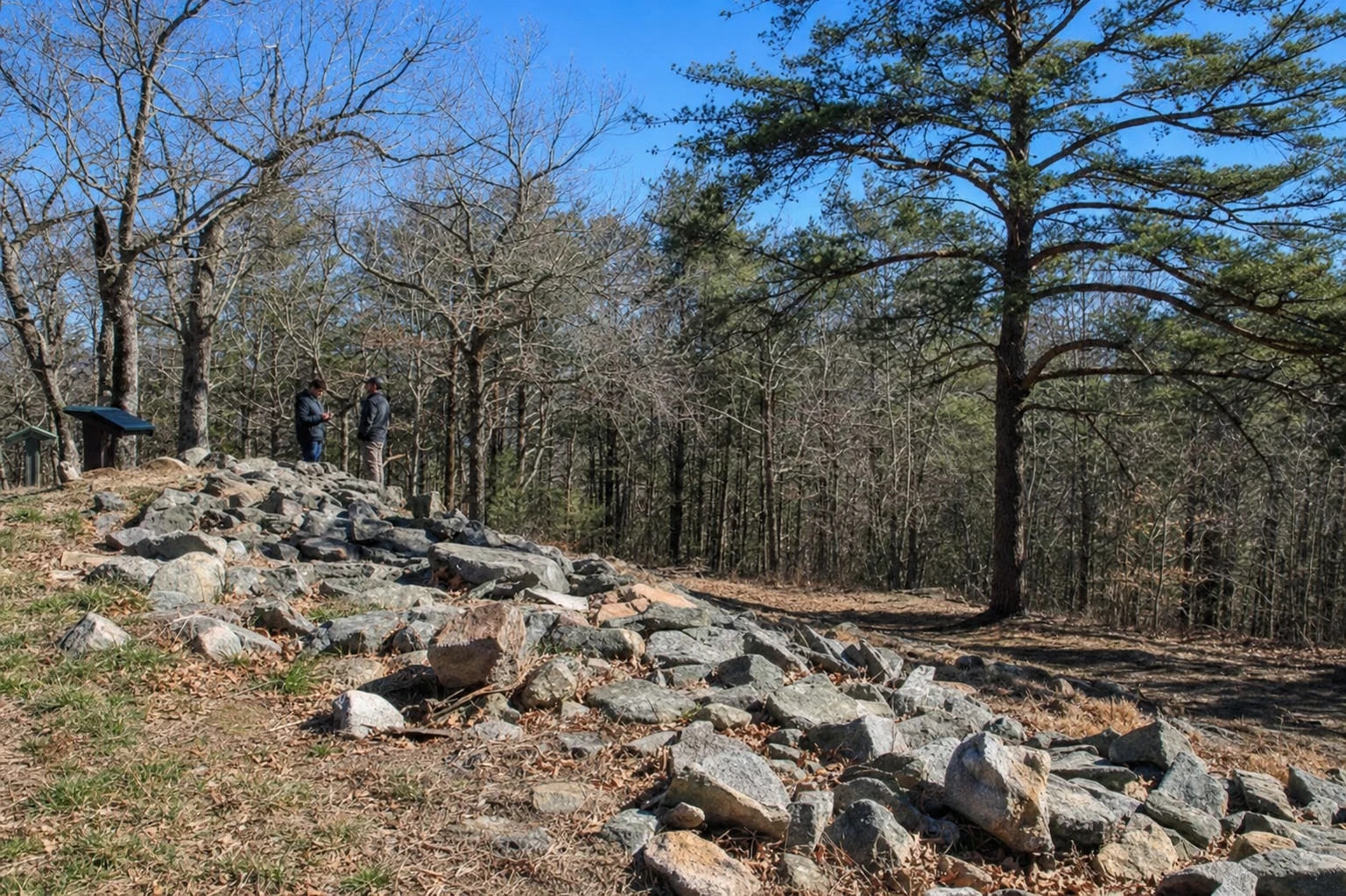
The park takes its name from an ancient, zigzagging stone wall near the summit, roughly 855 to 885 feet long. Nobody agrees on who built it or why. The theories run from a ceremonial Middle Woodland structure (500 to 1500 AD) to a fortification thrown up against pre-Columbian enemies.
The site also sits at the center of two old legends: the "Moon-eyed people," a light-skinned, nocturnal race the Cherokee are said to have driven out, and the far-fetched claim that the Welsh Prince Madoc explored here in the 12th century.
Getting There from Helen
Where the park sits
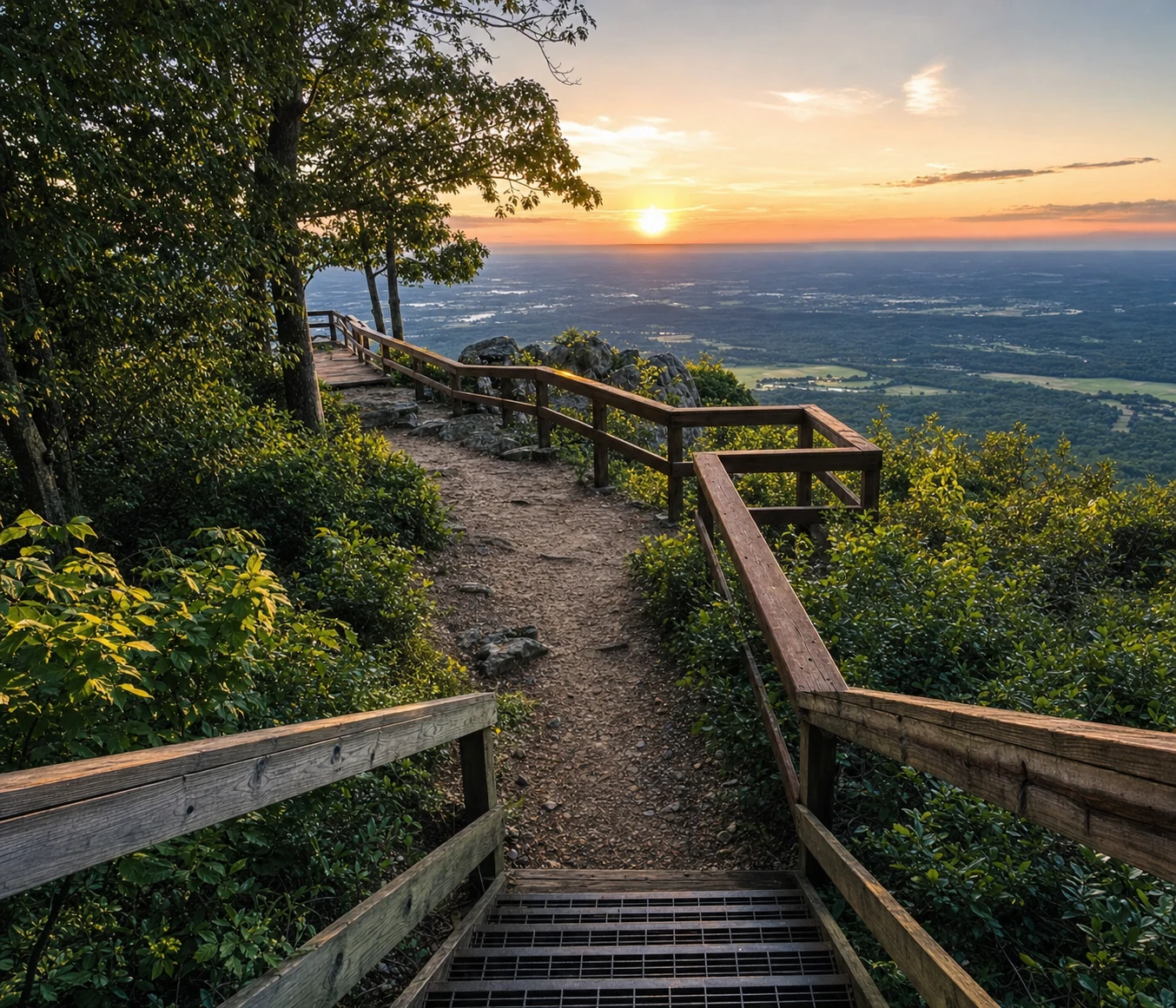
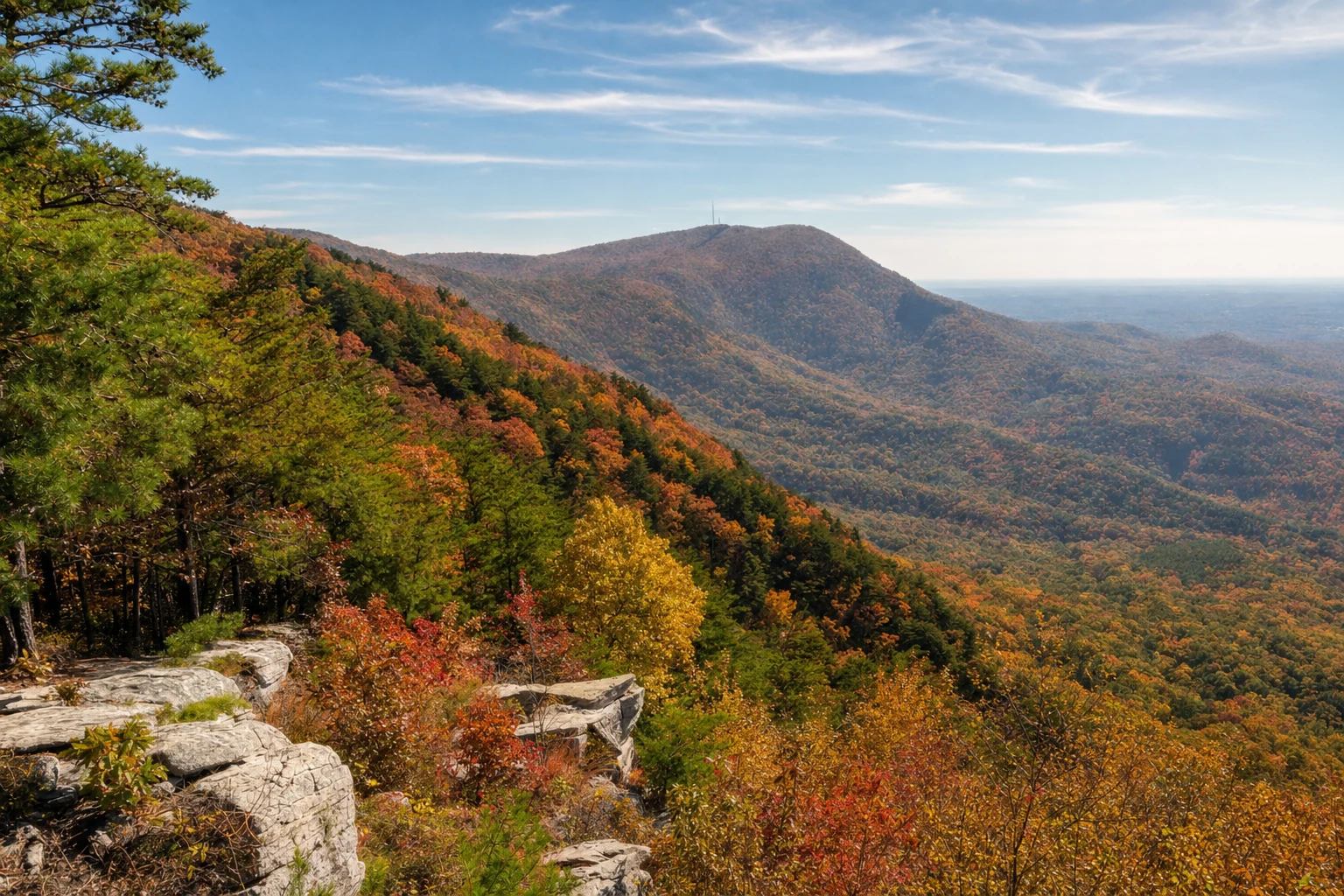
Fort Mountain State Park covers about 3,712 acres at the southwestern end of the Cohutta Mountains. At 2,850 feet elevation, you can see where the Appalachian Mountains give way to the Piedmont and Valley and Ridge regions to the south. It is managed by Georgia State Parks.
The Drive from Helen, GA
Getting to Fort Mountain from Helen takes you across the North Georgia highlands, from the eastern Blue Ridge over to the western Cohuttas. It is a great drive.
Route: The most direct and scenic route involves traveling west on GA-75/GA-11, connecting to GA-52. The drive typically routes through Dahlonega and Ellijay before ascending the steep gradients of Fort Mountain.
Distance and Time: The distance is approximately 67 to 91 miles, depending on the specific route taken (scenic vs. highway). The drive time is generally estimated between 1 hour 40 minutes and 2 hours 15 minutes.
Scenic Highlights: The drive along Highway 52 (often called the Cohutta-Chattahoochee Scenic Byway) is noted for its twists, curves, and panoramic views, particularly as one approaches the park entrance from Ellijay.
The Ancient Stone Wall
The main reason people make the drive is the ancient stone wall that zigzags along the mountainside near the summit. Nobody knows for certain who built it or why. After more than a century of study and speculation, it is still one of Georgia's biggest archaeological puzzles.
Physical Description and Dimensions
The wall does not enclose the summit entirely but rather guards the southern and eastern approaches.
Length: Sources vary slightly on the exact length, citing it as either 855 feet or 885 feet.
Composition: The structure is a dry-masonry wall built from local metamorphic stones (mica schist and gneiss) gathered from the immediate summit area.
Architecture: It follows a zigzag or serpentine pattern. The walls vary in height, currently standing between 2 and 6 feet, though they were likely higher before stone robbing and erosion occurred. The base thickness can reach up to 12 feet.
Associated Features: The wall is not merely a barrier; it contains distinct features including 19 to 29 pits (some described as "foxholes" or ceremonial pits), cairns, and the ruins of a gateway.
Theories of Origin
The ceremonial theory. Most archaeologists and historians lean toward the idea that the wall went up during the Middle Woodland period (around 100 BCE to 500 CE), or perhaps as late as 1500 CE. It just does not look built for war: there is no water source inside the perimeter, and the wall is low, which makes it poor for holding off a siege. That points to a ceremonial or astronomical purpose, maybe tied to the seasonal solstices, like other stone structures across the Southeast.
The De Soto idea. Early 20th-century writers guessed that the Spanish conquistador Hernando de Soto built the wall around 1540 to fend off the Creek while hunting for gold. Modern historians have mostly set this aside, since De Soto's expedition passed through in under two weeks, nowhere near enough time to stack a wall this size.
The Cherokee and the Moon-Eyed People
The mystery of Fort Mountain is deeply entwined with Cherokee oral tradition and later European settler myths.
The Moon-Eyed People
In Cherokee lore, the wall was not built by their ancestors but by an earlier race called the "Moon-eyed people" (Yunwi Tsunsdi). The stories describe them as small, bearded, and pale, with large blue eyes so sensitive to sunlight that they saw better at night and lived by the dark.
As the legend goes, the Cherokee (or in some versions the Creek) went to war with them and finally drove them out of the Appalachians during a full moon, when the light left them blinded. Some ethnographers think the tale points to a group of albinos or a different Native tribe; others read it simply as a story invented to explain the pre-Cherokee ruins people kept finding in these mountains.
The Prince Madoc Legend
A stubborn, though unproven, theory ties the Moon-eyed people to Prince Madoc ab Owain Gwynedd of Wales. The claim is that Madoc sailed to America in 1170, centuries ahead of Columbus, and set up colonies in the Southeast. Believers credit the stone walls at Fort Mountain, and similar ones in Tennessee and Alabama, to these Welsh settlers.
A plaque at the park once mentioned the Madoc legend, but it has since been removed or reworded, because no archaeologist has ever found evidence of a 12th-century Welsh presence in Georgia.
The Civilian Conservation Corps (CCC) Legacy
Beyond ancient history, Fort Mountain is a monument to the New Deal era. The Civilian Conservation Corps (CCC), specifically Company 468 (SP-6), developed the park’s infrastructure in the 1930s.
The Stone Fire Tower
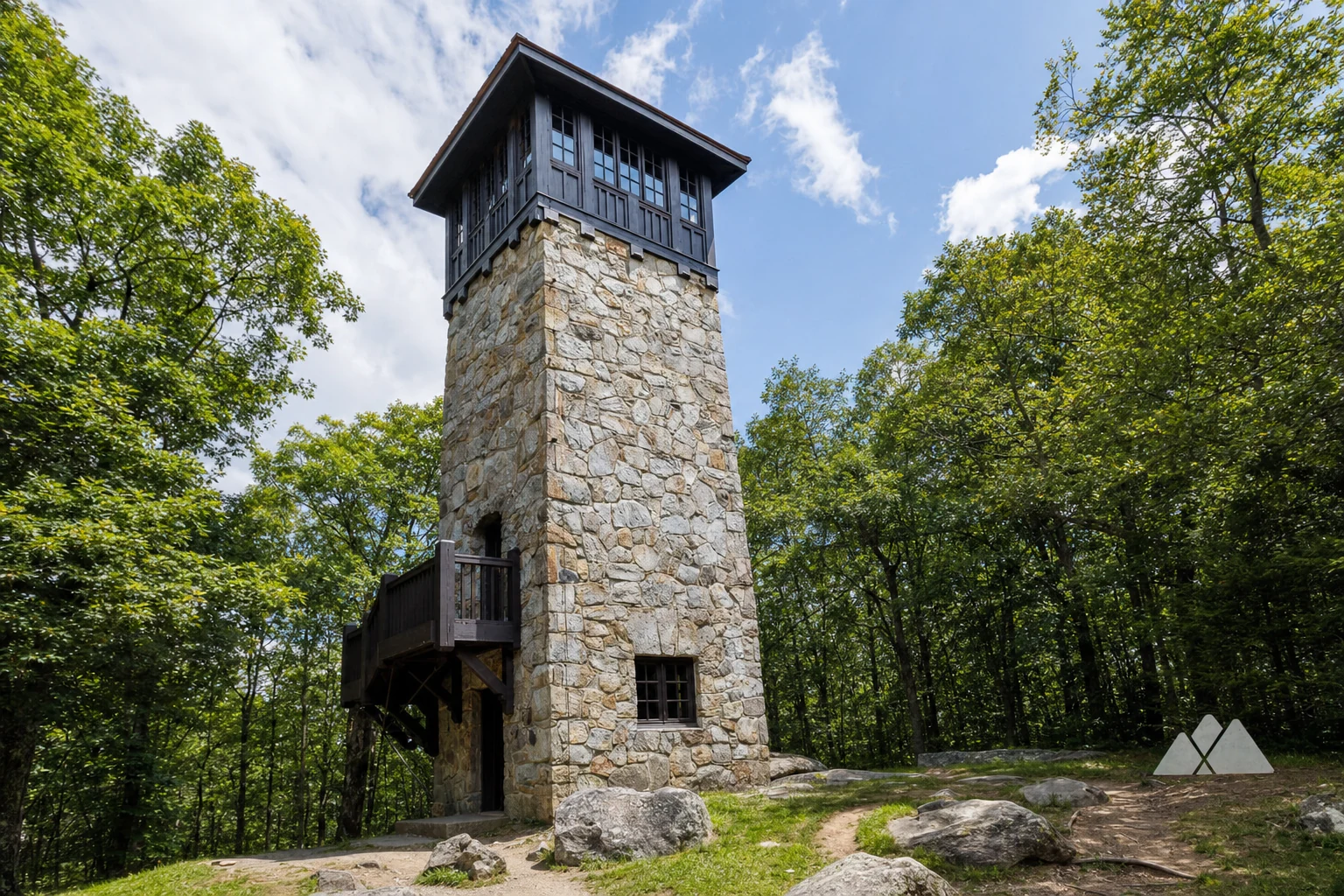
A four-story stone fire lookout tower stands at the summit near the ancient wall, built by the CCC between 1934 and 1935. Rangers used it to spot smoke up to 40 miles off, right into the 1960s. After the wooden cupola burned in 1971, the tower sat neglected for decades until a full restoration in 2015 and 2016 brought it back.
Related Imagery from Around Helen