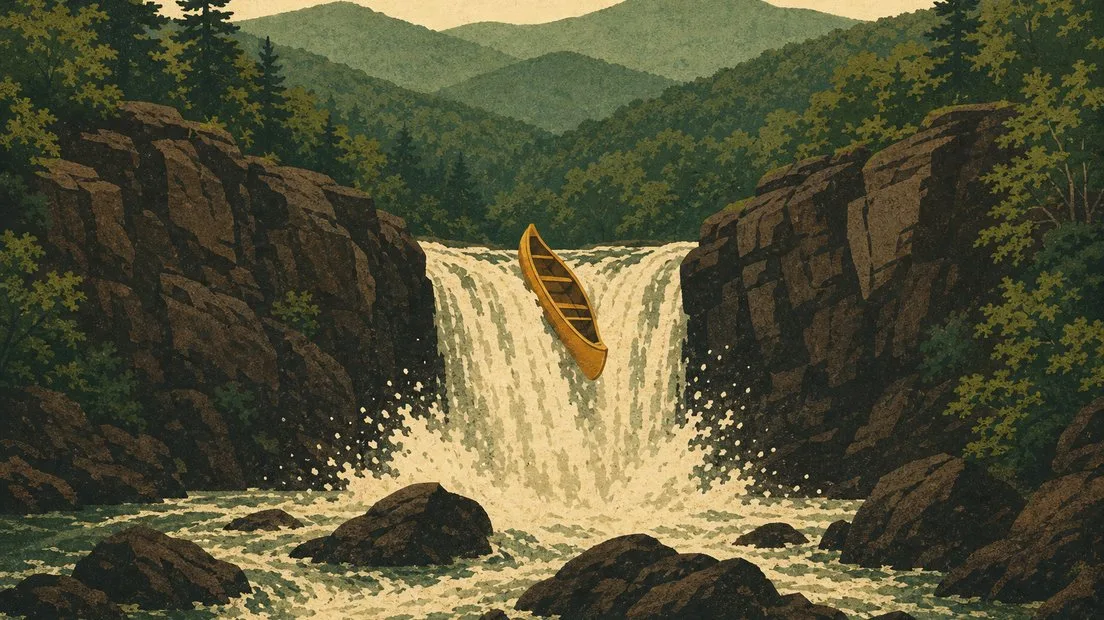
The dummy went first. In the summer of 1971, a film crew at Tallulah Gorge sent it over a waterfall, and director John Boorman looked at the result and gave the only note available. "It looks like a dummy," he said, according to Burt Reynolds. Reynolds, a former stuntman who had decided as a kid that "crazy was the best choice of the two," told him, "I can do that."
Most of what follows about that waterfall is Reynolds talking, and he told this one for at least 18 years, so season accordingly. The movie was Deliverance. You may know its reputation. We'll stick to the canoes, and to what the canoes did to a county and a river.
A poet and a river that doesn't exist
James Dickey was an Atlanta native and an established poet when his first novel came out in 1970. According to the New Georgia Encyclopedia, the idea grew out of a traumatic canoe accident he'd been in on the Coosawattee River in the early 1960s. In the book, four suburban men go down a wild river just before a new dam drowns it, and the trip goes about as badly as a trip can go. Dickey called the river the Cahulawassee and never said the story was in Georgia.
There is no Cahulawassee. There is the Chattooga, which forms the Georgia-South Carolina line in the far corner of Rabun County and closely resembles it, and the secret didn't last. Warner Bros. had bought the rights before the book was even out, and the production set up in and around Clayton from about mid-May to late August 1971.
Finding a leading man took some doing. A Hollywood Reporter item from early 1971, cited by the American Film Institute's catalog, says Steve McQueen turned down Reynolds's part. Reynolds's own version, in his autobiography, is grander: Marlon Brando, Jimmy Stewart and Henry Fonda were all in the original cast, "but then they were informed about the Chattooga, fifty miles of white-water hell and deadly waterfalls." His conclusion: "Those big stars wisely got the hell out." We found nobody else saying that, but we enjoy picturing Jimmy Stewart reading the river report.
The stars who stayed didn't know what they were doing either. "Not by any stretch of the imagination were we white water experts," Reynolds told the Palm Beach Post in 2012. They quit for the day and went back out to practice, and by the end, he said, "we could out-canoe anybody." The production had real help in Claude Terry, an Emory University professor, and veteran paddler Doug Woodward, its technical advisers according to the Atlanta Journal-Constitution. Terry also doubled for Jon Voight. Getting to work was its own stunt. A reporter from American Cinematographer described roping down a 1,200-foot, almost vertical cliff to reach the crew, and added, "Even so, there have been accidents, though no fatalities as yet." That "as yet" is doing a lot of work.
The man who wrote the book got sent home. Dickey and Boorman fell out as shooting went on, and Dickey's son Christopher later described the moment in his memoir. Boorman told him, "Jim, if you want to direct this picture, fine." Dickey said of course not. "And John had said in that case he thought it would be best if Jim left." He still turns up on screen as the sheriff at the end, his only film role.
Give me a spike
This is the stunt as Reynolds told Terry Gross on Fresh Air in 1994. The drop was "about 85 feet." The stunt people told him he was too crazy, and he doesn't appear to have argued. The crew had a dam they could control, so they shut off the water, and he went out into the middle of the river.
"I said, give me a spike, a mountain climbing spike. I went out in the middle of the river and drove the spike in, and I put a rope around it."
The plan was simple. The water would come back around him, he'd wave, the cameras would roll and he'd let go. Then he laid out his route for the crew like a man ordering lunch: "I'll hit that rock, and then I'll spin off to the left. And then I'll do a flip, and then I'll land down there." Four cameras stood by. He heard them let the water go.
"And I looked back, and coming at me was this tidal wave." The route he'd announced lasted about as long as you'd guess. "I went wherever the water wanted me to go," he said. "The first rock I hit, my tailbone cracked. Then I did turn a flip, which was what I said I would do, but I didn't do it on purpose."
He landed in what he called a hydrofoil, the kind of churning hole river people usually call a hydraulic. You can't swim out of one. Somebody had told him you have to swim for the bottom and let it spit you out, and he remembered, which may be the most impressive thing he did that day. What nobody had mentioned was the exit: "like shooting a torpedo out of a submarine about 70 miles an hour." He said he went over a 30-some-year-old in the best shape of anybody and came up 150 yards down the river "totally nude and about 78 years of age." His clothes, he said, "just vanished."
The crew, meanwhile, thought he'd drowned, and they were busy. In his telling, somebody reported, "there's a nude old man limping this way. But we've got to concentrate on getting Burt out of this hole, you know?"
The next day he went to the rushes, very anxious to see his stunt, and asked Boorman how it looked.
"And he said, like a dummy going over the falls."
Gross asked whether it really looked like that to him. "Not to me," Reynolds said. "It looked like a dummy but a different kind."
Now, the seasoning. TCM's account has a ninety-foot falls and quotes his autobiography with him surfacing about 200 yards downriver as a "seventy-five-year-old man," then coming back from the hospital for the rushes. The Palm Beach Post in 2012 has him about a mile downriver. In that same Fresh Air answer he also said Tallulah Bankhead "actually was born there and was named after this gorge." The Encyclopedia of Alabama has her born in Huntsville, named for her grandmother, who got the name because her own parents honeymooned at the falls. So it's a fine story from a man who wasn't under oath. He never named the waterfall, and neither will we.
Whose dam was it?
Reynolds said only, "We had a dam that we had control over." He didn't say whose. The film's end credits thank the Georgia Power Company, and Georgia Power's dam sits at the top of the gorge. We can't prove who stood at the controls that day, but we'd love to have that job on our résumé.
That dam came with its own fight. The company bought the land in 1909, and in 1911 Helen Dortch Longstreet of Gainesville, the widow of Confederate general James Longstreet, organized the Tallulah Falls Conservation Association to stop it and make the falls a state park. The state sued. The power company won in front of a Rabun County jury, and the dam was finished in 1913. Tallulah had been a famous resort for its waterfalls, around the little town of Tallulah Falls, and after that its river mostly went through a tunnel. By the time Hollywood showed up it was a gorge you could switch on and off, which had already drawn Karl Wallenda and his high wire the summer before.
On an ordinary day, our Tallulah Gorge guide notes, only 35 to 40 cubic feet per second runs through. The scheduled release days are when it looks like a river that could undress you.
What Rabun County got
The joke was on the people who lived there, and they knew it. The New Georgia Encyclopedia calls the film "the most degrading depiction of southern mountaineers ever put on film" and says it drew protests from north Georgians and Appalachian scholars. Many of the minor parts were played by locals with no acting experience. There was tension between the crew and residents during the shoot, and one account of it comes from local people interviewed by Foxfire students, the Rabun County teenagers who were already recording the real mountain culture the movie wasn't interested in. The sadistic men on screen were fictional, as Dickey's daughter Bronwen points out in an essay on the river. The neighbors who had to explain them were not.
It stuck for decades. When locals planned a Chattooga River Festival around the film's 40th anniversary in 2012, organizer Sarah Gillespie told Marketplace, someone stood up at a commissioners meeting and said the movie had ruined her life. The reporter heard of people passed over for jobs because they came from Rabun County. County official Tammy Whitmire refused to support the festival. "For people around the world to think that's what we are here? No," she said. "Or for me, it is not worth it."
Billy Redden, the banjo boy, was 55 by then and working at Walmart. He told the reporter he hadn't made the money he'd expected, and he still called the movie the best thing that ever happened to him. He also had a line for anybody listening: "We're not a bad people up here, we're a loving people."
Bronwen Dickey went up the river herself for that essay, and in the Long Creek Bar she listened to a bearded man who didn't know who she was say the worst thing that ever happened to the area was "that Deliverance." She wrote, "Half of me wanted to apologize to him for something, and half of me didn't feel there was anything to apologize for."
Deliverance fever
Before the movie, a few hundred people a year floated the Chattooga. After it, Bronwen Dickey writes, that "jumped into the thousands and then the tens of thousands." Doug Woodward, Terry's partner on the film, remembered what some of them brought. "People would show up with a couple of rafts they bought at K-Mart," he said in the Journal-Constitution, "one for them and one to hold a cooler of beer."
Then came the drownings. News items from 1972 to 1975, the AFI catalog says, reported as many as 19 drownings, and when another one happened it got attributed to "Deliverance fever." Dickey was quoted on it in a 1973 issue of Box Office. "They wouldn't have gone up there if I hadn't written the book," he said. "There's nothing I can do about it. I can't patrol the river. But it just makes me feel awful."
By 1975 the Forest Service had imposed strict rules, including helmets and life jackets. Its river guide still reads like a list of things somebody tried: inner tubes banned below Earl's Ford, a required minimum party size, and air mattresses prohibited outright. By the time of Dickey's daughter's essay, the count stood at 39 drowned since the agency began keeping records. Expert and novice paddlers alike come here from around the world, the Forest Service says, and "the river does not discriminate between them." Some of the dead were experts.
Some locals took it out on the visitors. People told Bronwen Dickey about smashed car windows and slashed tires at the put-ins, warning shots from the bank and barbed wire strung across the river. Barbed wire across a river that was already drowning people has no defense. The resentment under it is easier to follow, because by then your home was a punch line on bumper stickers all over the South.
Who got the rafts
Terry and Woodward came out of this rather well. They bought the rafts Warner Bros. had used in the filming, plus 19 acres near the river that had once been a country music park, and opened Southeastern Expeditions, one of the first whitewater outfits in the Southeast. It's the same outfitter on our Chattooga River guide, so the movie's rafts did eventually get an honest living. Terry was not a man you applied to lightly. His son told the AJC that when an ex-college wrestler asked for a job, Terry, in his early 60s, told him, "if you want to work here you have to wrestle me." The young man's later report: "I'd be flattering myself to say it was a draw."
By 2012 Marketplace was calling rafting a $20 million industry in Rabun County and tourism the area's top source of revenue. That's the awkward part, and it's what the festival fight was about.
The dam that never came
The plot of Deliverance runs on a deadline: go now, because the river is about to vanish under a lake full of vacation homes. The real Chattooga got a different ending, and the movie deserves less credit for it than you'd think.
The river had a long life before anybody yelled action. Cherokee and other tribes lived along it for centuries before European settlement, American Rivers notes, and Rivers.gov records 38 archeological sites along its corridor and places the Cherokee village of Chattooga Town, occupied from the early 1600s until the 1730s, near the present-day Highway 28 bridge. And Congress had already named the Chattooga in the 1968 Wild and Scenic Rivers Act, as one of 27 rivers to study for protection, two years before the novel came out.
The film's real connection runs through Claude Terry. He talked Georgia's governor, Jimmy Carter, into running Bull Sluice with him in a tandem canoe, in what's thought to be the first tandem descent of the rapid. Bull Sluice ends in a double waterfall, each drop roughly five feet. The AJC says 1974 and the Georgia Recorder says 1973. Carter later said it "was the first time I risked my life, I would say, coming down a wild river," and they made three trips in all. "Terry adopted me as one of his students," he told Outside.
According to American Rivers, the experience moved Carter to push for protecting 57 miles of the river (the federal listing totals 58.7). On May 10, 1974, it became the first Wild and Scenic River in the Southeast, which bars damming. Carter wasn't done. "I vetoed 16 different dam projects, I think, all over the United States," he said of his presidency, "which aroused a great deal of animosity and condemnation." Terry and Carter stayed friends and argued for decades, and late in 2019 they were both patients at Emory's hospital at the same time, though Terry was too sick to visit.
So the river in the movie that was about to die is still running, and the one Georgia Power dammed in 1913 runs on a schedule. The fight over boats has moved upstream. In 2012 the Forest Service decided to allow floating on the upper river with restrictions, after a lawsuit from American Whitewater, over objections like the one Bronwen Dickey heard in that bar: "if they open up that upper river, who's gonna pay to get the bodies out?"
Bull Sluice has a parking lot and a railing. The walk back to the car is uphill.