On August 26, 1936, Sheriff Luther Rickman was getting a haircut at Roy Mize's barber shop in Clayton, Georgia, when he heard a gun go off. He ran out the door, and a man on the sidewalk hollered that the bank was being robbed. Inside, one robber had pointed a gun at the only person in the building, Miss Druilla Blakely, and told her to hand over the cash. Rickman said she "screamed and run out at the back of the bank like a bullet - just went a'flyin'."
We know how he said it because three teenagers went to see him about 30 years later, tape recorder in hand, and printed it in his own words. That interview ran in the first issue of a school magazine, and the New Georgia Encyclopedia gives it much of the credit for the magazine's instant success. The magazine was named after a fungus. Within five years the name was on a national bestseller.
Paper airplanes and a burned lectern
The school was Rabun Gap-Nacoochee, up in Georgia's northeast corner. The second half of that name comes from our end of the mountains: it merged in 1927 with the Nacoochee Institute, formerly of Sautee, after both schools lost buildings to fire within six weeks of each other.
Eliot Wigginton arrived in 1966, fresh out of Cornell and hired sight unseen, to teach ninth- and tenth-grade English. Education Week counted 146 students on his roster. Boys could miss school to go coon hunting or pick cabbage, which tells you where Silas Marner ranked. His ninth graders greeted that book and Julius Caesar with paper airplanes. By his account, some boys once set fire to his lectern.
"The majority are ill-prepared and restless," he wrote to a friend. "When in school, they seem only to know how to sneer." Historian John Puckett, who later spent a year studying the program, went with "hostile, bored and rambunctious." Wigginton tried teaching the poetry of Simon and Garfunkel; Cher; Peter, Paul, and Mary; and the Lovin' Spoonful. Cher did not save the semester.
One day, the way he told it in 1985, he walked in, sat on his desk and said, "This isn't working. Why don't we try something else?" In a 1982 account he opens class by asking, "How would you like to throw away the text and start a magazine?" Either way, most of this origin story reaches us through Wigginton, and we'll get to why you should keep that in mind.
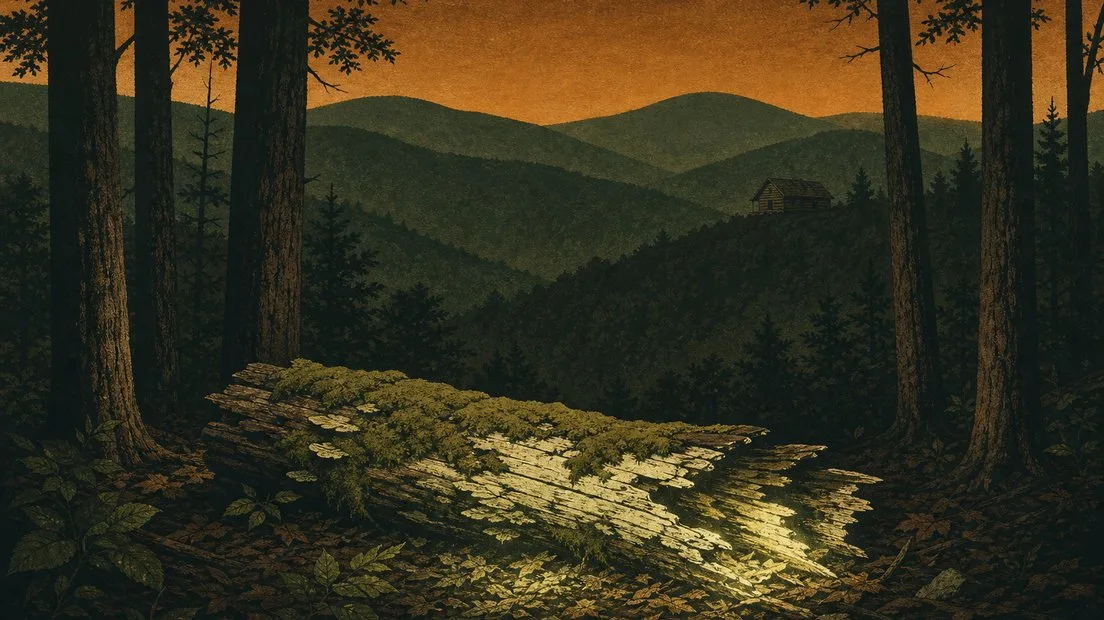
The class started a magazine on $440 in community donations, with no money from the school. For a name, the students passed over "Soul Plus" and voted for foxfire. (Some sources, including the New Georgia Encyclopedia, say the glow comes from lichens, as our Foxfire history page notes. Foxfire itself, Education Week and a University of Georgia forester say fungus, so that's what we're using here.)
Fifty cents, and the sheriff talks
Foxfire keeps a scan of its first issue online, and it's the best thing we read for this story. Spring 1967, Volume One, Number One, fifty cents a copy. The scan is marked "Second Printing." The masthead lists students in every editing job, and they filled 70-odd pages with work by published writers (A.R. Ammons among them), work by new ones and a regional section that turned out to be the part people wanted.
Rickman was born in Dillard in 1889. The magazine says that as a boy he drove mules hauling foundation stones for the school's first building, and that he decided to be sheriff at age ten after watching one chase a man down. "Mamma, quick as I'm old enough I'm going to be sheriff," he told his mother. She told him to start making friends. He became High Sheriff of Rabun County on the first day of 1917 and held the job for 24 years.
His bank story has five robbers, a sawmill hideout in North Carolina, a machine gun at a roadside wreck and two blowouts in one getaway. ("So they put on the spare and went on and by George, had another blowout.") One robber had ordered fifty pounds of tarpaper nails, and the gang took the back glass out of the car and scattered them down the road as they drove. "Did'ya' ever see Santa Claus sittin' up here in town a'throwin' out candy?" Rickman asked. "Like that." He traced them through the tag on a wrecked brown Ford, which led to a man named Zade Sprinkle. When he finally stood in front of Sprinkle in a North Carolina jail, Rickman shook his hand and said, "Zade, I came to discuss our bank robbery."
They had history. Two years earlier he had found Sprinkle in a roadhouse room, with papers to serve. "I said to him, 'Zade, where's your pistol?' And he said 'Under my pillow,' and that's what made me be in sympathy with him." Rickman got the pistol, then talked the Asheville sheriff out of putting Sprinkle in leg irons. Sprinkle told him the truth about the robbery. According to Rickman, he went to the penitentiary, had two severe heart attacks and was pardoned by the governor, and "All the other men was caught except Slim."
The rest of the regional section is just as good. A list of superstitions warns, "If you kill a toad, your cow will go dry." Expressions include "As ugly as homemade sin." Remedies for a sore throat include tying a dirty sock around your neck, and for a cut you might "Apply to the weapon instead of the wound." There's also an interview about moonshine stills with an unnamed Rabun Countyite, who noticed two fishermen working the same spot day after day. When they left, he found the blown-up remains of a still a few feet off shore. Teenagers had figured out what sells.
Hog dressing goes to New York
The most enduringly popular person in the whole project, by Education Week's reckoning, came through one of their own. "You know, since you're interested in old people, and what they used to do around here, you might be interested in my great aunt," a student named Patsy told Wigginton. "She still lives in a log house and does a lot of that old stuff." That was Aunt Arie Carpenter, 84 years old and living alone in a cabin in the woods. Southern Cultures describes her showing her visitors how to clean a hog's head. "Now see if you can take your fingers and pull that eyeball up and cut it," she told them. Once it was out, she tossed it out the back door.
Foxfire signed with Doubleday in the 1969-70 school year, and The Foxfire Book came out in March 1972. The full subtitle runs "Hog Dressing; Log Cabin Building; Mountain Crafts and Foods; Planting by the Signs; Snake Lore, Hunting Tales, Faith Healing; Moonshining; and Other Affairs of Plain Living." We've never seen better. It was a Book-of-the-Month Club selection and made the New York Times paperback list, and Wigginton and two students went on the "Today" show. Royalties at times topped $100,000 every six months, and they went back into the nonprofit program.
The same year, the same county got a very different kind of famous. The film of Deliverance opened in 1972, shot on and around the Chattooga, and Wigginton and some of his students were furious at how it showed mountain people. He encouraged three of them to do something about it, and they spent three months interviewing locals about the movie and printed the results as a magazine article, which is an unusually constructive way to be mad at Burt Reynolds.
Then Broadway called, more or less. In 1977, Hume Cronyn wrote to his friend Susan Cooper, looking for a short piece for his wife, Jessica Tandy, to perform. Cooper sent him Aunt Arie's reflections from the first book. They didn't use the excerpt, but it grew into a play, which opened at the Ethel Barrymore Theatre in November 1982, ran 213 performances and won Tandy a Tony. Cronyn said that once the students were reassured Rabun Gap wouldn't become a Broadway Dogpatch, "they became our greatest fans and sternest critics." Some saw it in Minneapolis and came home to record a two-hour tape of notes. The 1987 television version won Tandy an Emmy and put John Denver in Keith Carradine's part.
A piece of a mountain
Foxfire's own history says that in 1974 "the students took royalties from book sales and purchased a tract of land on Black Rock Mountain." So kids bought part of a mountain with hog-dressing money. We can't find an independent record of how that transaction went, but Education Week says some of the book profits went into the complex. Students working with Foxfire educators took apart old log buildings, moved them from their original sites and put them back together on the slope.
Foxfire dates the museum to 1974, but it took a while to become somewhere you could go. In 1985 Education Week called it "tucked away from tourists," and in 1993 the organization didn't have enough staff to open it as an attraction. The Foxfire Village Museum now has more than 20 historic log buildings with artifacts from Appalachian life between 1820 and 1940, kid-sized cabins and an archive of nearly 60 years of interviews.
Worth knowing when you read those dates: historian Jessica Wilkerson points out that this was Cherokee land for thousands of years, and that an 1819 treaty forced the Cherokee Nation to give up the territory that became Rabun County. She argues the early books mostly leave that out, and tell a story of white pioneers with little room for anyone else. Our Cherokee heritage guide covers the longer history.
The hard chapter
In May 1992, a 10-year-old student told his guardians that Wigginton had molested him during an overnight stay at Wigginton's cabin, after Foxfire's annual picnic. Wigginton had by then been Georgia's Teacher of the Year and had won a MacArthur grant. He denied it publicly and accused the family and its lawyers of trying to extort money from Foxfire.
Then his former students started calling the authorities. Grown men came forward with their own accounts, some going back to his first year of teaching. "I thought, here was a 10-year-old that had more courage than I had at 22, 24, 28, 29 years old," one of them told Education Week. By the time the case was set for trial, 18 men were prepared to testify that he had molested them or tried to, on 23 occasions.
On November 11, 1992, Wigginton pleaded guilty in the 10-year-old's case. He got 20 years, one to serve in the Rabun County jail and the rest on probation, with a $10,000 fine, and he had to resign from teaching and stay away from anyone under 18 for the length of the sentence. As of Education Week's 1993 reporting, he had never been charged in the other cases or admitted them. A 1986 complaint had gone nowhere because the statute of limitations had run out, and the sheriff said no one at Foxfire was told about it. Staff said they hadn't known, though one of the men raised the question in a lawsuit. Foxfire cut ties with him, and Wilkerson says it was slow to respond.
In a 2022 essay, Wilkerson refuses the version of this where you simply take the good with the bad. "This, too, is a Foxfire story," she writes. She also credits the program's survival to its students, including the alumni who told the truth despite the risk to the organization. Shopkeepers in Clayton put up posters that said "Foxfire Still Glows." Foxfire's executive director told NPR in 2017 that some of the former students who had been victims still supported the program "because they believed in it and they built it." Foxfire still lists the magazine as an ongoing student publication.
The fungus itself
The glow is real, and it's old news. In a 1999 University of Georgia extension paper, forester Kim Coder says Aristotle noted the "cold fire" and Pliny mentioned luminous wood in olive groves. In the 1780s someone proposed that the light came from tiny glowing animals in the wood. By the 1850s it had been pinned on fungus.
Around here the usual suspect is Armillaria, a root rot and wood decay fungus. Its small golden mushroom stays dark, and it's the threads running through the wood that give off light, with descriptions ranging, Coder says, "from a stark blue to a sickly green." A piece of wood usually takes at least four weeks to reach full glow and can keep going for up to eight. The wood needs to stay moist. Light shows up as low as 34 degrees, peaks around 77 and quits above 86. It also runs on a daily rhythm, brightest around 7:30 in the evening, whether or not anyone is out there to see it.
Coder's directions are strict. He writes about it as a fall sight, and he wants an overcast or moonless night, well away from artificial light. Look along the ground and in rotting logs and old stumps in damp woods. Give your eyes 20 to 30 minutes. "Forget flashlights, fires, candles, watch lights, or other light sources," he writes, and then, in the most ominous sentence we've found in an extension publication, "Beware the other denizens of the nighttime forest."
You'll want a flashlight in your pocket for the walk back, whatever he says. And if you do catch yourself on something in the dark, the first issue of Foxfire lists two treatments for cuts that we'd skip: kerosene, and treating whatever cut you.