Dahlonega, Georgia
The first major U.S. gold rush, a walkable square and wine country, 45 minutes from Helen
Is Dahlonega worth a day trip?
Why Dahlonega
Gold, a mint and the Cherokee story
Gold turned up here in 1828, about two decades before California, and thousands of prospectors poured into Cherokee land. The most-told version credits Benjamin Parks, a deer hunter who tripped over a gold-bearing rock a couple of miles south of today's town. The town's name comes from a Cherokee word for yellow or gold. The rush put heavy pressure on the Cherokee Nation's territory and fed the removal that followed.
So much gold was coming out of the ground that Congress opened a branch of the U.S. Mint here in 1838. It coined more than $6 million in gold before the Civil War ended it in 1861. The University of North Georgia's Price Memorial Hall now stands on the mint's site, topped by a steeple gilded with local gold.
Gold attractions
Museum, underground tour and panning
| Attraction | Hours | Prices and details |
|---|---|---|
| Dahlonega Gold Museum, 1 Public Square | Mon-Sat 9-4:45; Sun 10-4:45 | Adults $10, seniors $7.50, youth 6-17 $7. 1836 courthouse; 17-minute film. See our museum guide. |
| Consolidated Gold Mine, 185 Consolidated Gold Mine Rd | Daily 10-5 | 40-minute underground tour: adults $24.95, ages 3-12 $15.95. Gold panning from $60. |
| Crisson Gold Mine, 2736 Morrison Moore Pkwy E | Daily 10-6 | Panning and gem mining, open-air museum, rock shop; (706) 864-6363 |
Both mines close Thanksgiving and Christmas Day; Consolidated also closes Easter Sunday.
Wine country
Estate vineyards on the Dahlonega Plateau
The visitors bureau counts eight wineries and 12 tasting rooms in the Dahlonega area, with seven tasting rooms downtown. Hours change by season, so check each winery before you drive out.
| Winery | Address | Hours and notes |
|---|---|---|
| Wolf Mountain Vineyards | 180 Wolf Mountain Trail; (706) 867-9862 | Tastings Thu-Sun 11-5 (Mar-Dec); vineyard café lunch Thu-Sat 12-3; Sunday brunch |
| Montaluce Winery & Restaurant | 501 Hightower Church Rd; (706) 867-4060 | Mon-Thu 11-9, Fri-Sat 11-10, Sun 10-9; two restaurants |
| Kaya Vineyards & Winery | 5400 Town Creek Road; (706) 219-3514 | Call or check the winery's site for tasting hours |
| Three Sisters Vineyards | 439 Vineyard Way; (706) 865-9463 | Family farm winery; call for tasting hours |
The Public Square
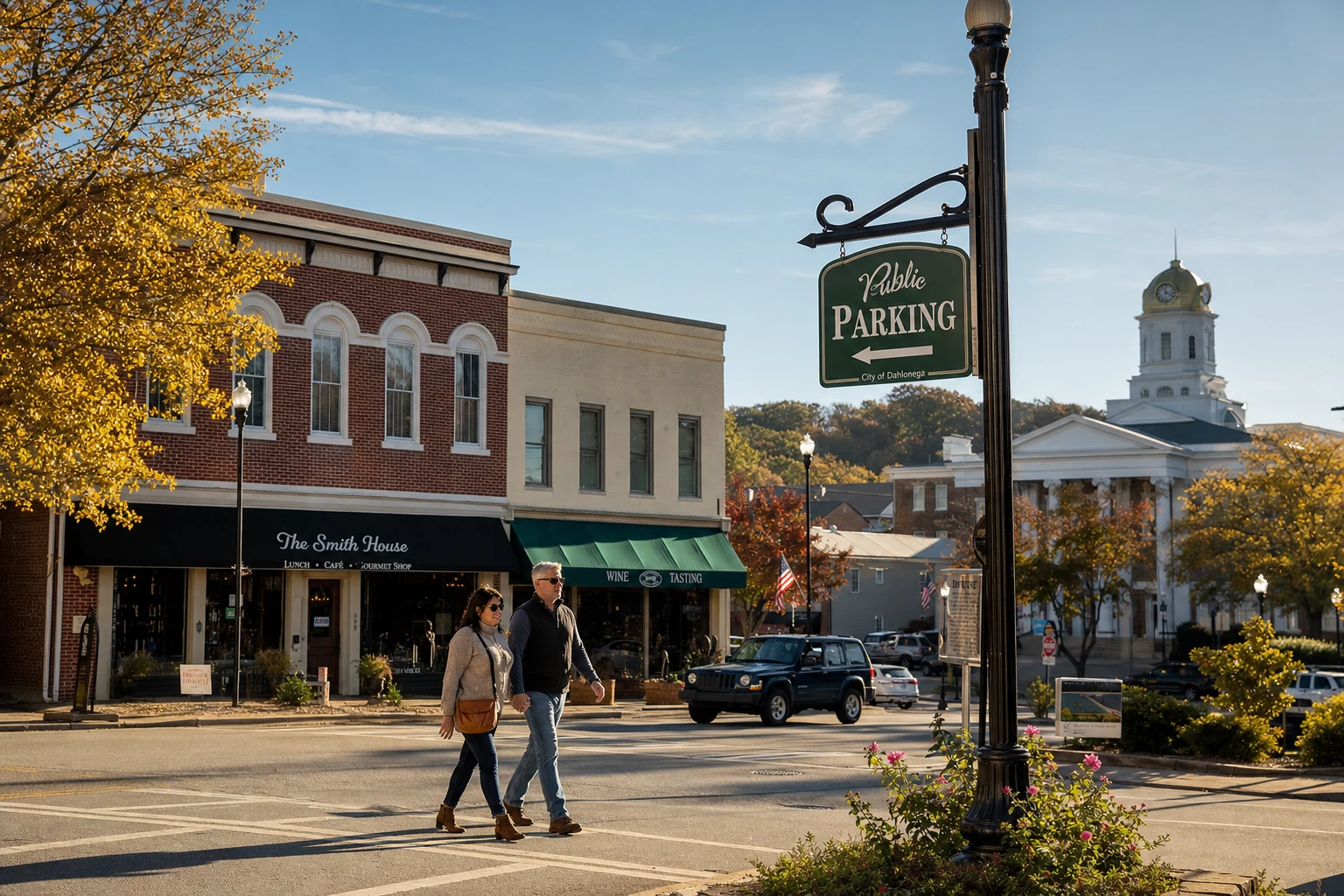
Everything radiates from the square, a National Register historic district around the old courthouse. The Smith House, at 84 South Chestatee Street, has served family-style Southern meals since 1922 under the same family; its September hours were Tuesday to Thursday 11 to 3, Friday and Saturday 11 to 7:30 and Sunday 11 to 3, so call (706) 725-8148 for fall hours. Live music happens at Canopy + the Roots, 53 West Main Street, with a fall schedule that runs through December.
Fall and holiday events
| Date | Event | Time |
|---|---|---|
| Oct 17-18 | Gold Rush Days Festival, Public Square | Opens 9 AM; parade Sat 3 PM |
| Sat, Oct 31 | Scares on the Square | 5-7 PM |
| Fri, Nov 27 | Lighting of the Square | 3-8 PM |
| Dec 5-13 | Dahlonega Christmas Market, Hancock Park | 10 AM-5 PM |
| Sat, Dec 12 | Dahlonega Christmas Parade, Public Square | Noon-1 PM |
Getting there
Dahlonega is about 27 miles and 45 minutes from Helen, through Cleveland. Past the square, the Appalachian Trail's southern terminus at Springer Mountain is in the national forest to the west; see our Appalachian Trail page. For the full rundown, see our Dahlonega visitor guide.
Quick questions
How far is Dahlonega from Helen?
About 27 miles, roughly 45 minutes without traffic.
Was Dahlonega really the first gold rush?
It was the first major gold rush in the United States, beginning in 1828, about twenty years before California.
How much is the underground mine tour?
Consolidated Gold Mine's 40-minute tour is $24.95 for adults and $15.95 for ages 3 to 12; children under 3 are free.
More to explore
Related destinations, trails and experiences nearby