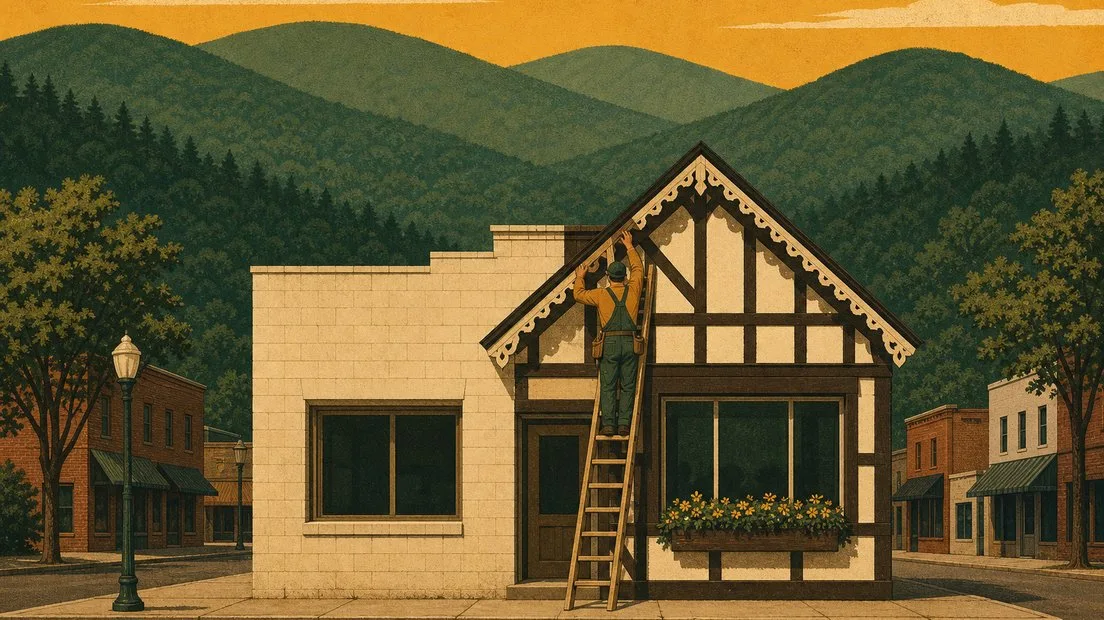
One of our favorite sentences in Georgia history is a photo caption. It sits under a National Archives picture of a gas station in Helen, in the New Georgia Encyclopedia, and it reads: "One service station owner borrowed $15,000 to add a store-top to his shop in order to conform to the alpine motif."
It doesn't give his name. It doesn't say what the lender thought. It leaves you to picture a man looking at a perfectly good filling station in the north Georgia mountains and concluding that what it needed, at $15,000, was to look more like Bavaria.
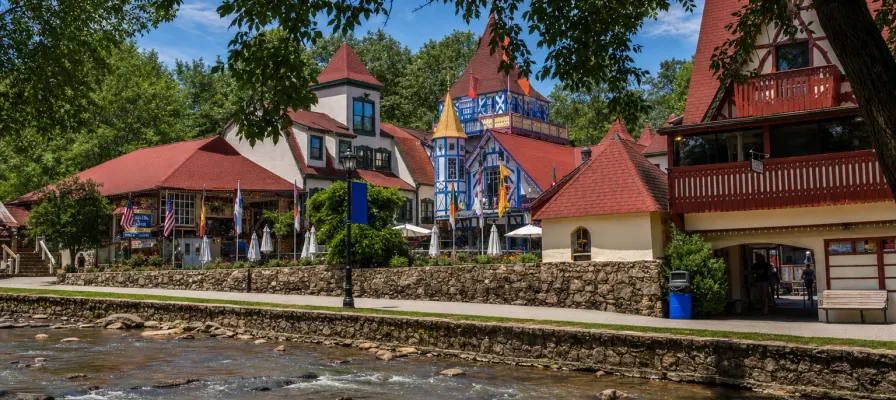
Helen has no German past to live up to. A 2014 Clemson thesis on its Oktoberfest calls the place "faux-Bavarian" and says outright that it isn't a historically German settlement. So how did a Georgia gas station end up in debt to the Alps? The answer involves a bin of cheap socks.
A town built to run out of trees
The Byrd-Matthews Corporation came for the virgin hardwoods and built a major sawmill here around 1910. A rail connector soon tied the new town to Gainesville. Even the name has two stories. The encyclopedia says Helen was the daughter of a Byrd-Matthews partner, while Blue Ridge Country says she was Helen McComb, niece of developer John E. Mitchell. We have no idea which one to thank.
The mill did what mills did. By the Depression most of the timber had been cut, and the company and most of the residents moved on to better forests. The encyclopedia's description of what stayed behind, in the 1950s and 1960s, is not gentle: "nothing more than a bleak row of concrete block structures" supporting nine businesses.
Plenty of cars still came through, because the road ran up toward the mountains and waterfalls. They just didn't slow down. "It was a very simple, little town," Terry Sims, who grew up three miles north, told Blue Ridge Country. Alta Buckley drove through in 1969. "And it was a pass-through place," she remembered. "It was just a Georgia town that was dying. Fortunately, it was not dying completely."
Lunch, on one of two dates
The story's founding scene is a meal, and nobody can agree when it happened. The encyclopedia says that in 1968 a group of local businessmen met for "what has become a legendary lunch." The City of Helen's history page says three of them sat down at a local restaurant in January 1969. White County News, citing Garrison Baker's book In the Shadow of Yonah, says they decided to act in 1968 and that work began in January 1969, which would make a January lunch one fast lunch. The visitors bureau's guide also has the meeting in 1968 and the carpenters in January 1969. Our history of the 1969 transformation sets the main tellings side by side. We won't be settling it.
The names are firmer. White County News and Explore Georgia both give the same three, and they make an odd committee. Jim Wilkins had come up from Atlanta, married Betsy Smith and raised four sons in Helen. He ran Wilco Hosiery Mill, which made argyle socks, from 1946 to 1956, and in 1962 he started Orbit Manufacturing, which made women's apparel. Bob Fowler worked for him at Orbit and would be elected mayor in the early 1970s. Pete Hodkinson was a businessman who did promotion for outlets, and he'll need his own section.
One of them, according to the city, said he'd talk to an artist he knew from church in Clarkesville.
Ten-cent socks
That artist was John Kollock, and Helen wasn't new to him. His widow, Nancy Kollock, told the story at a 2019 session hosted by the Helen Arts and Heritage Center. "Early, when he was a boy, they used to come to Helen and buy argyle socks," she said. "There was a factory here that made socks and they had a big bin of the rejects, and that's where the boys went because they were 10 cents."
Nobody in our sources connects that bin to Wilkins's sock mill, and the dates are tight: Kollock died at 85 in 2014, so he was about 17 when Wilco's run began. Still, we'll point out that a town this size can't have had many argyle factories.
Kollock had been drafted into the Army and sent overseas, where, his widow said, he fell in love with Bavaria and its towns. Driving through Helen, he noticed the mountains and the river looked a lot like what he'd seen there. Her description of what he did next is the most useful sentence anyone has spoken on this subject:
"He came over, took pictures of all the buildings, came back to his studio, put tracing paper over the photographs and then did a colored drawing of what that little building could look like if it was 'alpinized.'"
That's the clever part, in our opinion. Small-town rescue plans tend to die in committee, and it's hard to argue with a drawing of your own building, already fixed.
Gingerbread on concrete block
Helen City Council approved the proposal. Wilkins went first, on his Orbit outlet store. "He was the first property owner to change his store (the Orbit outlet store) into the alpine design," his daughter-in-law Helen Wilkins, a former mayor, told White County News. "Everyone saw how good it looked, and that was the start of the change of the face of Helen."
A federal photographer came through in May 1975, working for the EPA's Documerica project, and his caption is admirably flat. Helen was "a typical Georgia mountain village until 1969," when the town settled on a Bavarian Alpine motif. It was done "without state or federal funds." The buildings stayed, and only the exteriors changed. The town's visitors bureau says business owners and local carpenters did the work, and that facades got painted with scenes of Bavaria and North Georgia.
So the bleak row stayed, and it got a costume. The city says many old buildings had new fronts by the fall of 1969, and the encyclopedia says Kollock's paintings had taken tangible form by 1972. At some point, a service station owner went to see about a loan.
The Chattahoochee Trout Festival and Alpine Hoedown
A costume needs a party. On Sept. 20, 1969, Alpine Helen held its first promotional event, and it wasn't Oktoberfest. It was the Chattahoochee Trout Festival and Alpine Hoedown, which sounds like two towns arguing, and which White County News says ran as a trout festival for 19 years. Oktoberfest came in 1970, hosted by Pete Hodkinson. A National Archives photo from September 1975 shows a councilman's son sitting outside the circus tent at the festival, which is the detail we'd bring back if we had a time machine.
Hodkinson also staged motorcycle races and Easter olive hunts. None of our sources explains an Easter olive hunt, and we think about it more than we should.
"He was a master of (free publicity), and he didn't care if it was good, bad or indifferent, he was going to get publicity," Hue Rainey said of him in 2019. "He would create things. He lifted things off of the ground with a balloon, such as a Jeep once." That's one man's memory, but it fits the rest of the file. North Georgia Living says Hodkinson, a balloon pilot, noticed people stared when he floated over, so he invented a race from the "Center of the World to the Edge of the Earth." The center was Helen. The edge, in practice, was Interstate 95, anywhere between Maine and Miami. The Helen to the Atlantic race first flew in May 1974.
Hodkinson was killed in a balloon accident in 1976. He had been at this for less than a decade. "Pete had plans y'all never heard of," Rainey said, and later: "It was tough when he died, but we carried on."
The fair complaint
Not everyone has applauded. The encyclopedia says many question Helen's "rampant commercialism and its failure to focus more attention on its own Appalachian history and culture, rather than that of the German Alps." We think that's right, and we say so as a website named after the place. The city's own history page starts long before any sawmill, with "some of the most advanced native chiefdoms with monumental architecture and intensive agriculture," then Cherokee towns, then gold. None of that shows up in half-timbering. Our Cherokee heritage guide is a better start, and the Nacoochee Mound is just down the valley.
The same federal caption from 1975 mentions a development plan that cautioned about "the need for balance between commercialism and public interest," so people have been raising this for about as long as there's been an Alpine Helen.
It also worked, and we'd be lying if we said otherwise. A second 1975 caption counts "some 270 people" in town. The encyclopedia counts 430 residents in 2000 and nearly 1,200 hotel rooms, close to three rooms per person. It puts visitors at as many as 1.5 million a year. The visitors bureau says over 2 million, as visitors bureaus will.
The rulebook
What separates Helen from a town that bought some window boxes is that it kept enforcing the idea. Officials have regulated the downtown look since 1969, and you can read the current rules on the city's website. They're wonderful.
The City of Helen Architectural Guidelines are 25 scanned pages with an honesty most tourism documents can't manage. Helen, they say, is "not a true reproduction of a Bavarian Village, but an artist's interpretation of a typical Bavarian town." A real Bavarian building might have a few of the features. Helen's have many, "actually exaggerating the elements of Bavarian style." And: "The visitor to Helen sees the image of an Alpine village, not a true depiction of an Alpine village." This is the city talking, in a document written for builders.
Then it gets specific. A form "originally designed as a barn structure can be used in Helen as the base form of a motel." Where sheep once went through winding Bavarian paths, "in Helen tourists walk from shop to shop along brick paver paths." Metal roofing "must be red or brown, but not bright red." Signs get inspected every year, and the guidelines wince that since the early days "a number of inappropriate architectural elements not found within traditional Bavarian architecture have been added." Inappropriate to what, you could ask, in a Bavarian village in White County. They mean it, though. Elevators, a problem no medieval builder had, get a paragraph of their own that arrives at a tower: "Fortunately, there are many types of Alpine towers of appropriate proportions and dimensions that can readily be adapted to this unusual use."
Our favorite pages aren't in the guidelines at all. The city's approved color list, updated in October 2024, has 37 colors plus 10 for trim. It includes Khaki Shorts, Lady in Red, Wild, Wild West, Tarnished Copper and The Good Life, each with a code beside it. The font list, which the guidelines say comes with the sign application, has four entries: Century, Script, Old English and Goudy Old Style. "Fonts can only vary from this list in that they can be bold or italics," it says, and only within the same family and style.
The color list carries an update date, so if you're planning to alpinize something of your own, the guidelines tell you where to get the current chart: "Please check with the employees at Helen City Hall or Ace Hardware for an up-to-date color chart."