Currahee Mountain: The Crucible of the American Paratrooper
Where the WWII paratroopers of Band of Brothers trained, and how to visit Camp Toccoa and the museum today.
Currahee Mountain, in Stephens County, Georgia, takes its name from the Cherokee word quu-wa-hi, meaning "Stands Alone." It rises abruptly 800 feet above the surrounding Piedmont, a prominent landmark and the last peak of the Blue Ridge chain.
Camp Toccoa began as a National Guard facility and became, in 1942, a training ground for U.S. Army paratroopers. It was the birthplace of the 506th, 501st, 511th, and 517th Parachute Infantry Regiments.
The mountain became infamous for the "Three Miles Up, Three Miles Down" conditioning run, a grueling six-mile round trip that built endurance and weeded out unfit recruits. That run was central to the identity of the "Toccoa Men."
The Short Version
Currahee Mountain, in Stephens County, Georgia, takes its name from the Cherokee word quu-wa-hi, meaning "Stands Alone." It rises abruptly 800 feet above the surrounding Piedmont, the last peak of the Blue Ridge chain.
Camp Toccoa began as a National Guard facility and became, in 1942, a training ground for U.S. Army paratroopers. It was the birthplace of the 506th, 501st, 511th, and 517th Parachute Infantry Regiments.
The mountain became infamous for the "Three Miles Up, Three Miles Down" conditioning run, a six-mile round trip that built endurance and weeded out unfit recruits. That run was central to the identity of the "Toccoa Men."
The site is known worldwide through Stephen Ambrose’s book Band of Brothers and the HBO miniseries, which followed Easy Company, 506th PIR, and their training under Lt. Herbert Sobel and Lt. Richard Winters.
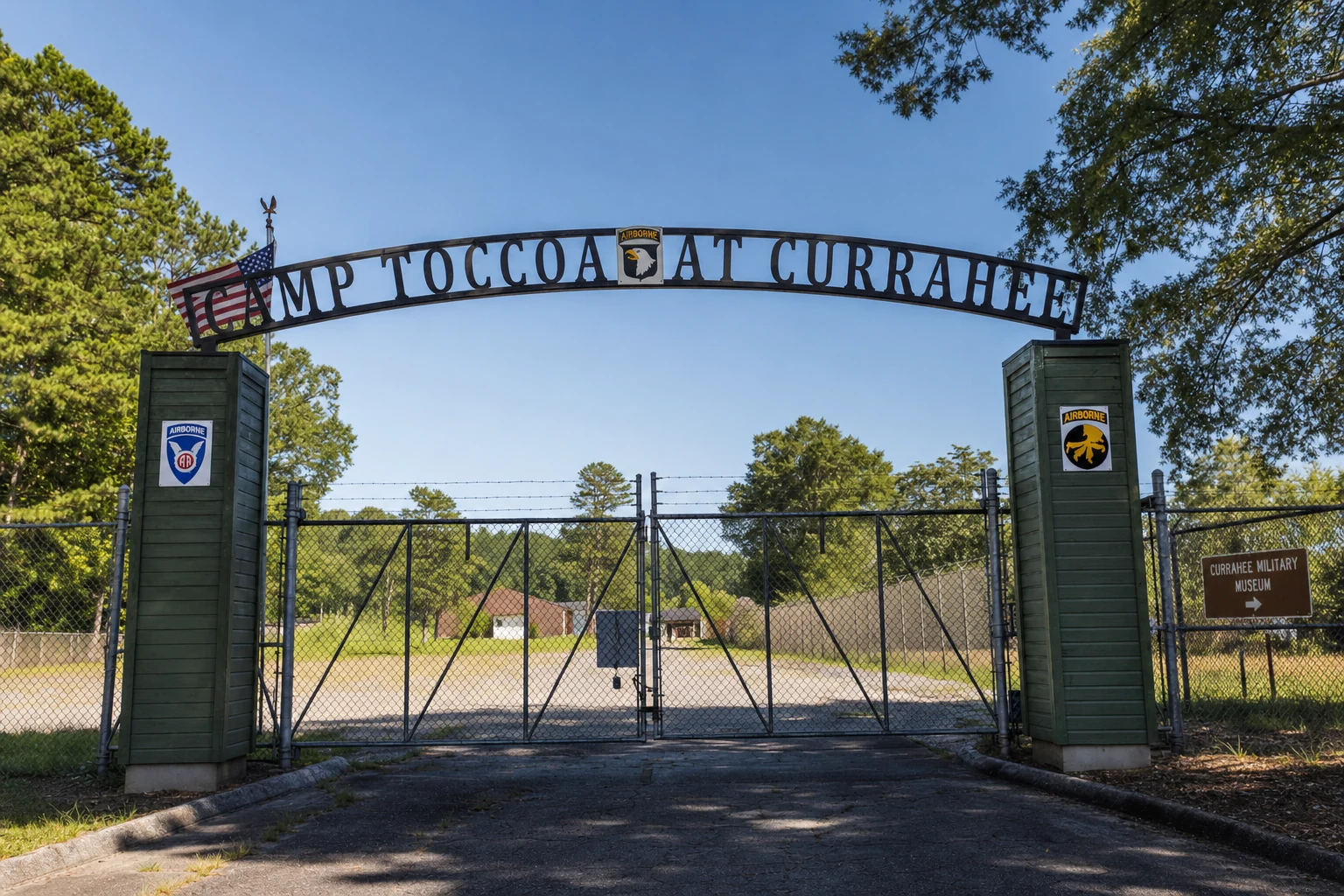
You can walk this history today. The Currahee Military Museum sits in downtown Toccoa in the historic train depot, and the Camp Toccoa at Currahee Project is restoring the original camp grounds, including barracks and a C-47 display.
The old run is now the Colonel Robert F. Sink Memorial Trail, a hiking route and the site of the annual Currahee Challenge race.
Why This Mountain Matters
Few places carry the military weight of Currahee Mountain. Located in Stephens County, Georgia, this solitary peak rises 1,735 feet above sea level, jutting sharply from the rolling hills of the Georgia Piedmont. Geologists know it as the southernmost peak of the Blue Ridge chain. But for the roughly 18,000 men who trained at its base during World War II, it was something else entirely: the place where the United States Army turned volunteers into paratroopers.
Between 1942 and the end of the war, approximately 18,000 men arrived at the base of this mountain to volunteer for a new, experimental form of warfare: airborne infantry. The training camp established there, Camp Toccoa, utilized the mountain’s steep grade as a tool for physical conditioning and psychological hardening. The chant "Three Miles Up, Three Miles Down" became the cadence of a generation of soldiers who would go on to liberate Europe and the Pacific.
What follows covers the full history of Currahee Mountain - from Camp Toccoa's founding and the exploits of Easy Company to the modern-day work to preserve the site.
The Establishment of Camp Toccoa
From Camp Toombs to Camp Toccoa
The facility that became the training ground for elite paratroopers was originally constructed in the late 1930s. Built under the auspices of Franklin D. Roosevelt’s Works Progress Administration (WPA) and the Civilian Conservation Corps (CCC), the site was initially intended for the Georgia National Guard and was dedicated on December 14, 1940.
Originally, the installation was named Camp Toombs, after Robert Toombs, a Confederate Civil War General and Georgia politician. However, in 1942, as the U.S. Army took over the site to begin paratrooper training, the camp’s name became a source of concern for Colonel Robert Sink, the commander of the 506th Parachute Infantry Regiment (PIR).
Colonel Sink recognized a grim irony in the geography and nomenclature of the arrival experience for new recruits. Aspiring paratroopers arrived by train in the town of Toccoa, marched five miles down Route 12 past the Toccoa Casket Company, and arrived at a place called Camp Toombs. Fearing that this sequence - caskets followed by "tombs" - would incite superstition and damage morale among men signing up for a highly dangerous job, Sink successfully petitioned the War Department to rename the facility. It was designated Camp Toccoa, taking the name of the nearby town.
The Airborne Experiment
The establishment of Camp Toccoa coincided with the U.S. military's urgent need to develop an airborne capability following the successes of German Fallschirmjäger units in the early stages of the war. The camp was unique because it was designed to take men directly from civilian life and train them as paratroopers, rather than retraining existing soldiers. It was a facility designed to separate the weak from the strong through one of the toughest physical regimens ever devised by the Army.
Four major regiments received their primary training at Camp Toccoa:
501st Parachute Infantry Regiment (PIR): Attached to the 101st Airborne Division.
506th Parachute Infantry Regiment (PIR): Attached to the 101st Airborne Division.
511th Parachute Infantry Regiment (PIR): Attached to the 11th Airborne Division.
517th Parachute Infantry Regiment (PIR): A Regimental Combat Team that served with various divisions.
Currahee Mountain: The Training Crucible
"Stands Alone"
The mountain dominating the camp skyline is named Currahee, a corruption of the Cherokee term quu-wa-hi. The translation is widely cited as "Stands Alone" or "Stand Alone". This name proved prophetically fitting for the paratroopers training in its shadow. The doctrine of airborne warfare dictates that paratroopers drop behind enemy lines, often scattered and cut off from immediate support. In combat, they effectively "stand alone" until relieved by ground forces. This linguistic coincidence became a point of pride and the battle cry for the 506th PIR: "Currahee!".
Three Miles Up, Three Miles Down
The defining feature of training at Camp Toccoa was the run up Currahee Mountain. The camp was situated at approximately 1,150 feet above sea level, while the summit of the mountain reached 1,735 feet. The service road winding to the top was a gravel track that provided a grueling physical test.
The run, immortalized as "Three Miles Up, Three Miles Down," was a six-mile round trip. Recruits ran the route three to four times a week. The geography of the run was deceptive; the ascent began gradually but became punishingly steep in the final mile, forcing legs to burn and lungs to gasp for air. The descent required controlling momentum against gravity, punishing the joints. The run had to be completed in under 50 minutes to meet the standards set by commanders like Colonel Sink and Lieutenant Sobel.
This run was not merely physical conditioning; it was a psychological filter. The constant presence of the mountain served as a looming challenge. Those who could not conquer the mountain were "washed out" of the airborne program. For those who remained, the mountain fostered a deep, shared bond - a "brotherhood" forged in sweat and exhaustion.
Easy Company and Band of Brothers
The Legend of Easy Company
While thousands of men trained at Camp Toccoa, the facility is most famously associated with Easy Company, 2nd Battalion, 506th Parachute Infantry Regiment. Their story was chronicled by historian Stephen Ambrose in his 1992 book Band of Brothers and subsequently dramatized in the 2001 HBO miniseries of the same name produced by Steven Spielberg and Tom Hanks.
Easy Company's story starts at Camp Toccoa. It was here that the unit was activated in 1942. The miniseries portrays the harsh leadership of the company's first commander, 1st Lieutenant Herbert Sobel. Sobel is depicted as a strict disciplinarian who used the Currahee run as a punishment and a tool to harden his men. One famous scene depicts Sobel revoking the men's weekend passes and ordering them to run the mountain immediately after a heavy spaghetti dinner.
Leadership and Legacy
The training at Toccoa forged the leadership dynamics that would carry Easy Company through D-Day, Operation Market Garden, and the Battle of the Bulge. The juxtaposition of Sobel’s tyranny against the quiet competence of Lieutenant Richard Winters (who began as a platoon leader at Toccoa) is a central theme of the unit’s history.
While Sobel was eventually reassigned and did not lead the company into combat, the physical fitness and discipline he instilled at Toccoa are often credited with the unit's survival and success. The "Tocoa Men" of Easy Company were reportedly in such superior physical condition that when they arrived at Fort Benning for parachute jump training, they skipped the initial physical training phase required of other recruits.
The battalion's march from Camp Toccoa to Atlanta in December 1942 showed just how fit these men had become. To prove the paratroopers' endurance, Colonel Sink ordered the 2nd Battalion to march 115 to 118 miles to Atlanta. They completed the march in roughly 33.5 hours (spread over several days), marching through the night and outpacing the Japanese Army's record for a similar maneuver. They arrived at the Five Points intersection in Atlanta to cheering crowds before boarding trains to Fort Benning.
The Currahee Military Museum
Location and Mission
To preserve the history of the 17,000 to 18,000 men who trained at the camp, the Stephens County Historical Society operates the Currahee Military Museum. The museum is located at 160 North Alexander Street in downtown Toccoa, housed within the restored train depot. This location is historically significant, as it is the exact spot where incoming recruits disembarked from trains before beginning the five-mile hike to the camp.
The Aldbourne Stable
One of the museum’s most unique and significant artifacts is a reconstructed horse stable from Aldbourne, England. After leaving Camp Toccoa and completing jump training, the 506th PIR shipped out to England in 1943 to prepare for the invasion of Europe. There, many paratroopers were billeted in stables in the village of Aldbourne.
When the original owner of the stables in England planned to demolish them, the Stephens County Historical Society acquired the structure. It was disassembled, shipped to Georgia, and painstakingly reassembled inside the museum. It now serves as an immersive exhibit, housing memorabilia and illustrating the living conditions of the soldiers known as the "Five-Oh-Sinks" before they jumped into Normandy.
Related Imagery from Around Helen