
Track Rock Gap Archaeological Area
A sacred mountain gap near Blairsville where ancestral Creek and Cherokee people carved soapstone boulders with footprints and rings
Track Rock Gap (9UN367) sits in the Chattahoochee-Oconee National Forest near Blairsville, Georgia, and it is one of the most important petroglyph sites in the Southeastern United States. Fair warning before you plan a visit: after catastrophic vandalism, access to the carvings has been severely restricted or closed through 2024 to 2026 while preservation work continues.
The soapstone boulders were carved by Native American peoples, mostly ancestral Creek and Cherokee, from the Woodland into the Mississippian period (around 1000 AD) and possibly earlier. This is not a Maya ruin. Archaeologists have thoroughly debunked the idea of a Central American origin, and the sophistication of the site belongs to Native North American cultures.
To the Cherokee and Muscogee (Creek) peoples, the gap is a sacred threshold. People have read the carvings as a record of a "Great Hunt," as the aftermath of a great flood, and as maps of the spirit world tied to Tsul 'kalu, the giant known as the Master of Game.
About the Maya Claim
In 2011 a theory went viral claiming the site was a lost Maya city called Yupaha. It leans on a misreading of ordinary farming terraces and a few coincidental words. Professional archaeologists and Tribal Historic Preservation Officers reject it flatly as pseudo-archaeology that erases Native heritage.
Getting Your Bearings
The Track Rock Gap Archaeological Area is a 52-acre federally protected site located in Union County, Georgia, within the Blue Ridge Ranger District of the Chattahoochee-Oconee National Forest. Situated approximately 5 miles east of Blairsville and south of the Young Harris Highway (U.S. 76), the site lies in a low gap between Thunderstruck Mountain and Buzzard Roost Ridge. This geographical positioning is significant; in the mountainous topography of the Southern Appalachians, gaps served not only as physical transit routes for trade and hunting but also as metaphysical "thresholds" in indigenous cosmology.
The site is renowned for its petroglyphs - figures carved into soapstone (steatite) boulders. While the petroglyphs are the most visible feature, the archaeological zone also encompasses a complex series of stone piles, walls, and agricultural terraces on the surrounding ridges, which have become the subject of intense debate and misinterpretation in the 21st century.
Geology and Environment
The petroglyphs are carved into chlorite schist, commonly known as soapstone. This metamorphic rock is relatively soft, making it an ideal medium for carving, but also rendering it susceptible to erosion from acid rain, lichen growth, and human vandalism. The area is volcanic in origin, containing a dormant fumarole, which distinguishes its geology from the sedimentary formations found elsewhere in the Southeast.
The Petroglyphs
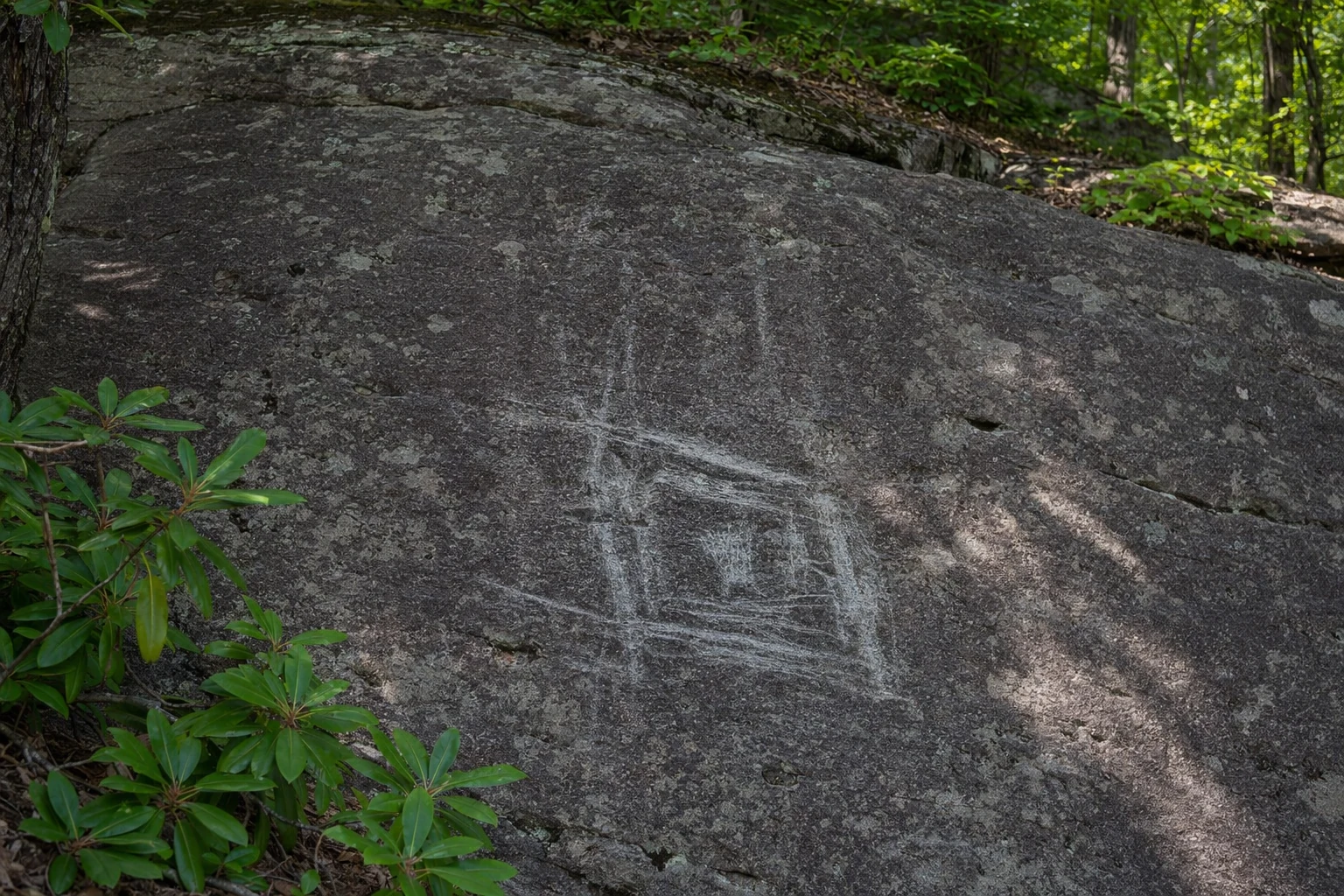
Track Rock Gap derives its name from the sheer density of carvings that resemble animal and human footprints. Early descriptions from the 19th century noted that the rocks appeared as if a multitude of creatures had walked over them while the stone was as soft as mud.
What the Carvings Show
Six table-sized boulders hold hundreds of symbols, and they fall into a few rough groups. Animal tracks are everywhere: bear, deer, turkey, and other bird prints, carved realistically enough to show how well the makers knew the local wildlife. There are human forms too, both footprints and stick-figure shapes. Then come the geometric marks, circles, concentric rings, crosses (often boxed inside a circle), grids, and curving lines. Finally you will spot cupules, small cup-shaped dimples pecked into the rock. Cupules show up in rock art all over the world and are usually tied to ritual, whether extracting stone powder or marking an event.
How They Were Made
Archaeological analysis indicates the carvings were created using a "pecking" and "grinding" technique. Indigenous artisans used harder hammerstones (likely quartz or quartzite) to strike the soapstone surface, creating the initial shape, which was then smoothed or deepened through abrasion. The creation of these glyphs was not a singular event but a cumulative process occurring over centuries, likely beginning as early as the Late Archaic period (3,600 years ago) for soapstone bowl extraction, with the majority of the visible figurative art dating to the Late Woodland and Mississippian periods (c. 1000 AD – 1800 AD).
What the Carvings Meant
The interpretation of Track Rock Gap is deeply rooted in the ethnohistory of the Cherokee (Ani-Yunwiya) and Muscogee (Creek) peoples. While Western archaeologists attempt to categorize the symbols, indigenous oral traditions provide the narrative context for the site's creation and function.
Cherokee Legends and James Mooney
In the late 19th century, ethnographer James Mooney recorded several Cherokee legends regarding the site. The Cherokee referred to the location as Datsu'nalasgun'ylu ("Where there are tracks") and Degayelun'ha ("The Printed Place").
One story says the tracks were made when a great flood nearly destroyed the world. As the animals climbed out of a "great canoe," the earth and rock were still soft, and their footprints set into the stone forever as the world hardened. Another version has hunters carving the glyphs while resting in the gap, recording a great hunt where game was driven through the narrow pass.
The site is also tied to Tsul 'kalu (Judaculla), the slant-eyed Master of Game, a giant spirit said to live in these mountains. Like Judaculla Rock over in North Carolina, Track Rock is seen as a boundary marker or a record that the Spirit Folk were here.
A Threshold Between Worlds
Modern ethnohistorical analysis suggests the location of the petroglyphs - in a gap between mountain peaks - is intentional. In Cherokee cosmology, gaps represent liminal spaces or thresholds between the physical world and the spirit world. The footprint motifs may signify the movement of spirits (or the spirits of animals) transitioning between these realms. As noted by historians, the tracks act as "physical testimony that spirit beings were there... and that they could still be lingering somewhere close-by".
The Muscogee (Creek) Connection
Before the Cherokee dominated the region in the 18th century, the area was inhabited by ancestors of the Muscogee Creek people, as confirmed by the Eastern Band of Cherokee Indians and tribal historians. Many scholars and tribal representatives assert that the site's origins lie with the Creek or a shared cultural tradition between the groups. The petroglyphs and nearby stone landscapes likely served ceremonial functions for these earlier inhabitants before becoming incorporated into Cherokee lore.
Related Imagery from Around Helen