
The Petroglyphs of Track Rock Gap
Six soapstone boulders carved with footprints, animal tracks, and rings, one of the Southeast's oldest and most argued-over rock art sites
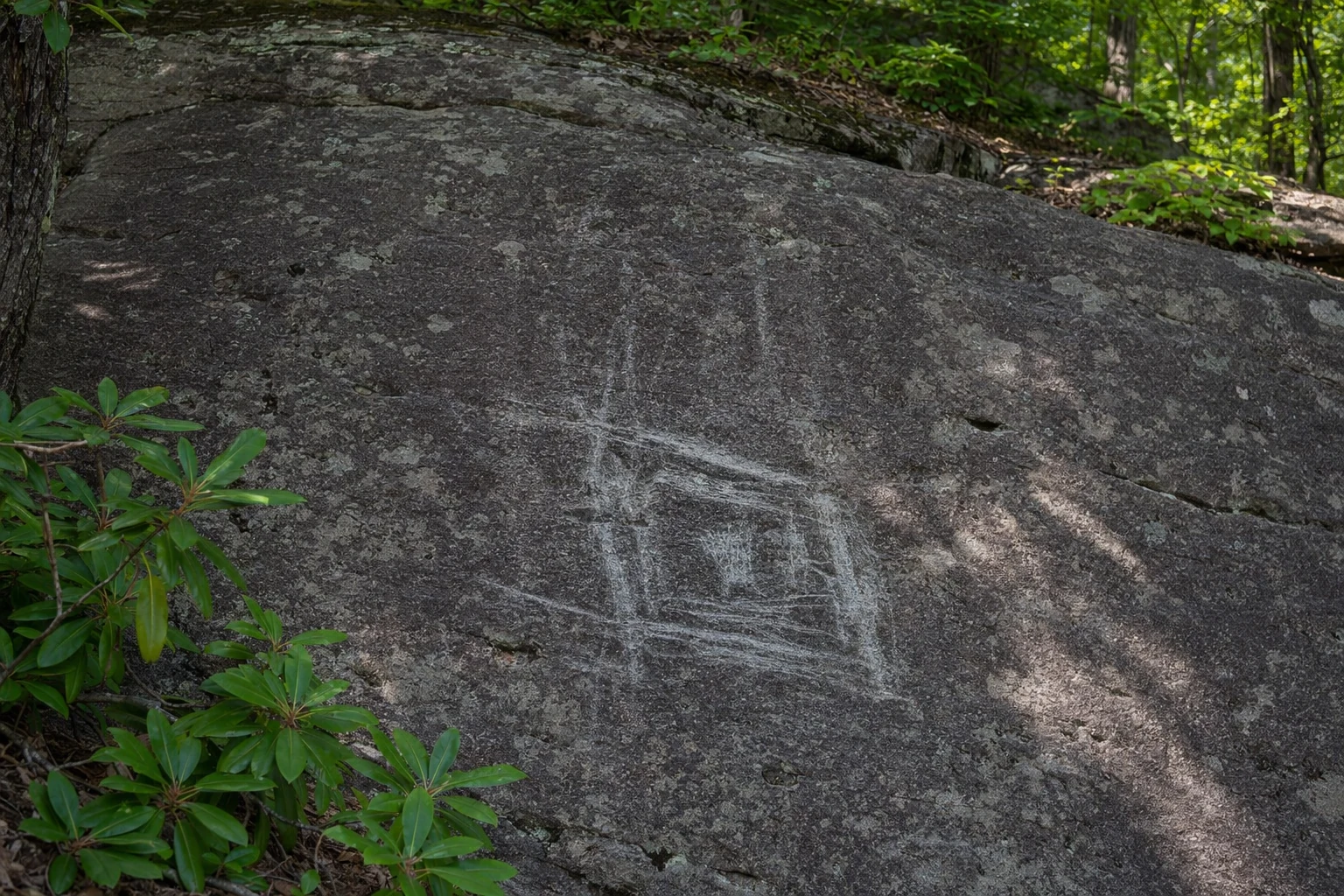
Track Rock Gap is one of the most important rock art sites in the Southeastern United States: six soapstone boulders carved with more than 100 petroglyphs. The carvings are the work of the ancestors of the Creek and Cherokee people, made across a long span that runs from the Archaic Period (8,000 to 1,000 BC) all the way to the late 19th century.
You may have heard a sensational claim that the site was built by Maya from Central America. It gets passed around online, but professional archaeologists and the Muscogee (Creek) and Cherokee nations firmly reject it.
What to Know Before You Go
After severe vandalism in 2020 and 2021, access to the petroglyph boulders themselves may be restricted, though the adjacent Arkaquah Trail stays open for hiking. Before you drive out, check with the Blue Ridge Ranger District for the current access rules at the site.
Getting Your Bearings
In the Chattahoochee National Forest, tucked into the gap between Thunderstruck Mountain and Buzzard Roost Ridge, there is a place that has drawn curious visitors for nearly two centuries. Track Rock Gap (9UN367) is where geology and Native culture meet in a way you find almost nowhere else in the Southeast. Exposed soapstone boulders carry centuries of carved footprints, geometric shapes, and abstract symbols that have survived erosion and weather, only to face a newer threat: vandalism.
This is more than a roadside stop. The story here pulls together Native American heritage, the hard work of preservation, and a running feud between real archaeology and sensational pseudo-history. What follows covers the site itself, the arguments about who made it, and the practical details of visiting this corner of Union County, Georgia.
Geographical and Geological Context
Track Rock Gap is located in the Blue Ridge Ranger District of the Chattahoochee National Forest, straddling the border of Union and Towns counties. The site sits at an elevation of approximately 2,200 feet (671 meters). The gap itself serves as a natural pass through the mountains, historically utilized by animal herds and subsequently by Native American hunters and traders.
The geological centerpiece of the site consists of six table-sized boulders composed of soapstone (steatite). Soapstone is a metamorphic rock largely composed of talc, giving it a softness that makes it ideal for carving but also susceptible to damage. The boulders at Track Rock are metamorphic remnants in a region characterized by ancient volcanic history, distinct from the sedimentary rock formations found elsewhere in the Southeast.
The Petroglyphs: Description and Interpretation
The name "Track Rock" is a literal translation of the Cherokee designation for the site, Datsu'nalasgun'ylu, meaning "where there are tracks," or Degayelun'ha, meaning "the printed (or branded) place".
The Glyphs
The carvings are petroglyphs, meaning the images were cut into the rock by pecking, grinding, or incising, rather than painted on like pictographs. There are hundreds of individual figures. Bird tracks, bear paws, and human footprints show up all over the stones; local folklore says these are the prints animals left while escaping a great flood, back when the rock was still soft as mud. You will also find geometric shapes, circles, concentric rings, crosses, and grid-like patterns, along with a handful of stick figures and stylized human forms.
Dating and Methodology
Determining the precise age of rock art is notoriously difficult. Archaeologists have speculated that the human activity at the site ranges from the Archaic Period (8000 to 1000 BC) through the Woodland and Mississippian periods, up to the 19th-century Cherokee inhabitation. However, most of the visible figures are believed to have been carved within the last 1,000 years, specifically beginning around A.D. 1000 during the Mississippian period.
The creation of these glyphs was a labor-intensive process. Indigenous artisans used hammerstones (harder rocks) to peck the outline of the figures into the softer soapstone, or used harder stones to rub and abrade the surface to create incisions.
Indigenous Origins vs. The "Maya Myth"
One of the most defining aspects of Track Rock Gap in the 21st century is the intense controversy surrounding its origins. This debate pits established archaeological consensus and Indigenous oral tradition against fringe history theories.
The Cherokee and Muscogee Heritage
The United States Forest Service (USFS) and tribal historians affirm that the site is of Creek and Cherokee origin. The region was historically inhabited by the Creek (Muscogee) people before the Cherokee expansion into the area. The carvings are consistent with Indigenous iconography found elsewhere in the Southeast, such as the Judaculla Rock in North Carolina.
Cherokee legends recorded by ethnographer James Mooney in the late 19th century describe the tracks as being made during a great hunt where animals were driven through the gap. Another legend suggests the tracks were impressed into the rock when the "Great Canoe" landed after a world-destroying flood.
The Maya Connection Claims
In 2011, an article by architect Richard Thornton circulated widely, claiming that Track Rock Gap was the site of an ancient Mayan city, potentially the mythical Yupaha sought by Hernando de Soto. Thornton argued that the stone terraces found on the hillsides near the petroglyphs were evidence of Maya architecture and that "Itza" Maya words were present in the Creek language. This theory was popularized by the show America Unearthed in 2012.
Archaeological Rebuttal
Archaeologists and tribal preservation officers have taken the Maya claim apart. The stone walls and terraces held up as "Maya ruins" are agricultural terraces built by Native Americans to keep soil from washing away while they farmed, or in some cases by 19th-century European settlers. No Maya artifacts, no jade, no obsidian, no telltale pottery, have ever turned up in Georgia. And the Muscogee Creek Nation and the Eastern Band of Cherokee Indians have said plainly that crediting their ancestors' engineering and art to a Central American civilization erases their own heritage and insults it.
Related Imagery from Around Helen