Georgia's Surviving Covered Bridges
Stovall Mill, Poole's Mill, and Georgia's surviving wooden covered bridges with driving directions
Georgia once had more than 250 covered bridges, many of them documented by the Georgia Historical Society. Fewer than 20 are left, and the ones in this guide are some of the best-preserved examples of 19th-century engineering you'll find.
A quick note on geography, since these are spread out. Stovall Mill Bridge is in the North Georgia mountains (White County), but Poole's Mill sits in the foothills of Forsyth County. Elder Mill is in the Oconee piedmont, and Auchumpkee Creek takes you into Central Georgia (Upson County). Seeing them all means a good bit of driving.
The Vanishing Tunnels of Georgia
In the late 19th century, the Georgia landscape was stitched together by more than 250 covered bridges, wooden tunnels that spanned the rushing creeks of the Appalachians and the languid rivers of the Piedmont. People called them "kissing bridges" for the privacy they gave courting couples, or just "tunnels across the creek," and they were practical structures. The roof wasn't for looks. It was there to keep the massive heart-pine timbers dry, because an uncovered wooden bridge might last only a decade before it rotted. Covered, they could stand for centuries.
Today, fewer than 20 of these bridges remain in Georgia. They're more than a photo stop. They take you back to a time when travel was measured in the clip-clop of hooves rather than highway miles. This guide covers a handful of the survivors: the cinematic Stovall Mill Bridge in the Alpine Helen area, the park-centered Poole's Mill Bridge, the drivable Elder Mill Bridge, and the sturdy Auchumpkee Creek Bridge. They all get grouped under "North Georgia" tourism, but seeing them all means committing to the backroads, from the Blue Ridge foothills down to the center of the state.
Stovall Mill Covered Bridge
The Cinematic Miniature of the Mountains
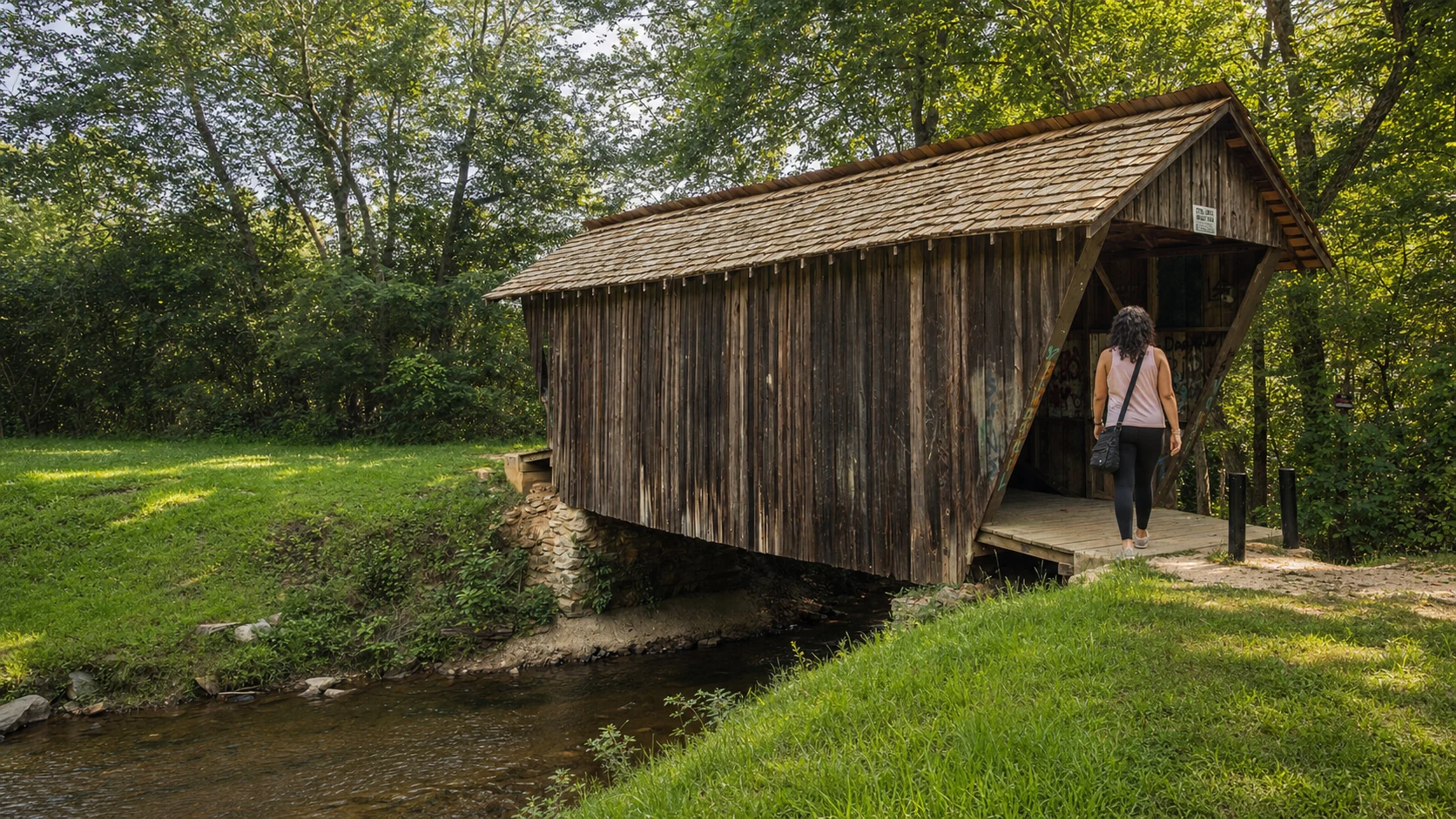
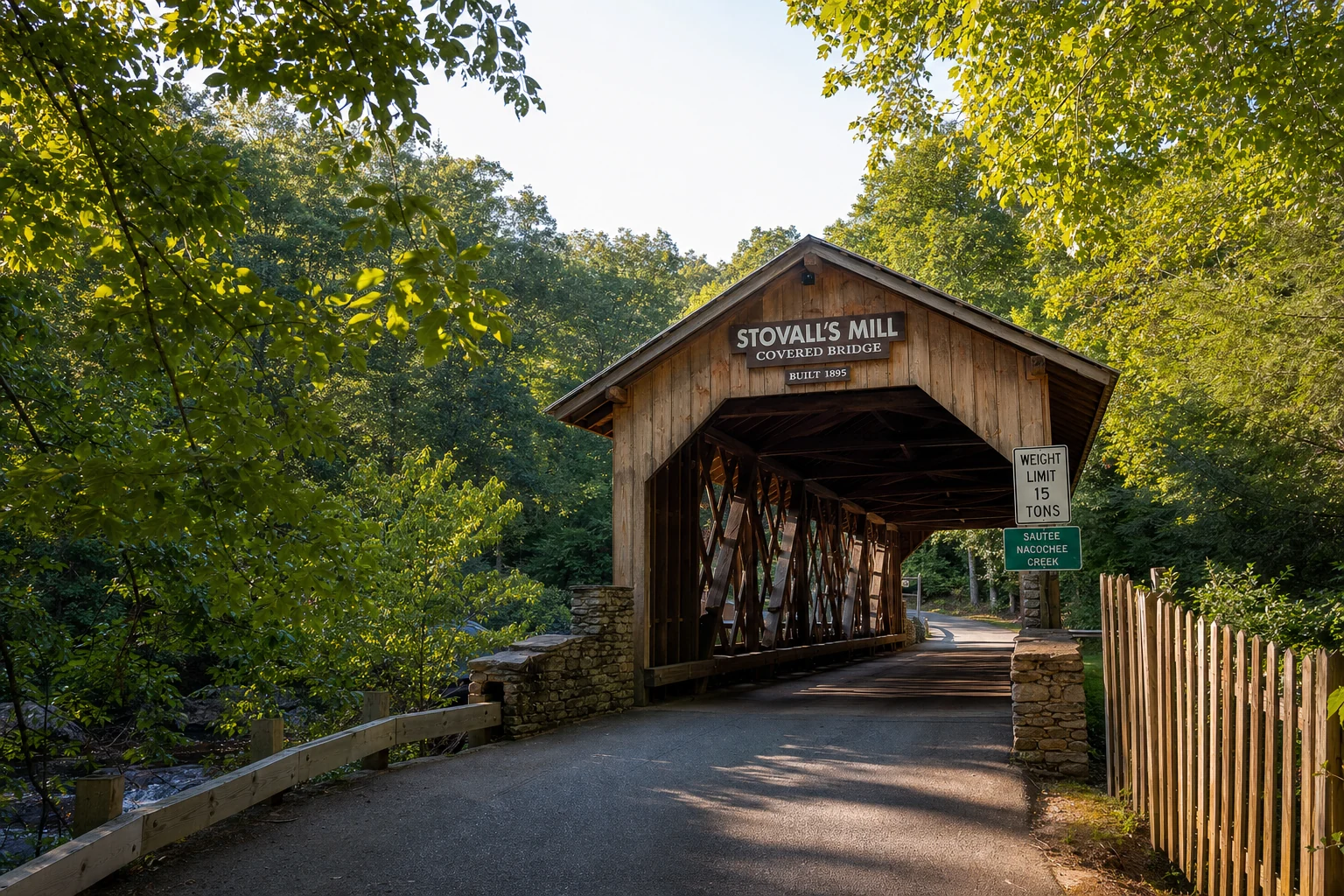
Located in the shadow of Mount Yonah and just a short drive from the Bavarian-themed village of Alpine Helen, the Stovall Mill Covered Bridge is a crown jewel of White County. It holds the distinction of being the shortest clear-span covered bridge in Georgia and is listed on the National Register of Historic Places, a small but solid piece of mountain craftsmanship.
Historical Provenance
The current structure, spanning Chickamauga Creek, was erected in 1895 by builder Will Pardue. It replaced an earlier bridge that was washed away by a flood in the early 1890s. The site was originally the epicenter of a complex owned by Fred Dover, which included a grist mill, saw mill, and shingle mill driven by a water turbine. In 1917, the operation was sold to Fred Stovall, Sr., lending the bridge its current name. While the mill and dam were destroyed in 1964, the bridge survived.
Culturally, this bridge is royalty. It was featured prominently in the 1951 film I'd Climb the Highest Mountain, starring Susan Hayward and William Lundigan, cementing its status as a local icon.
Architectural & Site Specifications
Truss Design: King-post truss (some sources describe it as a modified Queen-post with vertical posts and iron rods).
Length: Approximately 33 to 38 feet.
Span: One lane wide; restricted to pedestrian traffic only.
Waterway: Spans Chickamauga Creek.
Elevation: Located in the Sautee Nacoochee Valley, approximately 1,300–1,400 feet above sea level (based on regional topography).
Visitor Information
Address: GA Hwy 255, Sautee Nacoochee, GA 30571. (Specifically, ~3 miles north of the Old Sautee Store).
GPS Coordinates: Latitude: 34.711011 | Longitude: -83.675063.
Admission: Free.
Hours: Open daylight hours, year-round.
Parking: There are gravel pull-offs on both sides of the road near the bridge.
The Tourist Experience
Stovall Mill Bridge is not just a static monument. It is a beloved local swimming hole. Beneath the bridge, Chickamauga Creek pools around large shoals, creating a refreshing dip for summer visitors. The interior of the bridge, though historically significant, is heavily marked with graffiti - modern "petroglyphs" of lovers' initials that some find charming and others find vandalistic. Picnic tables are available on the banks, making it an ideal lunch stop.
Photography Tip: The best angle is from the creek bank looking upward to capture the stone abutments and the rush of water beneath the timber floor. Early morning fog often settles in the Nacoochee Valley, providing a moody, ethereal atmosphere for photographers.
Poole's Mill Covered Bridge
The Forsyth County Park Jewel
One thing to know up front: Poole's Mill Covered Bridge is in Forsyth County, near Cumming and Ball Ground, not up in the mountains. It sits roughly 45 miles southwest of Helen, so it's a separate leg of the trip.
Historical Provenance
The history of this site dates back to c. 1820, when Cherokee Chief George Welch constructed a gristmill and a sawmill here. Following the Cherokee Removal (Trail of Tears) in 1838, the land passed to Jacob Scudder and later, in 1880, to Dr. M.L. Pool.
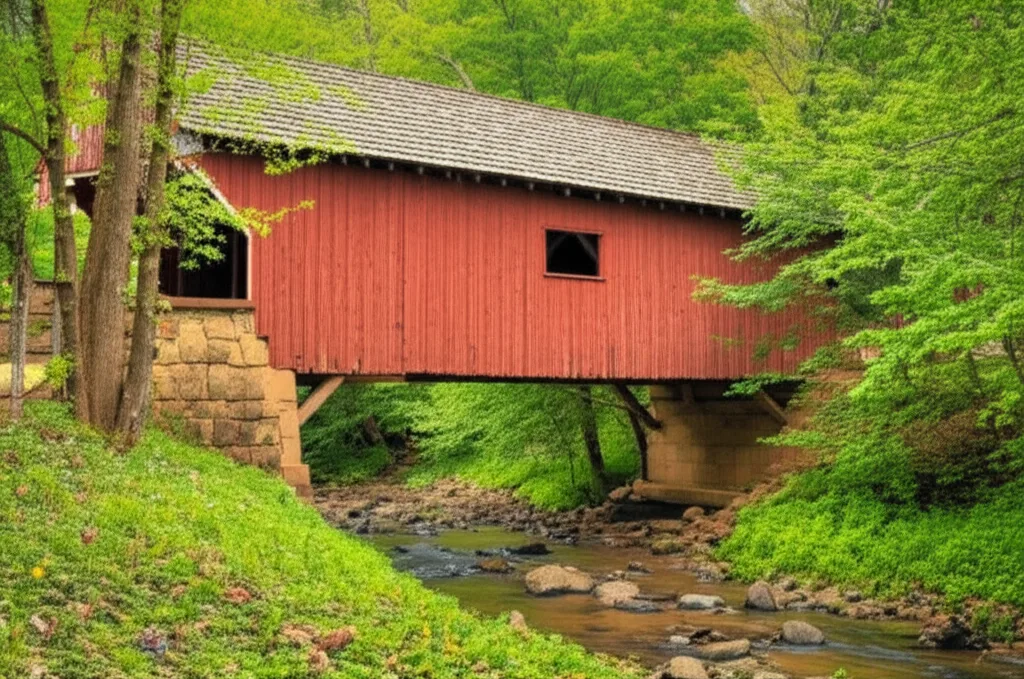
The current bridge was built in 1901. Its construction is the stuff of local legend. The contract was initially given to a builder named John Wofford. Wofford reportedly drilled the holes for the lattice pegs in the wrong locations. Upon realizing his error - and perhaps overwhelmed by the precision required - he abandoned the project (some accounts suggest he left town after consuming a gallon of corn whiskey). The bridge was completed by Bud Gentry, who had to redrill the holes. Visitors with a keen eye can still spot the misplaced holes in the timbers today.
Architectural & Site Specifications
Truss Design: Town Lattice truss.
Length: 96 feet.
Waterway: Spans Settendown Creek.
Restoration: The bridge collapsed/sagged significantly in the 1980s/90s. It was restored in 1997, with a support pier added in the middle of the creek for stability.
Visitor Information
Location: Poole's Mill Park.
Address: 7725 Poole's Mill Road, Ball Ground, GA 30107.
GPS Coordinates: N34 17.459 W84 14.555.
Admission: Free.
Hours:
March – October: 6:00 AM – 9:30 PM
Related Imagery from Around Helen