Nora Mill Granary, Grinding Since 1876
One of Georgia's oldest working gristmills, still turning out stone-ground grits and meal on the Chattahoochee near Helen.
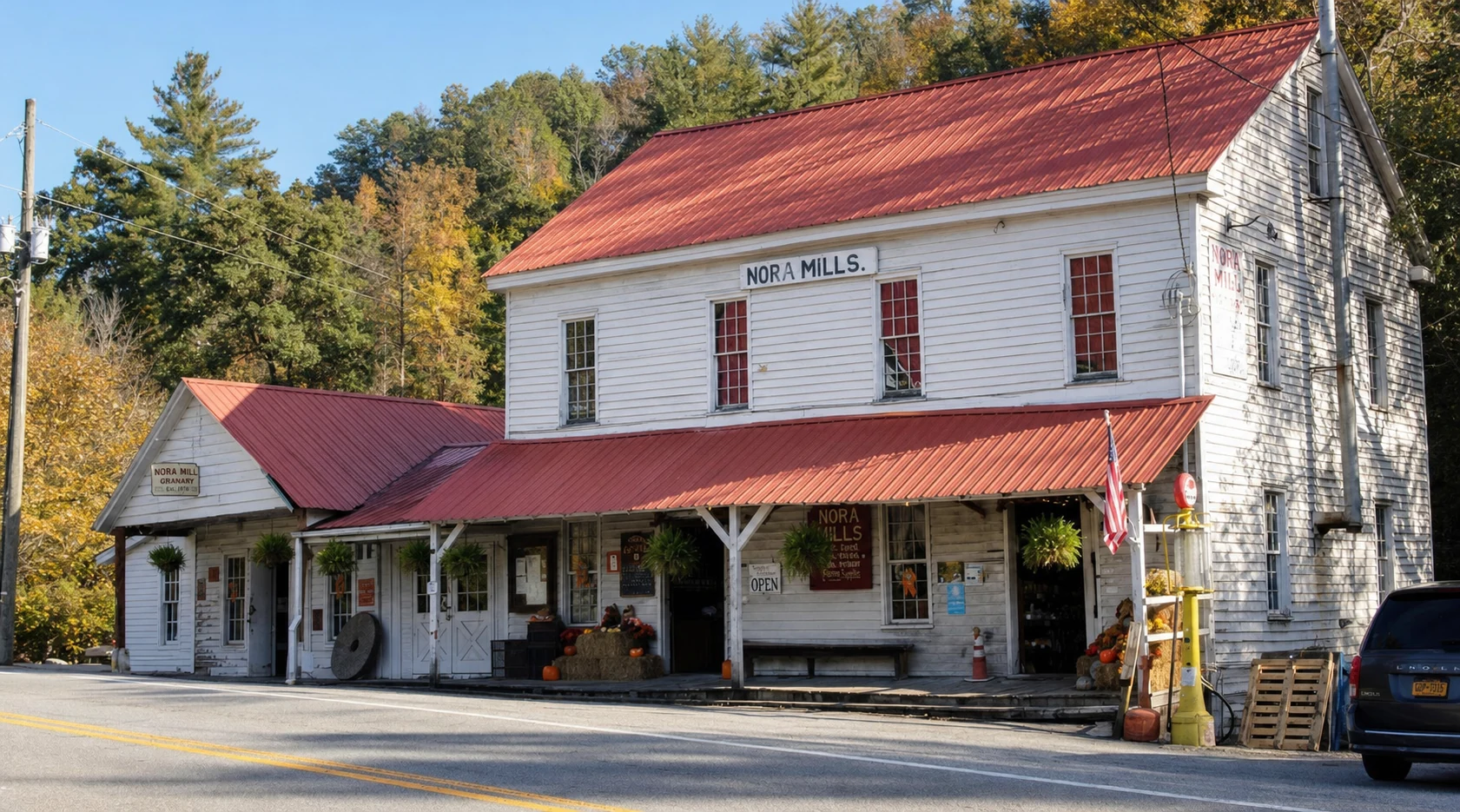
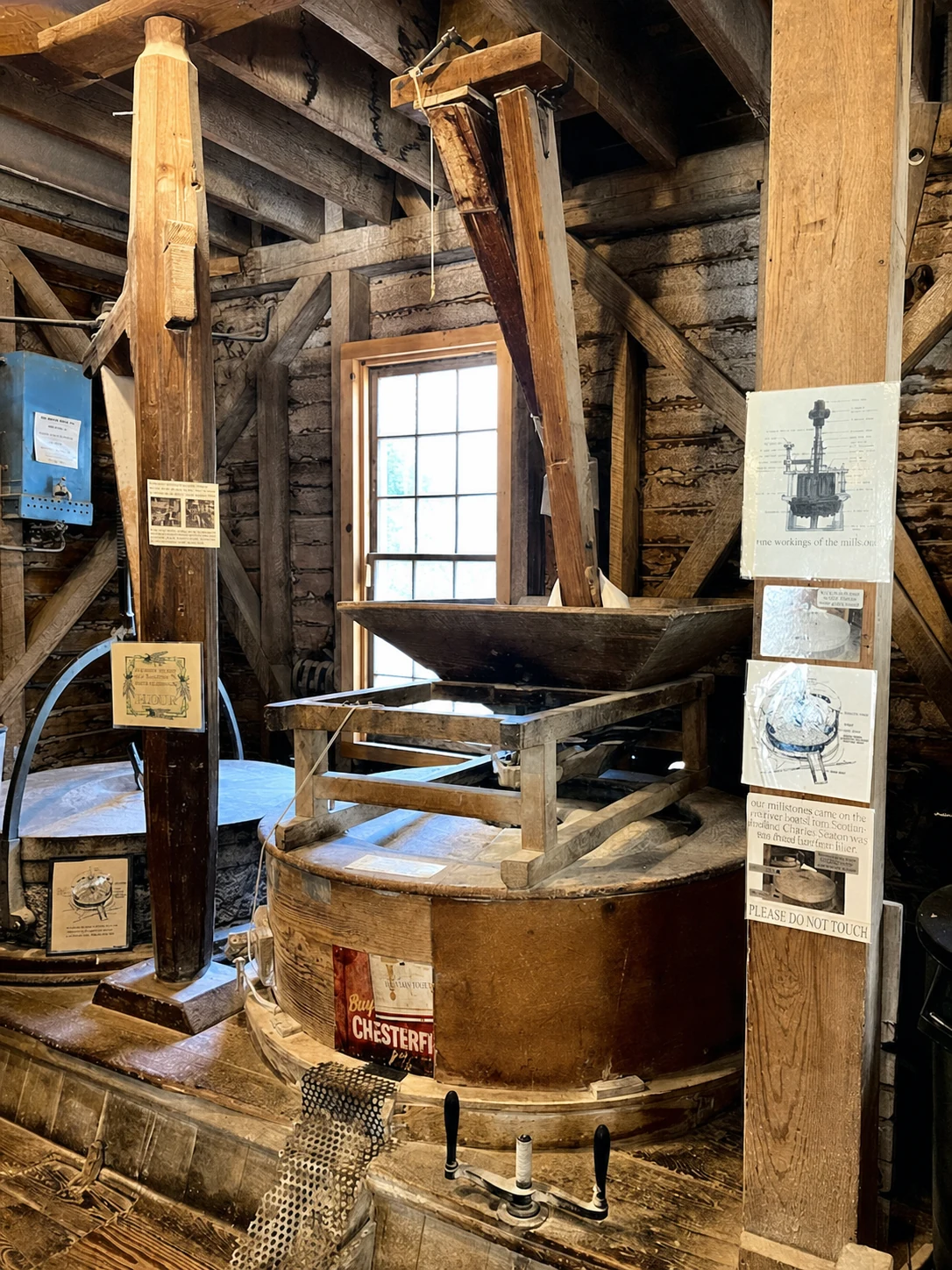
Gold miner John Martin built Nora Mill Granary in 1876, and it's still one of the oldest working gristmills in Georgia, nearly 150 years on. What makes it stand out is the machinery. Instead of the usual vertical water wheel, Martin fitted the mill with a cast-iron water turbine and 1,500-pound French Burr millstones, both of which still grind grain today.
Dr. Lamartine G. Hardman, a physician and later Governor of Georgia from 1927 to 1931, bought the mill in 1902. He named it after his late sister, Nora, and folded it into his large farm holdings in the Sautee-Nacoochee Valley.
What to Know Before You Go
After years sitting empty, the mill was brought back to life in the early 1980s by retired Army Lt. Col. Ron Fain. His family is now in its fourth generation running the place, and it still operates as a commercial mill.
The draw for most visitors is the food. Nora Mill still grinds whole grains without removing the germ, which is how you get products like "Georgia Ice Cream" (white grits) and "Pioneer's Porridge" that keep the flavor and nutrition of the whole corn.
A Mill on the Chattahoochee
In the foothills of the North Georgia mountains, where the Chattahoochee River begins its long run toward the Gulf of Mexico, Nora Mill Granary has been grinding grain since 1876. The four-story wooden building isn't a museum piece. It's a working commercial mill, and it connects the post-Civil War Reconstruction years to today's farm-to-table cooking. Just outside the alpine-themed town of Helen in White County, it still processes corn and wheat using the same basic machinery installed nearly 150 years ago.
What makes Nora Mill interesting is more than its age. It's a good window into how the Sautee-Nacoochee Valley shifted from a gold-prospecting frenzy to a settled farming community. Its water turbine, used in place of a vertical water wheel, marks a specific step in the history of water power. Its owners tie it to the top of Georgia politics through Dr. Lamartine G. Hardman, and its survival into the 21st century owes almost everything to the Fain family.
What follows covers how Nora Mill got started during the Georgia Gold Rush era, how its French Burr stones and wooden raceway actually work, what makes its stone-ground products different from store-bought versions, and why it remains worth a visit for anyone passing through the Helen area.
From Gold Rush to Farm Country
To understand how Nora Mill got started, it helps to picture White County in the mid-1800s. The Sautee-Nacoochee Valley, historically significant as a center of Cherokee culture before the Indian Removal Act of 1830, became the epicenter of America's first major gold rush in the late 1820s and 1830s. By the time the Civil War concluded, the easy alluvial gold had largely been extracted, and the region began a slow, painful pivot toward agriculture and more permanent settlement patterns. The Georgia Historical Society has documented this transition as one of the most significant economic shifts in north Georgia's development.
From Prospecting to Processing
John Martin, the founder of the mill, arrived in Georgia initially as part of this wave of prospectors seeking fortune in the mineral-rich soils of North Georgia. Unlike many transient miners who departed for California in 1849 or Colorado in 1859, Martin chose to settle permanently in the Sautee-Nacoochee Valley. His transition from extractor to processor mirrors the broader economic shift of the region. As the gold industry waned, the population that remained required reliable infrastructure to process staple crops, particularly corn, which was the dietary backbone of the rural South.
In 1876, Martin constructed the mill on the banks of the Chattahoochee River. The choice of location was strategic; the river provided ample kinetic energy, and the site was accessible to the farmers of the valley who needed their harvest ground into meal and grits. The construction of such a substantial four-story facility indicated a long-term investment in the community's agricultural future, moving away from the "boom and bust" cycle of mining toward the steady, seasonal rhythm of the harvest.
How the Mill Was Built
Nora Mill is a fine example of plain, functional industrial building from the Reconstruction South. Built from local timber and stone, it rises four stories, a height driven by the fact that grain processing works by gravity, moving grain down through the floors as it's ground.
The Water Turbine
What really sets Nora Mill apart is its power source. Most surviving mills of the era have the iconic vertical water wheel, overshot or undershot, but John Martin went with a water turbine instead.
A turbine is more efficient than a vertical wheel, capturing a higher share of the water's energy. Sources put it at "80 percent more efficient than a paddle wheel," which was a serious investment for Martin and a sign he wanted "the very best in late 1800's technology."
To feed the turbine, Martin built a 100-foot wooden raceway, or sluice box. It diverts water from the Chattahoochee to build the head pressure that drives the turbine blades under the mill, and it let the miller control the flow precisely for steady grinding speeds even when the river's daily flow shifted a little.
The French Burr Millstones
The grinding stones are the heart of the operation. Martin installed 1,500-pound French Burr (or Buhr) stones, quarried in the Marne Valley of northern France from a freshwater quartz called burrstone. It's prized for its hardness and porosity. Softer stones wear down fast and leave grit in the meal, but French Burr stones hold a sharp cutting edge and turn out fine, high-quality flour and meal.
The quartz in France rarely comes in blocks big enough for a single millstone, so French Burr stones are usually built from segments cemented together and bound with iron bands.
Nora Mill still runs on the original stones from 1876, which says a lot about both the material and the millers who have kept them "dressed" over the decades. Dressing means periodically recutting the grooves, or furrows, so the stones shear the grain cleanly instead of crushing it. The mill is listed on the National Register of Historic Places.
The Hardman Era (1902 to 1998)
The trajectory of the mill changed significantly in 1902 when it was purchased by Dr. Lamartine Griffin Hardman.
Dr. Lamartine G. Hardman
Dr. Hardman was a major figure in Georgia. A physician from Commerce, Georgia, he was also a serious farmer and politician. He served in the Georgia House of Representatives and then as Governor from 1927 to 1931, a term focused on running the state efficiently, though he clashed with the legislature more than once.
Hardman was one of the largest landowners in the state, with holdings across seven counties in Georgia and Florida. Buying the mill was part of a bigger push into the Nacoochee Valley that also included the "West End" estate, now the Hardman Farm Historic Site, which he bought from the Hunnicutt family in 1903.
How the Mill Got Its Name
Upon purchasing the mill from John Martin's estate or successors, Hardman renamed the facility "Nora Mill" in memory of his younger sister, Nora, who had passed away. This renaming cemented the mill's identity, which it retains to this day.
Related Imagery from Around Helen