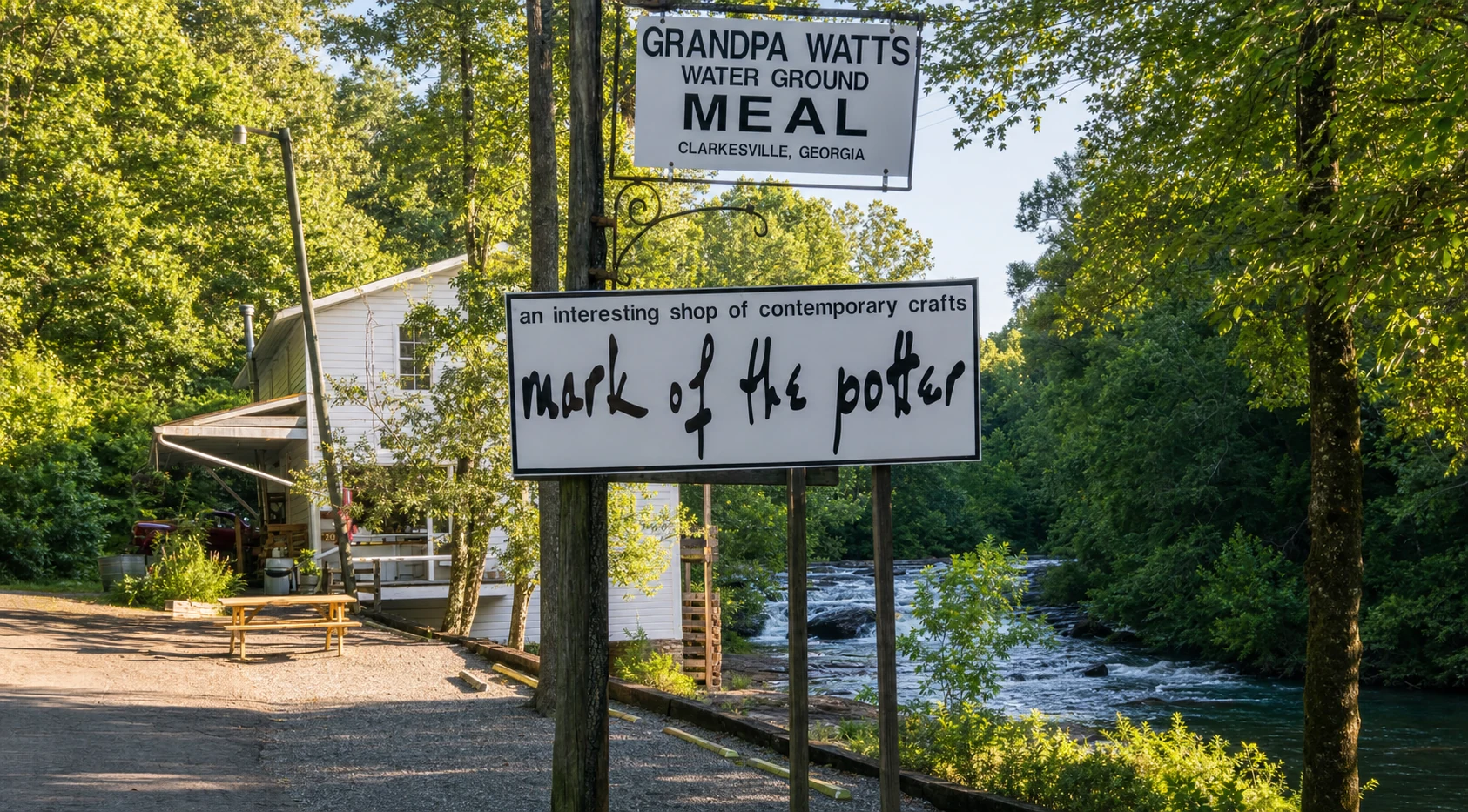

Mark of the Potter on the Soque River
Georgia's oldest craft shop, set in a 1930s gristmill where resident potters throw clay above a river full of giant trout.
Housed in the 1930s Grandpa Watt's Mill, Mark of the Potter is the oldest craft shop in Georgia, open continuously since 1969.
It's also a good example of a mountain gristmill given a second life. What once ground corn for local farmers now turns out pottery, with the old building and its river setting still intact.
A Working Mill Turned Craft Shop
Mark of the Potter sits in Clarkesville, Habersham County, Georgia, and it's one of the best examples in the South of an old building put to new use. It's housed inside Grandpa Watt's Mill, built during the Great Depression, and the place went from grinding corn to selling pottery and hasn't stopped since. John and Glen LaRowe opened it in 1969, making it Georgia's oldest pottery store, and it still pairs working ceramic production with a real piece of local history.
You get to watch potters throw clay on the wheel while the Soque River runs right past the building. Unlike a typical retail gallery, Mark of the Potter is a living craft shop, where resident potters make the wares on site. What follows covers the history of the building, its setting on the Soque, how the potter residency works, and why the place matters to the craft tradition of Northeast Georgia.
From Gristmill to Gallery
The history of this site goes back nearly a century and a half before the pottery arrived, tying it to the farming economy of Habersham County. People have used the Soque River's water power at this exact spot since the early 1800s.
The Era of Milling (1821–1960s)
The first recorded industrial use of the site occurred in 1821, when Joseph Hill constructed a mill for the production of cornmeal. This early structure, known as Hill's Mill, operated for a century, serving the local agrarian community until it ceased production in the 1920s. The site's continuity was ensured in 1928 when Robert Watts and his father, Allen "Grandpa" Watts, purchased the property. Leveraging Grandpa Watts' expertise in construction and milling, the family embarked on revitalizing the site during the lean years of the Great Depression.
The current structure, which houses the pottery today, was completed in 1930–1931. Known as Grandpa Watt’s Mill, it utilized the foundation of the original Hill’s Mill to support the generator house. During its operational peak, the mill was a vital economic hub, grinding corn for local farmers and selling meal to the public. It also served as a waystation for travelers journeying from Atlanta to the mountain lakes, establishing a tradition of tourism that persists today. Local oral histories and records suggest the mill played a role in the shadow economy of the Prohibition era, with the mill reportedly sprouting corn for the production of mash used in moonshine, a common commodity in the North Georgia mountains during that period. The Georgia Historical Society has documented the role of rural mills like this one in the regional economy.
The Flood and the Transition (1966–1969)
The mill's industrial life ended abruptly in the mid-1960s. A catastrophic flood caused the Soque River to crest its banks, ruining the milling machinery and forcing the closure of Grandpa Watt’s Mill. The building sat abandoned until 1968, when John and Glen LaRowe, who had long admired the site, purchased the property from Letie Watts. The LaRowes undertook a "gigantic renovation," repurposing the industrial space for artistic production while retaining its historic character.
In the Spring of 1969, the site reopened as Mark of the Potter. The transition marked a shift from the grinding of grain to the turning of clay, yet the essential relationship with the river and the community remained intact. The LaRowes converted the upstairs portion of the mill into their residence, living above the shop and establishing a model of the "working studio" that defines the location to this day.
The Building and the River
At Mark of the Potter, the setting is part of the point, not just a backdrop. The building is a well-kept example of the plain industrial architecture that once dotted these mountains.
The 1930s Gristmill Structure
The building retains the aesthetic and structural elements of a 1930s corn-grinding mill. Key architectural features include the original footprint and the integration of the structure with the riverbank. Although the water wheel that once powered the grinding stones halted decades ago, the sensory experience of the building is dominated by the sound of the river and the visual presence of the shoals.
Renovations over the decades have focused on accessibility and display rather than modernization. The interior features rustic displays where pottery is often showcased on repurposed industrial artifacts, such as large wagon wheels used as plant stands. The "back porch" is a critical architectural addition, extending out over the river and serving as the primary observation deck for visitors to interact with the river's wildlife.
The Soque River Ecosystem
The Soque River (pronounced "sew-quee") runs entirely within Habersham County, through the foothills of the Blue Ridge region, and is renowned as one of the premier trout fisheries in the Southeastern United States. The specific stretch of river flowing past Mark of the Potter acts as a de facto sanctuary.
In a tradition spanning over 50 years, fishing is strictly prohibited on the Mark of the Potter property. This policy has resulted in a localized population of "giant" rainbow and brown trout that congregate at the base of the shoals. These fish, conditioned by decades of feeding by tourists, have grown to unusual sizes, with some observers noting fish exceeding 20 inches in length. Visitors can purchase fish food to throw from the porch, creating a spectacle that has become as iconic as the pottery itself. This interaction transforms the site into a micro-ecotourism destination, distinguishing it from other craft galleries that lack such direct engagement with the natural world.
How the Resident Potters Work
Mark of the Potter isn't quite a cooperative. It's a private shop that runs on a resident potter and consignment model. That mix keeps a steady stream of new work coming in while also supporting a wider circle of regional artists.
In-House Production and Residency
The core identity of Mark of the Potter is defined by its "team of in-house potters". Historically, the shop employs approximately four to six resident potters at any given time. These artisans work on-site, often visible to the public in the "back right-hand corner" of the shop, where they turn clay on the wheel.
This residency serves as a professional incubator for ceramicists. For example, Ester Lipscomb, a noted potter in the region, served as a resident potter at Mark of the Potter for six years after being recruited by the retiring head potter, Matt Henderson. Other alumni of the program include Molly Altman, who worked as a production potter there before moving on to residencies in New Mexico and Colorado. The residency allows potters to refine their skills in a high-volume production environment while interacting directly with the customer base.
Identification and Attribution
Because the gallery sells works produced by multiple in-house artisans under the collective banner of the shop, a system of attribution is necessary. Works are often identified by individual signatures or a system of colored dots on the bottom of the pottery, allowing repeat customers to identify and collect work from specific potters. This system balances the collective brand of "Mark of the Potter" with the individual artistic identity of the resident craftspeople.
Related Imagery from Around Helen