The Transformation of Helen
How a dying lumber town reinvented itself as a Bavarian alpine village
The story of Helen, Georgia's transformation from a dying lumber town to one of the most visited tourist destinations in the Southeast is one of the most remarkable tales of community reinvention in American history. In the late 1960s, Helen was fading. The lumber industry that had sustained the town for decades was gone, businesses were closing, and the once-bustling mountain community was in danger of disappearing entirely. What happened next was not a government rescue program or a corporate development scheme but a grassroots act of imagination that would change the town's identity, economy, and future forever.
The transformation began in 1968 with a conversation and a sketch. A group of local business owners, desperate for a way to save their dying town, gathered to brainstorm ideas for attracting visitors. Among them was John Kollock, an artist and businessman with a vision that was as audacious as it was specific: what if Helen, with its mountain setting and proximity to natural attractions, remade itself as an Alpine Bavarian village? The surrounding Blue Ridge Mountains, Kollock argued, bore a resemblance to the foothills of the Alps, and a Bavarian theme would give Helen a distinctive identity that no other town in the Southeast could claim.
John Kollock's Vision
The artist who reimagined a town
John Kollock was not a city planner or an architect. He was an artist from Clarkesville, a small town east of Helen, and a retired businessman with a unique perspective. During the 1950s, Kollock had been stationed in Bavaria as part of the American military presence in post-war Germany. The alpine villages he encountered there -- with their half-timbered facades, steep-pitched roofs, painted murals, and cascading flower boxes -- made a lasting impression. When he looked at the mountains surrounding Helen, he saw a landscape remarkably similar to the Bavarian foothills he remembered: steep-sided valleys, a river winding through the center, dense forests climbing the ridges. The setting was already alpine. The buildings just needed to catch up.
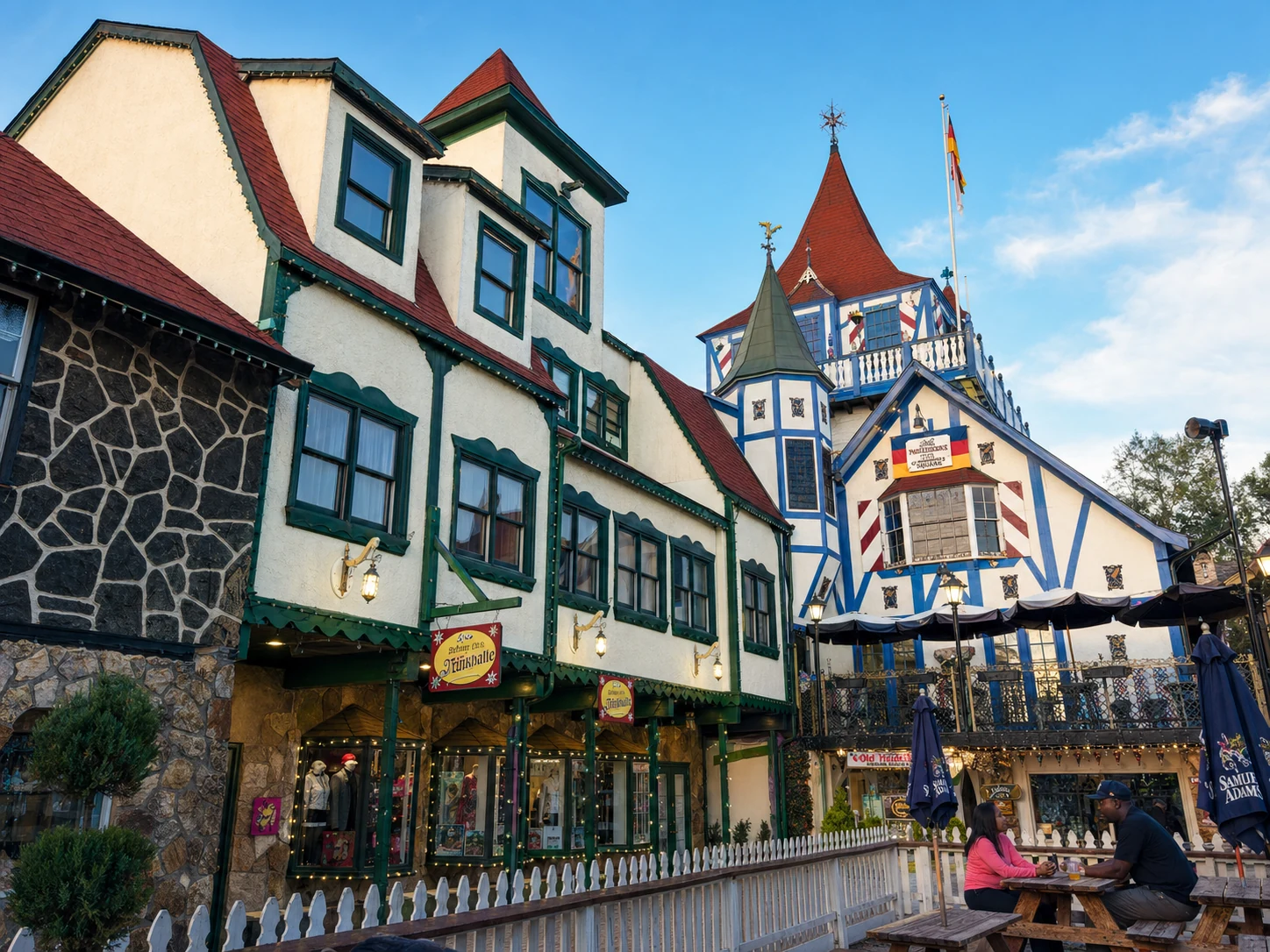
After the initial meeting, Kollock went home and produced a series of watercolor sketches showing what Helen's existing commercial buildings would look like if they were given Bavarian facades. The sketches were revelatory: the plain, tired concrete-block commercial structures of downtown Helen were transformed on paper into charming Alpine storefronts with half-timbered walls, steep pitched roofs, wooden balconies, and flower boxes. Each watercolor depicted a specific, recognizable building in Helen, making the vision concrete and achievable rather than abstract and fanciful.
What made Kollock's proposal so compelling was its practicality. He was not proposing to tear down the existing buildings and start from scratch. Instead, he showed how the Bavarian look could be achieved by adding decorative facades, trim, and paint to the existing concrete-block structures. This approach made the transformation affordable for individual business owners, who could invest a few thousand dollars to reshape their storefronts rather than the hundreds of thousands it would cost to build new. It was a cosmetic revolution, not a structural one, but the visual impact would be transformative.
The Grassroots Movement
Business owners build a new identity
The initial reaction to Kollock's sketches was enthusiastic but the execution was entirely voluntary. There were no government mandates, no municipal bonds, and no corporate sponsors. Each business owner who participated did so at their own expense and on their own timeline. The first few buildings to adopt the Alpine look were acts of faith, individual bets that a coordinated theme could save a dying town. When those early conversions began to attract attention and visitors, more business owners followed suit, and a momentum built that eventually swept through the entire downtown.
The construction was done largely by local craftsmen who learned the Bavarian decorative techniques from Kollock's drawings and from photographs of actual Alpine villages. Over the course of 1969 and the early 1970s, building after building received its transformation: decorative half-timbering was applied over plain siding, wooden balconies were added, rooflines were accented with carved trim, and the entire downtown was repainted in the warm earth tones and bright accent colors characteristic of Bavarian architecture. The Chattahoochee River flowing through town added to the Alpine illusion, resembling a mountain stream in any number of European villages.
The results were immediate and dramatic. Visitors began arriving in numbers that Helen had never seen, drawn by the novelty of an Alpine village in the Georgia mountains and by the genuine charm of the cohesive streetscape. Businesses that had been on the verge of closure found themselves thriving. New restaurants, shops, and attractions opened to serve the growing tourist trade. Helen had not merely survived its crisis; it had reinvented itself into something entirely new and commercially viable.
Zoning and Preservation
Protecting the Alpine character by law
As Helen's success grew, the community recognized the need to protect the visual coherence that made the town special. What had begun as a voluntary design movement was formalized through zoning ordinances that require all new construction and major renovations in the downtown area to conform to Alpine architectural guidelines. These regulations specify building materials, color palettes, roof styles, and decorative elements, ensuring that every new structure contributes to rather than detracts from the Bavarian atmosphere.
The zoning laws have been both celebrated and debated over the decades. Supporters argue that they are essential to preserving the unique identity that drives Helen's economy, preventing the kind of architectural chaos that plagues many tourist towns. Critics note that the mandatory theme can feel constraining and that the Bavarian identity, while charming, has no organic connection to the region's actual history. Both perspectives have merit, and the tension between them has produced an ongoing conversation about authenticity, commerce, and community identity that is itself a fascinating aspect of Helen's story.
Legacy and Impact
A model for community reinvention
More than fifty years after the transformation, Helen's Bavarian experiment has proven to be one of the most successful community reinvention stories in American tourism. The town attracts millions of visitors annually, supports hundreds of businesses, and generates tourism revenue that sustains not just Helen but the surrounding White County economy. The Oktoberfest celebration, which began just one year after the transformation in 1970, has become the longest-running Oktoberfest in the United States. The Georgia Historical Society has documented Helen's transformation as one of the most successful community reinvention stories in the state.
Helen's story has inspired other communities facing economic decline to consider thematic reinvention as a path forward. The success demonstrates what a small group of determined citizens can accomplish when they combine creativity with practical action, and it stands as a reminder that a town's identity is not fixed but can be consciously shaped by the people who live there. To understand the broader historical context of the region, explore the story of Travelers Rest, a historic stagecoach inn that served settlers before Helen was even founded. Whether one views Helen's transformation as a triumph of imagination or a curious cultural anomaly, there is no denying its impact on the community, the region, and the millions of visitors who have found joy in its Alpine streets.
Continue Exploring
More history and stories from the region
Related Imagery from Around Helen