The Lumber Town That Ran Out of Lumber
Helen's story begins with trees. In the early 1900s, the Byrd-Matthews Lumber Company built a massive operation in the Nacoochee Valley, harvesting the virgin hardwood forests that covered the surrounding mountains. A lumber mill on the Chattahoochee River processed the timber, and a narrow-gauge railroad carried it out to market. At its peak, Helen was a bustling company town of several hundred people, with a hotel, stores, and the infrastructure of a place that expected to last forever.
But lumber towns live and die by the forest, and by the 1930s, the mountains around Helen had been logged nearly bare. The mill closed, the railroad was dismantled, and the population began its long slide. By the 1960s, Helen was a ghost of its former self: a handful of concrete-block buildings lining a two-lane highway, a gas station, and not much reason for anyone to stop. Through traffic on GA-75 passed through without slowing down.
The 1968 Meeting
The meeting that changed Helen's fate took place over lunch in 1968. Pete Hodkinson, a businessman who owned a motel and several other properties in town, gathered a group of fellow business owners to discuss what could be done. The gathering was informal -- just a handful of desperate entrepreneurs sitting around a restaurant table, staring into the face of economic oblivion. The town's location was beautiful, nestled in a valley surrounded by mountains with the Chattahoochee River running through it, but beauty alone was not enough to attract visitors. They needed a hook, a reason for people to stop, get out of their cars, and spend money.
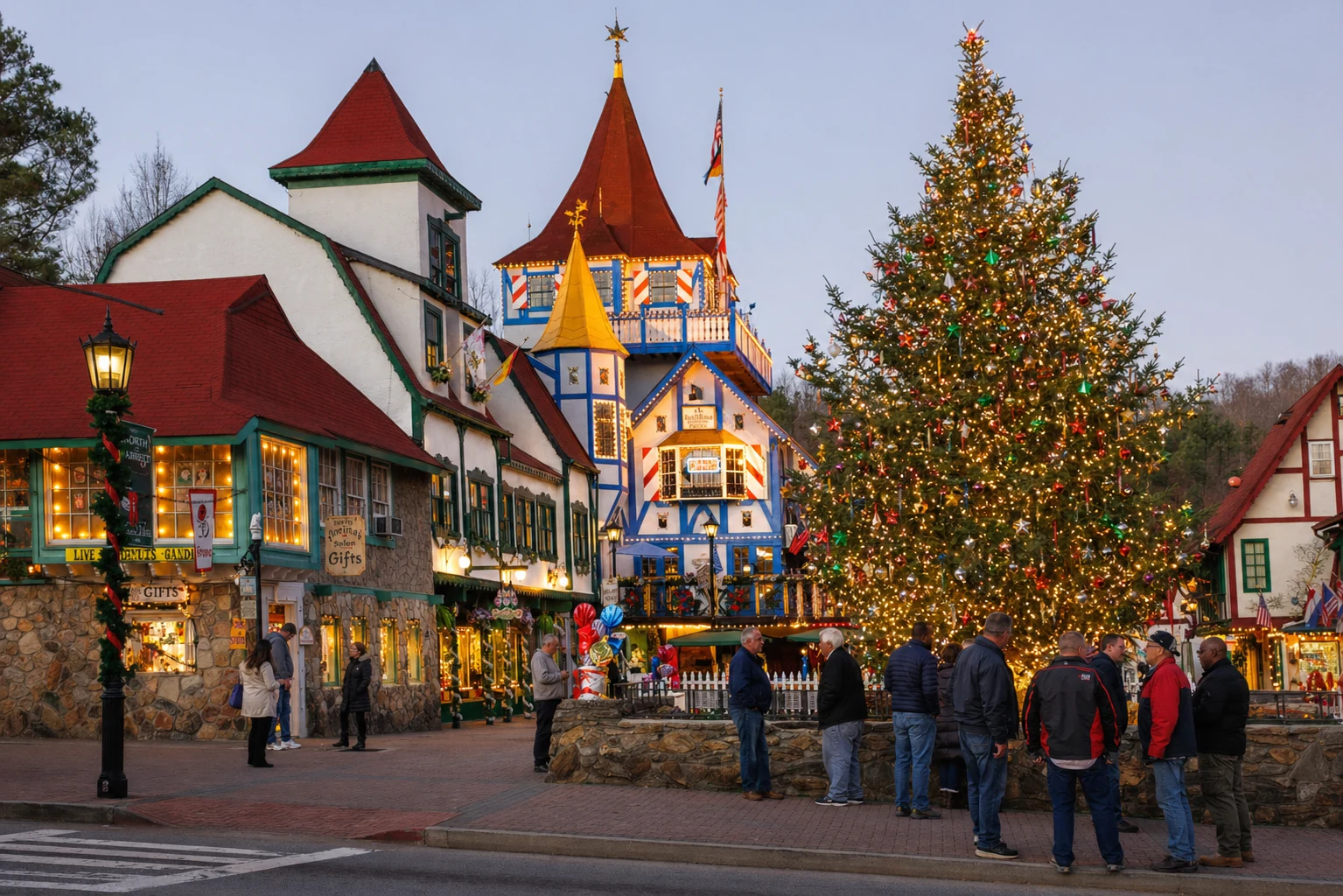
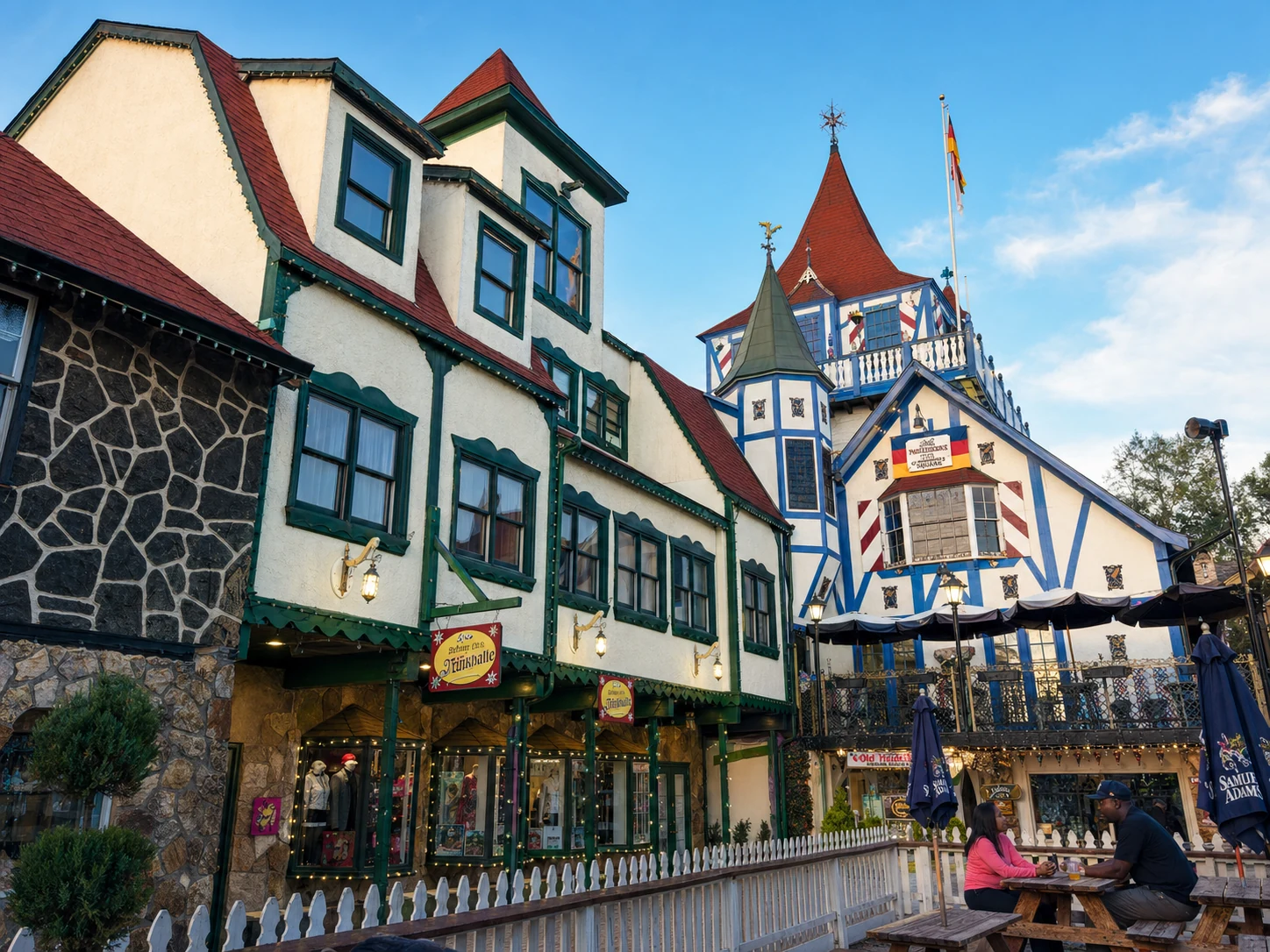
The idea came from an unexpected source: John Kollock, an artist and retired businessman from Clarkesville, a nearby town. Kollock had been stationed in Bavaria during the 1950s, and the memory of those alpine villages had never left him. He looked at the Nacoochee Valley, with its steep mountains rising on either side and the river running through the center, and saw something no one else had seen: a resemblance to the alpine villages of his military days. His proposal was bold to the point of absurdity: repaint every building in town to look like a Bavarian village. Add half-timbering, balconies, shutters, and flower boxes. Turn Helen into a piece of Germany in the Georgia mountains.
"The mountains make the valley. The river makes the setting. All we need to do is make the buildings match the landscape, and people will come." -- John Kollock, 1968
Kollock's Watercolor Vision
Kollock did not just talk. He went home and did what artists do -- he made his vision visible. He painted watercolor sketches of every building in Helen as he imagined it could look: the gas station with a peaked roof and window boxes, the motel with timber-framed balconies, the shops with painted facades depicting alpine scenes. Each sketch showed the transformation of a specific, recognizable concrete-block building into a charming Bavarian storefront. The plain facades of downtown Helen, those drab cinder-block rectangles that lined GA-75, were reimagined on paper with half-timbered walls, alpine balconies, painted murals, and window boxes overflowing with flowers. He showed the watercolors to the business owners at a follow-up meeting, and something remarkable happened. They said yes.
Not everyone said yes enthusiastically. Some thought the idea was ridiculous. But the alternative was watching the town die, and that was a certainty. The Bavarian plan was a gamble, but at least it was a gamble with a chance. One by one, the business owners agreed to repaint their buildings according to Kollock's sketches. The first renovations began in 1969, and by the early 1970s, enough of the town had been transformed that the effect was startling.
The Wendy's with Gingerbread Trim
The transformation worked far better than anyone had anticipated. Tourists came in droves, drawn by the novelty of a German village in the Georgia mountains and by the genuine beauty of the setting. Helen quickly became one of Georgia's top tourism destinations, and the city council, determined to protect the investment, passed zoning ordinances requiring all commercial buildings to maintain the Bavarian theme.
These zoning laws apply to everyone, including national chains, and this is where Helen's story gets genuinely remarkable. The Wendy's in Helen has a peaked roof and timber framing -- you have never seen a Wendy's like this one. The Huddle House restaurant features gingerbread trim and alpine shutters. The gas stations have flower boxes and hand-painted signs. Every fast-food franchise, every convenience store, every commercial building in the district must comply with the Bavarian architectural guidelines. No building in the commercial district is allowed to deviate from the aesthetic, creating a consistency that is rare in American tourism destinations, where a single McDonald's golden arch can shatter the illusion of an entire themed district. In Helen, the golden arches had to learn to speak Bavarian.
The Legacy
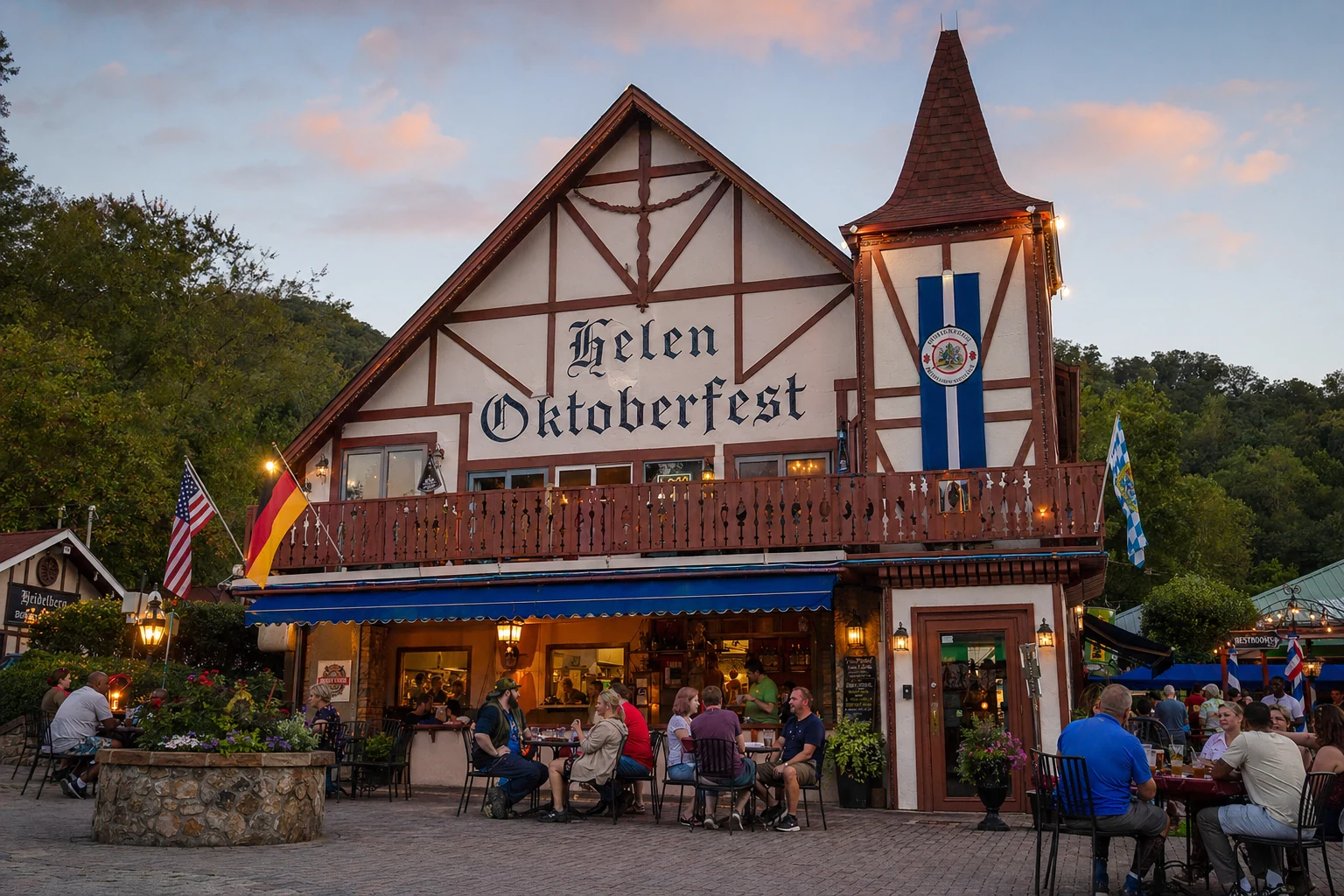
Today, Helen draws over two million visitors a year to a town with a permanent population of about 500, according to the Helen Chamber of Commerce. Its Oktoberfest, launched in 1970, is the longest-running Oktoberfest celebration in the South. Its Christmas market brings thousands during the holiday season. And the Bavarian facades that John Kollock painted in watercolor more than fifty years ago are still maintained, still photographed, and still bringing people to a town that, by all rights, should have disappeared decades ago.
Helen's transformation is not without its critics. Some argue that the Bavarian theme is superficial, a Disneyland-style facade laid over a town with no actual German heritage. Others point out that the focus on tourism has made Helen unaffordable for ordinary residents and created a monoculture economy vulnerable to downturns. These are valid criticisms. But they should be weighed against the alternative, which was a dead town, abandoned buildings, and a community that no longer existed.
The story of Helen is, at its heart, a story about imagination and desperation producing something remarkable. A dying town looked at itself, decided it could be something else entirely, and painted itself into a new identity. It is not Bavaria. It never was. But it is alive, it is thriving, and it is one of the most visited destinations in the American South. John Kollock's watercolors saved a town.
Local writers sharing the hidden stories and trails of North Georgia's mountain country.
Continue Exploring
More stories from North Georgia
Related Stories
More about Helen's culture and community