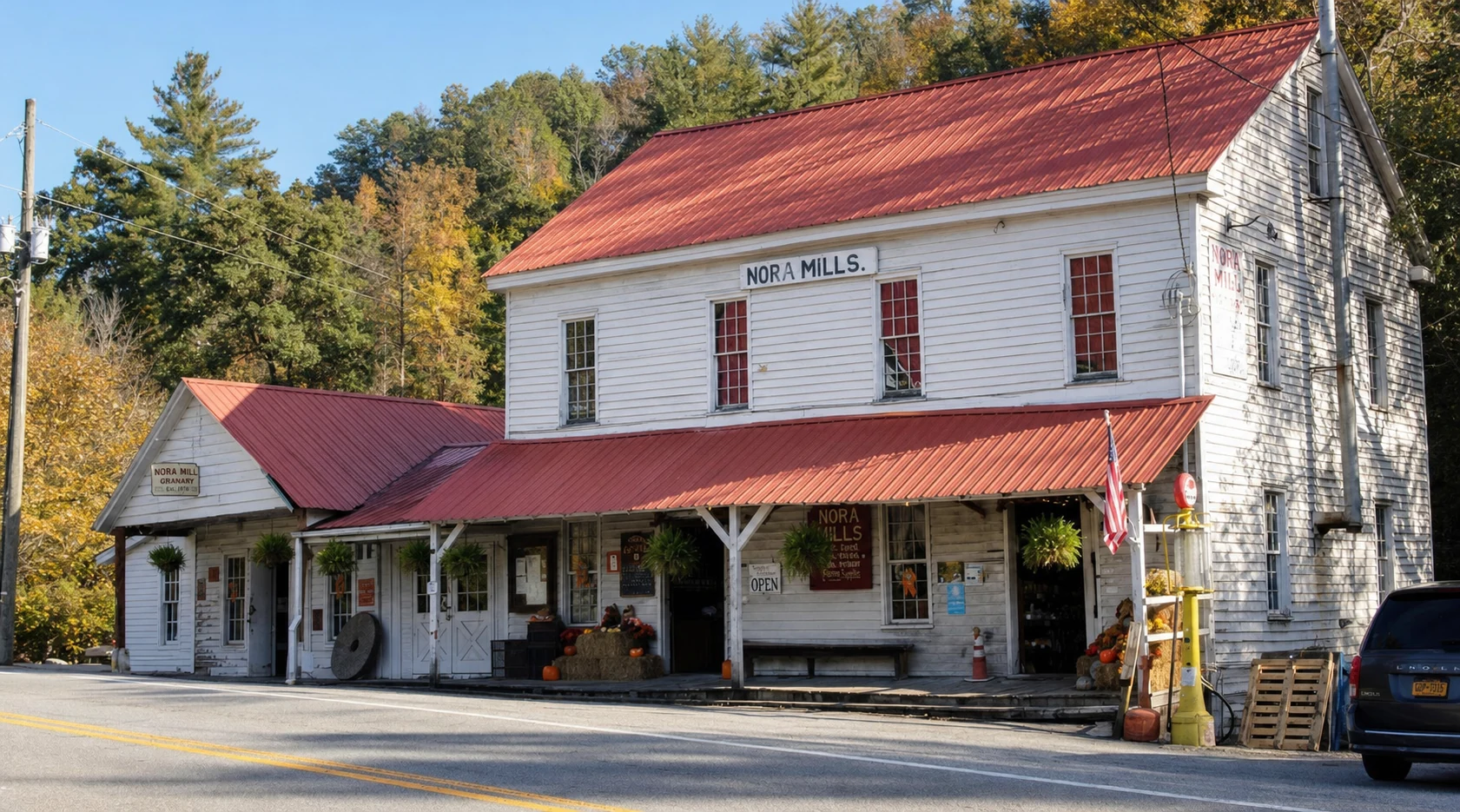
Nora Mill Granary, a Working 1876 Gristmill
Just south of Helen, this mill still grinds corn on its original French Burr stones using water power from the Chattahoochee.
What to Know Before You Go
Built in 1876, Nora Mill Granary is one of the oldest continuously operating gristmills in Georgia, and it still grinds on its original 1,500-pound French Burr stones. Unlike a lot of historic mills that are museums now, Nora Mill is a real production facility, grinding corn daily with water power from the Chattahoochee River through a wooden raceway and turbine.
It sits just south of the alpine village of Helen at about 1,447 feet, a landmark along the Helen to Hardman Farm Heritage Trail. The mill is known for stone-ground products, especially "Georgia Ice Cream" (grits) and "Pioneer's Porridge," which keep the nutritional germ of the grain that modern processing strips out.
A Working Piece of the Past
Nora Mill Granary is a working piece of North Georgia's industrial past. In the Sautee-Nacoochee Valley, right next to Helen, it's both a commercial mill and a living history museum. It's known for sticking to 19th-century methods, using water-powered French Burr stones to produce stone-ground cornmeal, grits, and flour.
What makes it matter is more than its age. It's an unbroken line of grain processing that outlasted the industrialization of food. By keeping the original 1876 machinery running, Nora Mill gives you a real, hands-on link to the region's farming past while still making a living at it today.
Founded by John Martin (1876 to 1902)
The mill was constructed in 1876 by John Martin, a prospector who originally arrived in Georgia during the gold rush era. Unlike many transient miners who departed once the gold reserves dwindled, Martin chose to settle permanently in the Sautee-Nacoochee Valley. Recognizing the agricultural potential of the region and the hydraulic power available from the Chattahoochee River, Martin invested in state-of-the-art technology for the time.
Rather than utilizing a traditional vertical water wheel, which was common in rural Georgia, Martin installed a water turbine. This decision reflected a forward-thinking approach to industrial engineering, as turbines provided greater efficiency and consistent power regulation compared to overshot or undershot wheels. The original structure was a massive four-story building, designed to house the heavy machinery required to process grain for the surrounding farming community.
The Hardman Era
In 1902, the mill's ownership transitioned to Dr. Lamartine G. Hardman. Hardman was a prominent physician and agriculturalist who would later serve as the Governor of Georgia from 1927 to 1931. It was Dr. Hardman who bestowed the current name upon the facility, christening it "Nora Mill" in memory of his sister, Nora, who had passed away.
Under the Hardman tenure, the mill remained a vital economic hub for White County. The Hardman family retained ownership of the property until 1998, ensuring its preservation through the majority of the 20th century, even as small-scale milling declined nationwide.
The Fain Family Brings It Back
The 1980s restoration
By the late 20th century, the mill had ceased regular commercial operations and the building sat vacant. In the early 1980s, Retired U.S. Army Lieutenant Colonel Ron Fain, having deep roots in the Northeast Georgia area, approached the Hardman family to lease the property. Fain, working alongside his parents, undertook the massive task of revitalizing the dormant machinery and bringing the mill back to life.
Ron Fain did not merely reopen the building as a static attraction; he apprenticed under knowledgeable millers, including Tom Farmer and Clyde Keltner, to master the "lost art" of water-powered grain milling. He became active in the Society for the Preservation of Old Mills, and the mill is now documented by the Georgia Historical Society, ensuring that the restoration adhered to historical accuracy.
Current Leadership
Following Ron Fain's passing in 2001, the operation passed to his daughter, Joann Fain Tarpley. Today, the mill is managed by the third and fourth generations of the Fain family. Specifically, Joann's son, Joe Vandegriff, and his wife, Addi, oversee daily operations. Joe Vandegriff has assumed the title of "Miller," responsible for dressing the stones, maintaining the turbine, and ensuring the quality of the grind. This generational continuity is rare in industrial heritage sites and is a primary factor in the mill's continued authenticity.
How the Milling Works
The French Burr stones
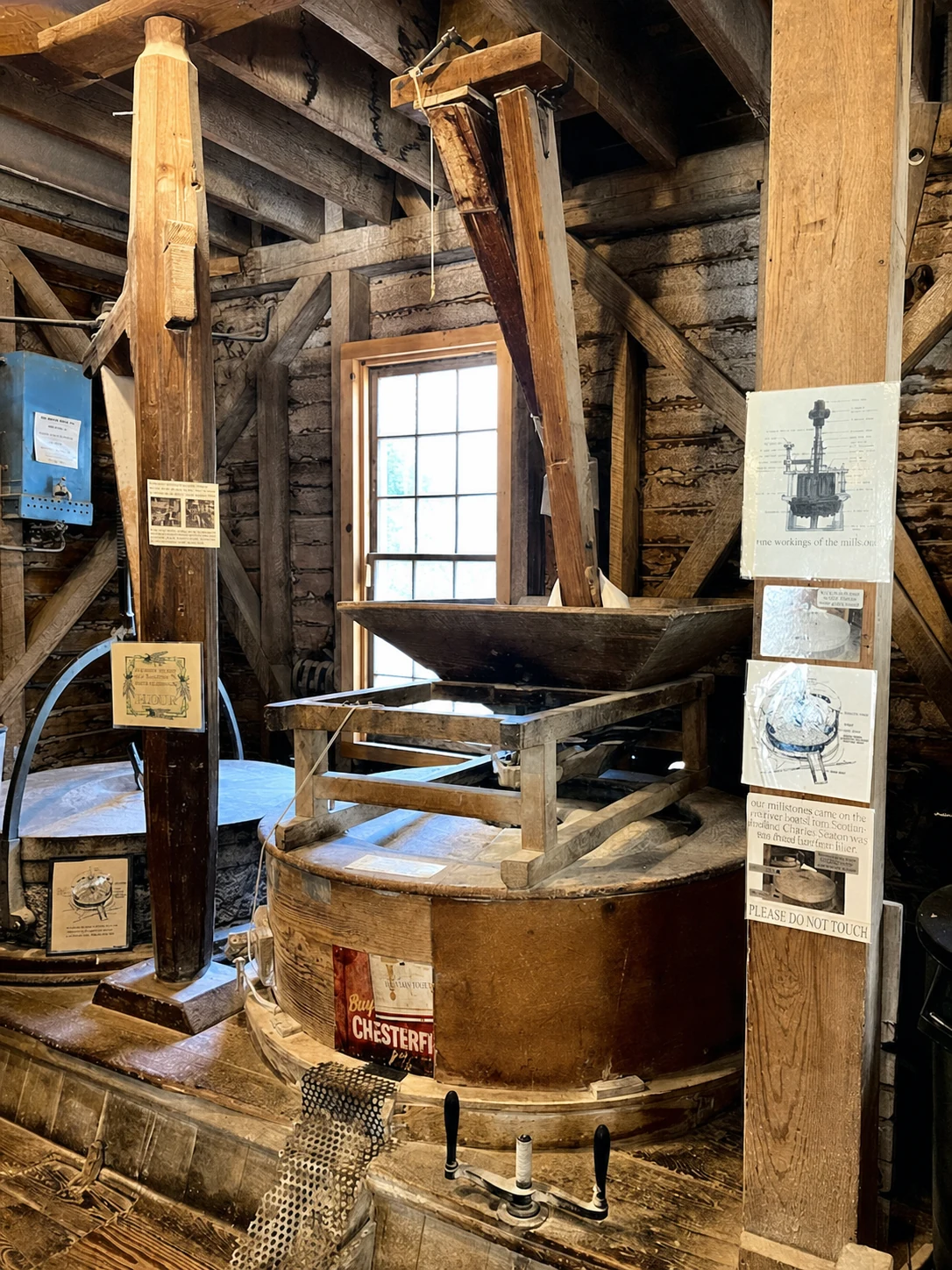
The heart of Nora Mill is its pair of original French Burr millstones, installed by John Martin in 1876 and weighing about 1,500 pounds each. They were quarried in the Marne Valley of northern France, near the Paris Basin, from a freshwater quartz (chert) known for its hardness and porosity. Millers prized it over British gritstone or German Cullin stones because it produced a finer, whiter flour without leaving gritty residue.
These are the same type of stones George Washington used at his Mount Vernon gristmill, and their pink granite composition is still considered the gold standard for stone grinding.
How the Water Powers It
Nora Mill doesn't use a vertical water wheel. It runs on a water turbine, a more efficient way to turn the river's energy into rotating force. Here's how the water moves through it.
A dam on the Chattahoochee River diverts water into a 100-foot wooden raceway. The water runs down the raceway and drops into the turbine beneath the mill, and its pressure spins the turbine blades. That spinning turbine drives a main shaft running up into the mill, which turns the runner stone (the top stone) over the bed stone (the stationary bottom one).
Corn is fed between the stones. Because stone grinding runs cooler than the high-speed steel rollers used in modern processing, it doesn't scorch the grain. That keeps the corn's natural oils and germ, which is where the better flavor and nutrition come from.
Modern Production Capabilities
While the 1876 stones are the centerpiece, the mill also utilizes a 1950s-era electric mill (a "Meal Master") to supplement production when river levels are low or demand is exceptionally high. A busy day at the mill can yield between 1,200 and 1,400 pounds of grits.
Products: The Culinary Output
Nora Mill Granary distinguishes itself by producing "whole grain" products. In modern industrial milling, the germ and hull are often removed to extend shelf life, removing flavor and nutrition. Nora Mill retains these elements.
Related Imagery from Around Helen