What the Mound Actually Is
The Nacoochee Mound is a Native American platform mound, classified by archaeologists as a South Appalachian Mississippian structure dating to the Lamar Period, roughly 1350 to 1600 AD. It stands approximately 20 feet high and 190 feet in diameter, built up over generations by adding successive layers of earth. Platform mounds like this one were the ceremonial and political centers of Mississippian communities, typically supporting a chief's house or a temple on their flattened summit. They are found throughout the Southeast, from Cahokia in Illinois to Etowah in northwest Georgia, and they represent one of the most impressive architectural traditions of pre-Columbian North America. The Nacoochee Mound sits at the very heart of the Nacoochee Valley, positioned at the confluence of the Chattahoochee River and several tributaries, a location that was strategically significant for trade, agriculture, and defense.
The 1915 Smithsonian Excavation
In 1915, the Smithsonian Institution's Bureau of American Ethnology sent a team to excavate the Nacoochee Mound, and what they found beneath that placid green hillside was staggering: 75 human burials, arranged in multiple layers within the mound's earthen fill. The burials spanned several centuries of use, and many were accompanied by elaborate grave goods that spoke of wealth, power, and far-reaching trade connections. The excavators recovered copper celts -- axe-like implements made from copper that had been traded all the way from the Great Lakes region, hundreds of miles to the north. They found intricately carved shell gorgets, conch shell drinking cups transported from the Gulf Coast, finely crafted ceramic vessels in the distinctive Lamar style, and an array of stone tools. Some of the marine shell objects had traveled more than 500 miles to reach this mountain valley, tangible evidence of the extensive trade networks that connected Mississippian communities across the entire Southeast.
The excavation also revealed the construction history of the mound. It had been built up in stages, with new layers of earth added over older burials, gradually raising the mound higher. Post molds in the summit indicated that structures had stood on top, probably the houses of chiefs or the buildings where important ceremonies took place. The mound was not simply a burial site but a living monument, continuously enlarged and rebuilt over centuries.
"Seventy-five burials, copper celts from the Great Lakes, conch shells from the Gulf of Mexico -- the Nacoochee Mound was a crossroads of trade and power, centuries before Europeans set foot in these mountains."
Captain Nichols and the Gazebo
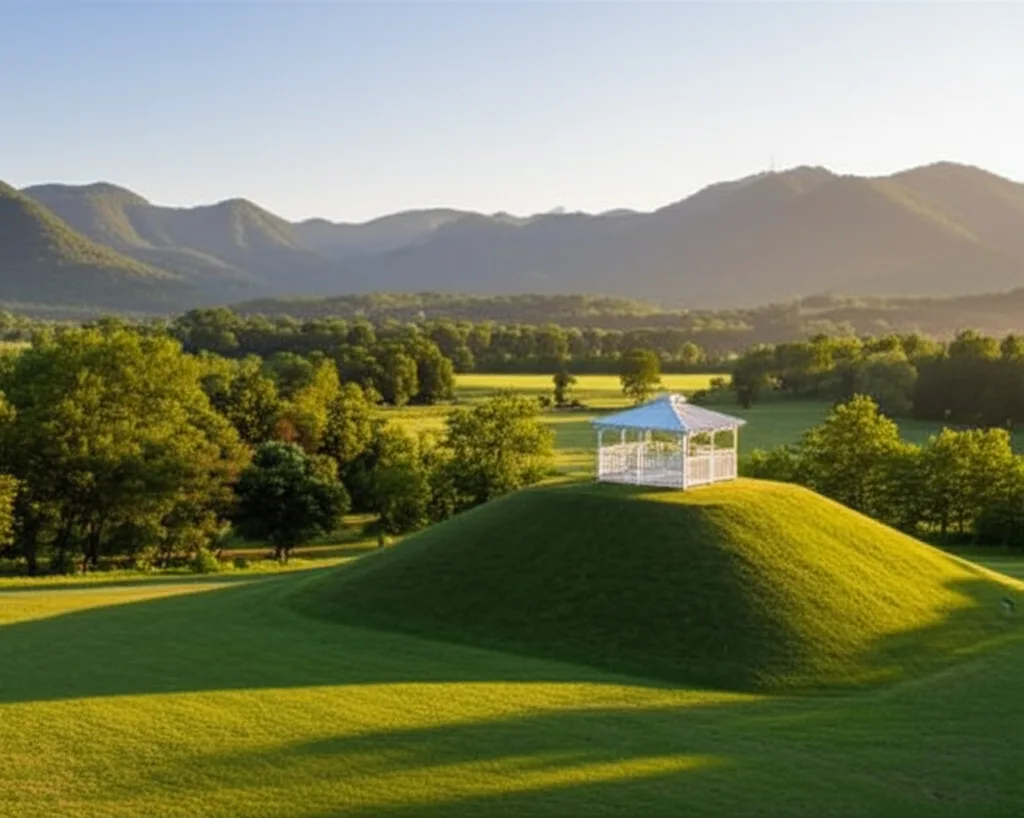
The white gazebo that crowns the mound today has nothing to do with the mound's original purpose, and its story adds another layer of complicated history to the site. It was built around 1890 by Captain John Nichols, who owned the surrounding farmland. Before constructing the gazebo, Nichols shaved off the top two feet of the mound to create a level platform for the structure -- casually removing the uppermost archaeological layer of a centuries-old burial ground to make a pleasant spot for afternoon tea. Nichols apparently thought the mound would make an agreeable place for a summer house, a place where he could sit in the shade and survey his property. The gazebo has been rebuilt several times since then, most recently in 2013, but it has remained a fixture atop the mound for well over a century, becoming so inseparable from the landmark that most people cannot picture the mound without it.
Whether Nichols knew he was building a garden pavilion on a Native American cemetery is debatable. By the 1890s, the mound's archaeological significance was not yet widely understood, and many landowners in the region treated mounds as curiosities or convenient elevated building sites. But from a modern perspective, the image is jarring: a decorative white gazebo perched atop a burial ground containing the remains of 75 people, their bones interred with the copper and shell objects that marked them as important members of their communities. The two feet of earth that Nichols removed from the summit likely contained some of the most recent and best-preserved burials and artifacts, lost forever to a landscaping decision.
The Romeo and Juliet Myth
For decades, the Nacoochee Mound has been the subject of a romantic legend: that the name "Nacoochee" means "evening star" in Cherokee, and that the valley was the site of a Romeo and Juliet-style love story between a Cherokee maiden named Nacoochee and a warrior from a rival tribe named Sautee. In the legend, the two lovers threw themselves from Yonah Mountain rather than be separated. The valley, the story goes, was named in their honor.
It is a lovely story, and it appears in nearly every tourism guide to the area. It is also almost certainly fiction. There is no documented Cherokee oral tradition that includes this legend before it appeared in 19th-century Euro-American writings. The name "Nacoochee" may derive from a Cherokee word, but its meaning is disputed. Historians of the region have traced the love story to the Victorian era, when romanticized "Indian legends" were commonly invented or embellished for popular consumption. The mound itself predates the Cherokee by several centuries.
Visiting Today
The Nacoochee Mound is located on GA-75 at its junction with GA-17, about 3 miles south of Helen. The mound is on private land and is not open for climbing or close-up visits, but it is clearly visible from the road, and a small pull-off allows you to stop and photograph it. The nearby Hardman Farm Historic Site, managed by the Georgia Department of Natural Resources, offers tours of the 1870 plantation house and grounds and provides historical context for the mound and the valley.
Look at the mound, admire the gazebo, and take your photograph. But remember what lies beneath: not a love story from a Victorian novel, but the remains of a people who built monumental earthworks, traded across vast distances, and created a civilization that thrived in this valley centuries before anyone thought to put a white gazebo on top of it.
Visitor Information
- Location: Junction of GA-75 and GA-17, Sautee-Nacoochee, about 3 miles south of Helen.
- Access: Viewable from roadside pull-off. The mound itself is on private land.
- Nearby: Hardman Farm Historic Site for tours and historical context.
Local writers sharing the hidden stories and trails of North Georgia's mountain country.
Continue Exploring
More stories from North Georgia
Related Stories
More history and heritage from the Nacoochee Valley