Raven Cliffs Wilderness
A wild 9,000-acre tract in the Chattahoochee National Forest, home to a rare fissure waterfall, old hemlocks, and some of the best backcountry near Helen.
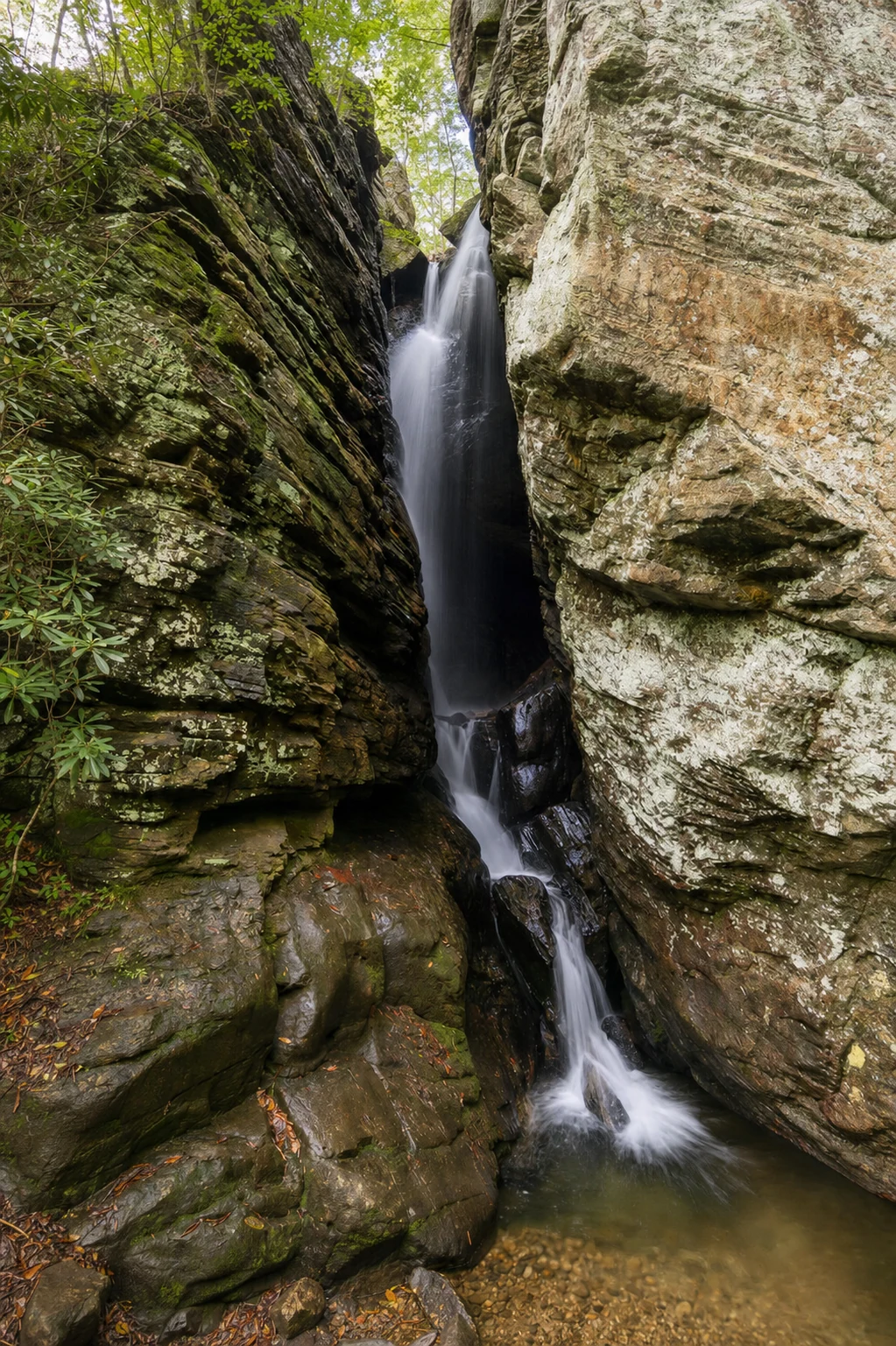
The Raven Cliffs Wilderness is a federally protected area within the Chattahoochee National Forest in northern Georgia, and it's one of the most ecologically important tracts of land in the Southern Appalachians. Congress designated it in 1986. The terrain is rugged, shaped by the Blue Ridge escarpment, and it covers somewhere between 9,115 and 9,240 acres depending on which official figure you go by. Its best-known feature is Raven Cliff Falls, where Dodd Creek runs through a massive fracture in a granite escarpment instead of over it, creating a rare fissure waterfall. The wilderness also shelters a lot of unusual plant life, including Shuttleworth's ginger (Hexastylis shuttleworthii) and old stands of Eastern Hemlock (Tsuga canadensis), some with old-growth character despite the ongoing threat from the hemlock woolly adelgid. The area is managed to keep its wild character, solitude and natural processes left mostly alone, while still handling heavy demand from backcountry campers and hikers. It was established by the Georgia Wilderness Act of 1986, and its acreage has been cited over the years anywhere from an initial 8,562 to the current official 9,240.
How It Became a Protected Wilderness
The 1986 designation and what it means
The Raven Cliffs Wilderness was formally established on October 27, 1986, with the passage of Public Law 99-555, known as the Georgia Wilderness Act of 1986. This legislation was part of a broader movement to secure legal protection for the remaining roadless areas in the Eastern United States, placing them under the National Wilderness Preservation System. The Act mandates that these lands be managed to preserve their natural conditions, prohibiting permanent improvements, commercial enterprises, and motorized transport to ensure the area remains "untrammeled by man".
Why the Acreage Numbers Vary
There is some variance in the acreage figures associated with the Raven Cliffs Wilderness, worth explaining here.
Legislative Acreage: The original text of the Georgia Wilderness Act of 1986 (P.L. 99-555) designated "certain lands in the Chattahoochee National Forest... which comprise approximately 8,562 acres" as the Raven Cliffs Wilderness. In the same Act, the Rich Mountain Wilderness was designated with an acreage of approximately 9,649 acres. It is highly probable that the figure 9,649 acres is a conflation with the neighboring Rich Mountain Wilderness.
Current Official Acreage: Modern administrative data from the U.S. Forest Service and Wilderness.net lists the current official acreage of Raven Cliffs at 9,115 acres to 9,240 acres. These adjustments often result from more accurate GIS mapping technologies and minor boundary adjustments over decades of management.
Location and Topography
Situated within White, Lumpkin, and Union Counties, the wilderness is positioned within the Blue Ridge Ranger District. The topography is rugged, with elevations ranging from approximately 1,800 feet (550 m) along the lower reaches of Boggs Creek to 3,846 feet (1,172 m) at the summit of Levelland Mountain. Other significant peaks within the wilderness include Cowrock Mountain and Wildcat Mountain, both exceeding 3,700 feet. The area is bordered to the north by the Mark Trail Wilderness and lies across U.S. Highway 129 from the Blood Mountain Wilderness, creating a contiguous corridor of protected high-elevation habitat.
The Fissure Waterfall and the Rock Around It
Why Raven Cliff Falls looks like nothing else
The defining geological feature of the wilderness is Raven Cliff Falls. Unlike typical cascading waterfalls that flow over a rock face, this feature is characterized by a hydrological flow through a vertical fracture in a massive gneiss/granite outcrop.
The total vertical drop is about 100 feet (30 m), broken into three sections: an upper drop of 60 feet (18 m), a middle drop of 20 feet (6.1 m) into a deep pool, and a final 20-foot cascade into the creek bed below.
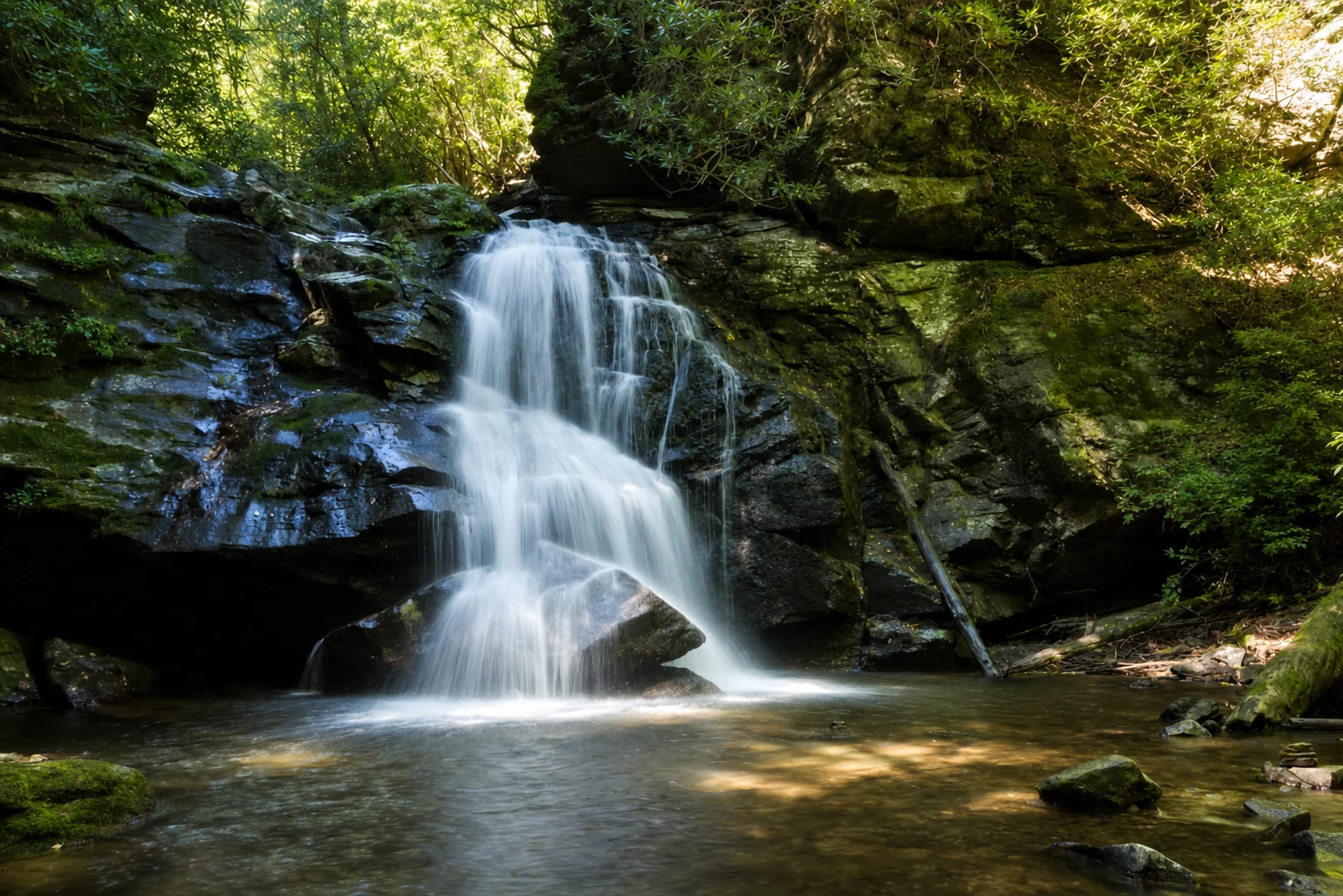
The Fissure: The watercourse, Dodd Creek, splits a massive granite cliff face, flowing within a narrow crevice. This distinct geomorphology protects the falls from direct sunlight in areas, fostering a microclimate conducive to mosses and shade-tolerant vegetation.
Dodd Creek: A tributary of the upper Chattahoochee River basin, Dodd Creek is the primary drainage for the Raven Cliff Falls trail area. It is noted for high water quality and supports trout populations, making it a critical hydrological resource within the wilderness.
Geologic Context
The wilderness lies within the Blue Ridge geologic province. The substrate consists largely of metamorphic rocks such as schists, gneisses, slates, and quartzites, formed during the Grenville and Alleghenian Orogenies over one billion to 250 million years ago. The cliffs themselves are resistant igneous or metamorphic outcrops that have withstood the weathering that eroded the surrounding slopes, resulting in the dramatic relief visible today.
The Forest and What Grows Here
Recovering woods, old hemlocks, and rare wildflowers
The forests of Raven Cliffs Wilderness are a mosaic of successional stages. While much of the region was subjected to heavy logging in the late 19th and early 20th centuries, the rugged terrain protected certain ravines and steep slopes from timber extraction.
Hardwood Recovery: The forest has largely recovered, presenting a dense canopy of mixed hardwoods (oak, hickory) and scattered pines that are now 60 to 100+ years old.
Eastern Hemlock (Tsuga canadensis): The wilderness contains significant stands of Eastern Hemlock, particularly along stream corridors like Dodd Creek. These trees are ecologically vital, often described as "redwoods of the east," capable of living hundreds of years and growing to 150 feet. While some sources describe these as recovering second-growth, others identify riparian corridors where logging was difficult as supporting "old-growth" hemlock characteristics - trees exceeding 300 years of age with specific bark patterns indicating advanced maturity.
Hemlock Woolly Adelgid Threat: The integrity of these hemlock stands is under severe threat from the hemlock woolly adelgid (Adelges tsugae), an invasive insect that causes mortality in hemlocks within 4 to 10 years of infestation. Management within wilderness areas presents a conflict between the mandate to leave nature "untrammeled" and the need to intervene (biological or chemical control) to save this foundational species.
Wildflower Diversity and Rare Species
The moist, shaded coves and high rainfall of the Raven Cliffs Wilderness support a diverse understory of wildflowers, ferns, and mosses.
Shuttleworth’s Ginger (Hexastylis shuttleworthii): Also known as Largeflower Heartleaf, this species is of particular interest. It is native to the southeastern United States and features large, urn-shaped flowers that bloom at ground level, often hidden under leaf litter. It thrives in the acidic, moist soils found along the creeks in Raven Cliffs.
Vasey’s Trillium (Trillium vaseyi): Noted for its large, rich red blooms, this species has been documented along the Raven Cliff Falls trail. It requires the rich, mesic hardwood forest habitat provided by the wilderness.
Indian Cucumber Root (Medeola virginiana): Large colonies of this perennial are found in the wilderness. It is characterized by whorled leaves and produces berries that turn purple in autumn. It is considered an indicator of moist, healthy forest soils.
Other Notable Flora: The area supports Mountain Magnolia (Magnolia fraseri), Foamflower (Tiarella cordifolia), and dense thickets of Rhododendron and Mountain Laurel, which create the "green tunnel" effect characteristic of Southern Appalachian trails.
Wildlife You Might See
The fauna of Raven Cliffs Wilderness is typical of the Southern Blue Ridge but includes species sensitive to human disturbance. Visitors should follow Leave No Trace principles to minimize impact on wildlife habitat.
Mammals: Black bears (Ursus americanus) are frequently encountered, necessitating strict food storage regulations for campers. Other common mammals include white-tailed deer, raccoon, bobcat, and varying species of squirrel.
Avian Life: The area supports ruffed grouse and wild turkeys. Of particular conservation importance are Peregrine Falcons (Falco peregrinus). Historically extirpated from the region, they have been reintroduced and are known to nest on high cliff faces. To protect nesting sites, rock climbing and rappelling on the cliff faces near the falls are prohibited.
Aquatic Life: The streams, including Dodd Creek and Boggs Creek, are designated trout waters, supporting populations of wild trout that require cold, oxygenated water shaded by the hemlock and hardwood canopy.
Hiking and Camping Here
The Raven Cliff Falls Trail
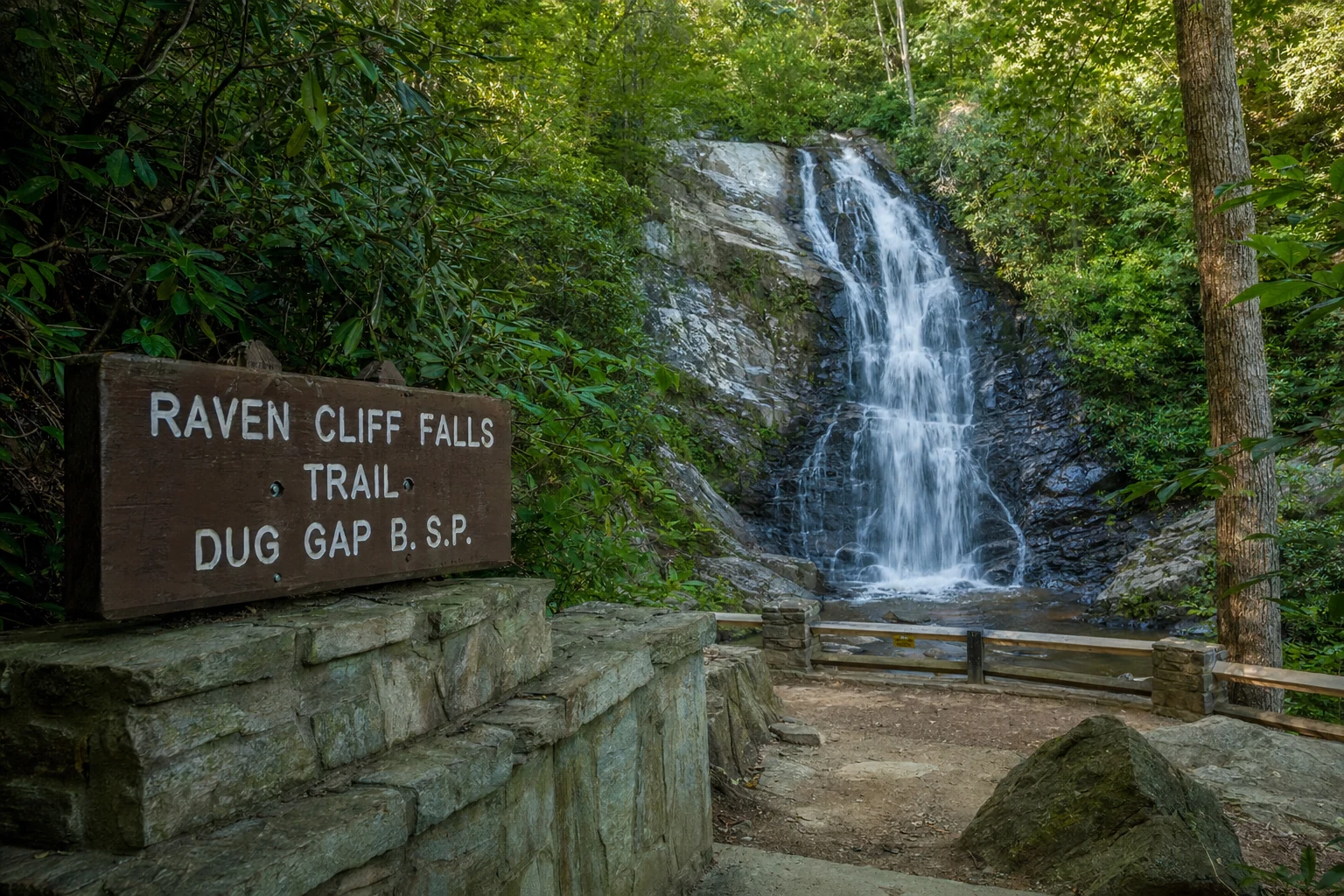
The primary access for visitors is the Raven Cliff Falls Trail (Trail #11), a 2.5-mile (one way) hike following Dodd Creek.
Trail Character: The trail is rated moderate, with an elevation gain of approximately 560 feet. It features multiple stream crossings, some utilizing wooden bridges and others requiring rock hopping.
Access: The trailhead is located off the Richard B. Russell Scenic Highway (GA 348). Amenities at the trailhead are minimal, consisting of a gravel parking lot (capacity ~30 vehicles), vault toilets, and bear-resistant trash bins. A parking fee of $5 is required. Check current conditions on AllTrails before visiting.
Backcountry Camping Regulations
Camping within the wilderness is managed to minimize impact while allowing for primitive recreation.
Designated vs. Dispersed: While there are no developed campgrounds with hookups, dispersed camping is permitted. "Trailhead campsites" exist near the parking area, and numerous established primitive sites are located along Dodd Creek.
Permits and Fees: Camping is generally free (after the parking fee) and first-come, first-served. No reservation system exists for backcountry sites.
Bear Canister Requirements: Due to high bear activity, the use of bear-resistant food containers is strongly emphasized and, in some contexts within the region, required. Reports indicate that traditional "bear hangs" are often ineffective against habituated bears in this high-traffic corridor. Specific advice suggests keeping all scented items in canisters to prevent wildlife conflicts.
Related Imagery from Around Helen