Toccoa Falls
A 186-foot free-falling waterfall on a quiet college campus, one of the tallest east of the Mississippi
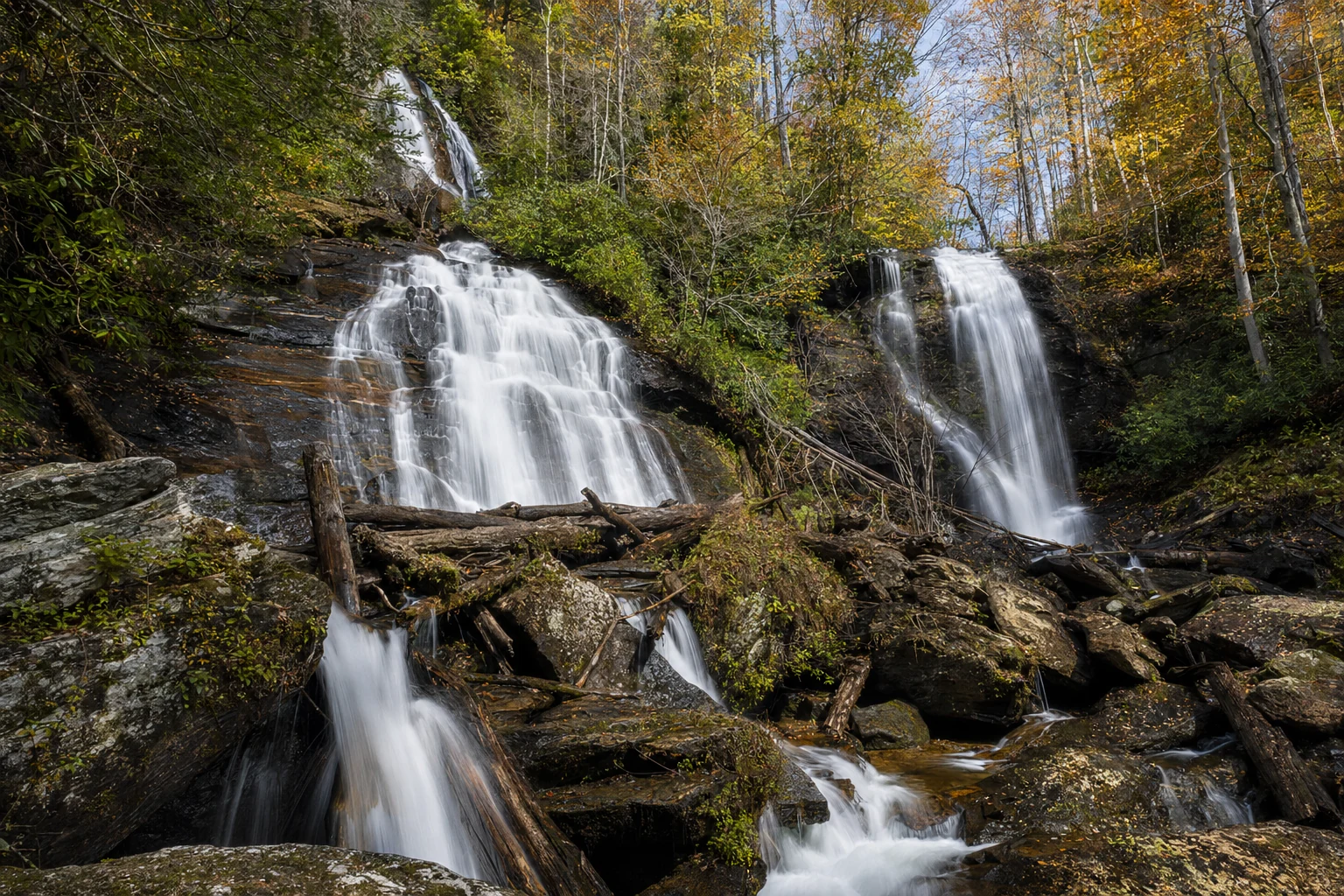
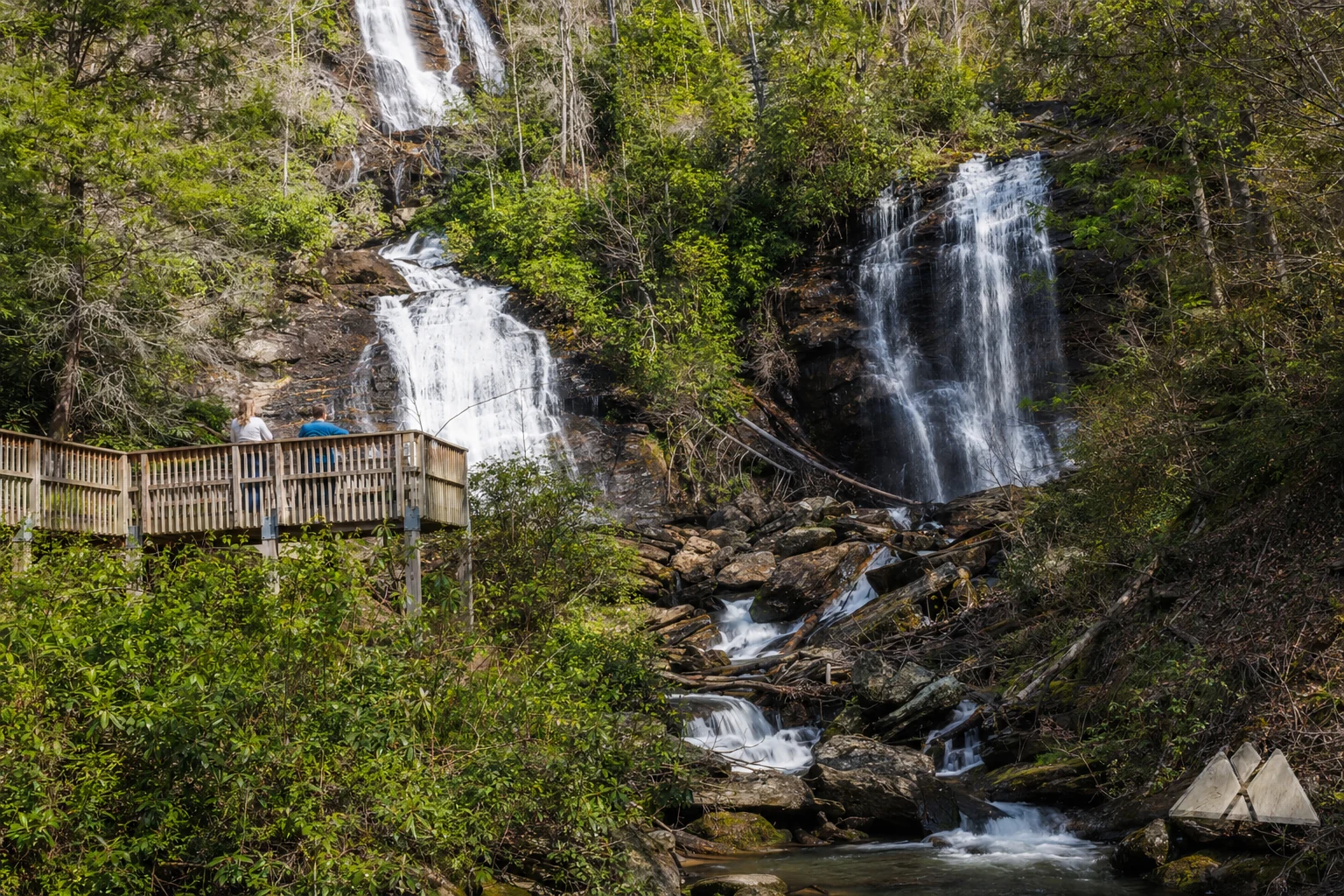
Toccoa Falls is one of North Georgia's most underrated natural attractions. This 186-foot free-falling waterfall sits on the campus of Toccoa Falls College, a small Christian liberal arts school in the foothills of the Blue Ridge. The drop is actually taller than Niagara Falls, making it one of the tallest free-falling waterfalls east of the Mississippi. What sets it apart from other waterfalls in the region is how easy it is to reach: the path from the parking lot takes just a few minutes, it costs $2 to get in, and the history behind both the falls and the campus gives the place a weight that most roadside waterfalls lack.
History & Founding
College Origins and Waterfall Discovery
Toccoa Falls College was established in 1907 by evangelist Richard A. Forrest, originally founded as the Golden Valley Institute in Golden Valley, North Carolina. The institution's pivotal moment came on January 1, 1911, when Forrest purchased the Haddock Inn and 100 acres of land in northeast Georgia for just $10 down on a $25,000 purchase price - a transaction that would define the college's identity for over a century. The original Haddock Inn, which stood on the property, has since burned to the ground, but many buildings constructed in the early 20th century remain standing today, adding to the historical character of the 1,100-acre campus.
The waterfall has been part of the college since 1907. Locals just call it "The Falls," and for the college it is the defining landmark, the thing everyone pictures when they think of the campus.
The name "Toccoa" derives from a Cherokee word pronounced "Tock-oh-aye," connecting the waterfall to the Indigenous peoples who inhabited the region for centuries before European settlement. In the 1750s, following the Great Awakening, Scottish missionaries from England established a Native American settlement that converted to Christianity, complete with schools and churches, though this community was eventually destroyed by rival tribes.
Academic Evolution
The college evolved significantly throughout the 20th century. In 1928, secondary courses were reorganized and the state of Georgia accredited it as Toccoa Falls High School, which operated until 1976. The institution received its full four-year college charter in 1937, authorized to grant Bachelor of Arts degrees in Biblical Education. Today, Toccoa Falls College remains a regionally accredited evangelical Christian liberal arts institution affiliated with the Christian and Missionary Alliance, serving over 1,700 undergraduate and graduate students across four schools: the School of Arts & Sciences, the School of Christian Ministries, the School of Professional Studies, and the Fetterman School of Nursing.
The 1977 Dam Disaster: A Community Tragedy
The Kelly Barnes Dam Collapse
The most significant and tragic chapter in Toccoa Falls history occurred on the early morning of November 6, 1977 - a date that remains seared in the collective memory of the region. Heavy rainfall during an intense weather event caused the Kelly Barnes Dam, located above Toccoa Falls Bible College on Toccoa Creek, to fail catastrophically at approximately 1:30 a.m. The resulting flood took 39 lives and caused $2.8 million in damage - a staggering loss for a small rural community.
The destruction was comprehensive and devastating. The flood destroyed nine houses, 18 mobile homes, two college buildings, and many motor vehicles, while additionally damaging five houses and five college buildings. Two bridges on Toccoa Falls Drive and a culvert at County Farm Road were completely destroyed, and one bridge abutment at Highview Road was demolished. The city's water supply was contaminated for several days, and extensive damage extended throughout the Toccoa area and especially across the college campus, including destruction of the adjacent trailer park.
Engineering Analysis and Contributing Factors
The actual causes of the dam's failure proved complex and multifactorial. A technical investigation board concluded that the failure could not be attributed to a single cause but rather resulted from "a combination of factors." The most probable causes identified included a local slide on the steep downstream slope - likely associated with piping (seepage through the dam structure) - followed by an attendant localized breach in the dam's crest and progressive erosion. Additionally, saturation of the downstream embankment contributed to the total structural collapse.
Contributing to the difficulty in pinpointing exact causes was the dam's age and the severe lack of design, construction, and maintenance records. The dam featured serious structural vulnerabilities: spiral riveted pipes embedded within the earth embankment, multiple pipes concentrated in a localized area, pipes through the dam that were only partially or incompletely plugged, and inadequate repair of local slope failures. When the initial breach began, it triggered progressive erosion that the aging structure could not withstand.
The scale of the disaster - with a peak discharge of 24,000 cubic feet per second surging through the channel - was quantified through field surveys and hydrologic calculations. The magnitude of the failure was so severe that it removed a major portion of the dam structure, making it virtually impossible to determine every contributing factor.
Legacy and Response
Immediately following the disaster, Georgia Governor George Busbee requested federal technical assistance from President Jimmy Carter. The federal response was swift - President Carter pledged federal assistance to investigate the causes and implications of the failure. This federal involvement and the careful investigation that followed helped establish improved dam safety protocols across the nation.
The dam was never rebuilt, and today the site remains a reminder of the community's resilience. The tight-knit Toccoa Falls community emerged from the tragedy stronger, though the memories of those lost remain central to the region's identity. The college itself has been at the forefront of remembering the tragedy, with commemorative events continuing to honor the lives lost and celebrate the community's recovery.
Visiting Toccoa Falls: Essential Information
Contact & Location
Toccoa Falls College is located at 107 Kincaid Drive, Toccoa Falls, Georgia 30598. For visitor inquiries, call the Campus Bookstore Office at 706-886-7299, extension 5219, or contact the college's main line at 706-886-6831. The college website (www.tfc.edu) provides additional campus information.
Hours of Operation
The waterfall is open to the public year-round with the following standard hours:
Monday-Friday: 10:00 AM to 4:00 PM
Saturday-Sunday: 12:00 PM to 4:00 PM
It's important to note that hours are subject to change due to holidays, campus closures, and special events. Closures may occur around Labor Day, Veteran's Day, Fall Break (typically the second or third weekend of October), the last two weeks of December through New Year's, MLK Day, President's Day, Spring Break (typically the second week of March), Good Friday, Memorial Day, and Independence Day. Visitors should call ahead to confirm hours, particularly if a wedding or campus event is scheduled - one insider tip is to verify the falls are open since private events sometimes affect public visiting hours.
Admission & Pricing
Admission is remarkably affordable for such a spectacular natural attraction. Adult admission is $2, seniors (age 60+) are charged $1, and children six years old and younger enter free. A family of four or more can enter for a flat rate of $6. Payment is collected at the Gate Cottage gift shop, which also sells souvenirs and snacks.
Parking & Accessibility
Free parking is available in a large gravel parking lot located in front of the college library. The lot typically has ample parking capacity, though it can fill quickly during peak tourist seasons (summer weekends) and when the college is in full session. Insider tip: Visit during times when the college is not in session - summer break or winter break - to enjoy far fewer crowds and easier parking availability.
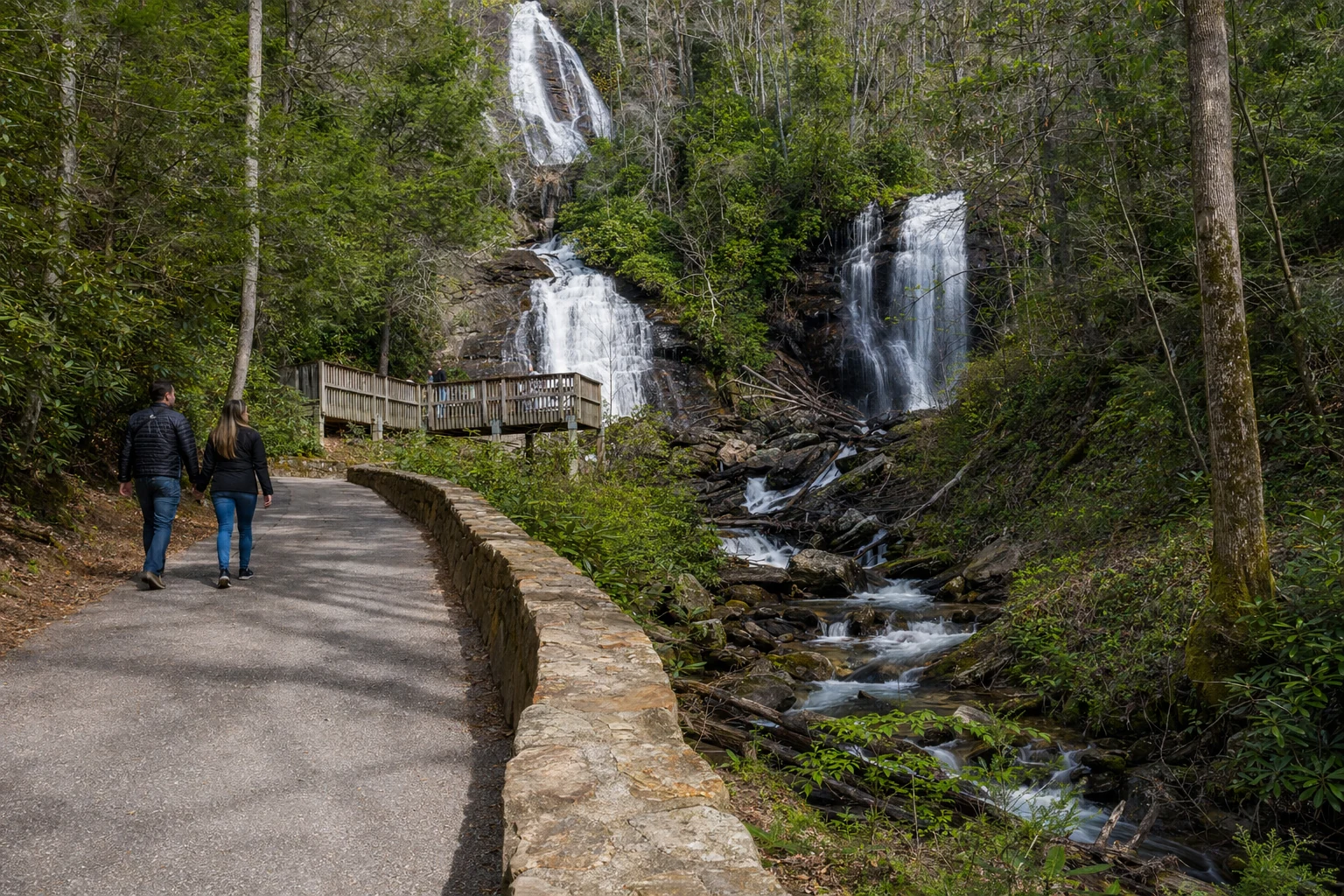
The grounds are notably accessible for visitors of all mobility levels. A meandering stream flows through the lower part of the campus from the base of the waterfall, and the path to the falls is handicap-accessible, featuring a short 100-yard graveled path. The width of the trail accommodates wheelchairs comfortably, and the gentle slope makes it manageable for most visitors.
The Waterfall Experience: What to Expect
Upon arrival, visitors check in with gate security, who request a simple identification and ask the purpose of your visit (answer: "to see Toccoa Falls"). This security protocol exists to protect the campus and preserve the falls themselves. After parking in the gravel lot, visitors enter the college's library building to pay admission at the gift shop.
From there, you exit through a rear door onto a small patio lined with cedar-paneled walls and flower boxes - a carefully curated introduction to the natural spectacle ahead. The graveled trail begins from the Gate Cottage and slopes gently downward toward the falls, passing alongside Toccoa Creek. The entire walk from parking to the waterfall base takes only a few minutes.
When you round the last bend and see the full height of the falls, the scale is startling. The water drops 186 feet in a clean free-fall, barely touching rock on the way down, and the roar fills the small clearing. Mist rises off the plunge pool and drifts through the surrounding trees. It is one of those places where you just stand there for a while.
Related Imagery from Around Helen