Spring Wildflowers in the North Georgia Mountains
Trilliums, azaleas, lady slippers, and the springtime bloom cycle climbing the North Georgia ridges
Every spring, the North Georgia mountains put on one of the best wildflower shows in the eastern United States, and it happens in stages. First the valley floors wake up, then the mid-elevation slopes, and finally the highest windswept balds. If you time it right, you can chase the bloom uphill for weeks. The forest floor comes alive with ephemeral wildflowers before the canopy leafs out, then flowering dogwoods and redbuds take over, and by late May the heath balds are thick with flame azaleas and rhododendrons.
This guide covers what to look for, when to find it, and where to go. Whether you are a dedicated botanist or just someone who likes a pretty hike, this is your roadmap to spring wildflower season in the Blue Ridge.
What You'll Be Looking At
Knowing what you are looking at makes the whole experience better. The bloom season breaks down into three phases: the Early Ephemerals (March-April), the Flowering Canopy (April), and the Heath Bloom (May-June).
Act I: The March of the Ephemerals (March - Early April)
These plants rush to bloom, set seed, and die back before the hardwood canopy leafs out and blocks the sunlight.
Trillium (Trillium spp.)
Trilliums are the iconic wildflower of Appalachian cove forests, and North Georgia has a remarkable number of species.
Identification: Look for three leaves whorled around a stem, with a single flower in the center consisting of three petals and three sepals.
Key Species:
Toadshade (Trillium cuneatum): Also known as "Sweet Betsy." Distinguished by mottled leaves (looking like camouflage) and a sessile maroon flower that sits directly on the leaves without a stalk. It smells faintly of spices or fruit.
Act II: The Flowering Canopy (April)
Flowering Dogwood (Cornus florida)
Identification: The "petals" are actually four white bracts surrounding a cluster of tiny yellow true flowers. The bark has a texture often described as alligator hide.
Lore: Legend suggests the cross of Christ was made of dogwood, and the bracts represent the nails, stained with red tips. It is the quintessential sign that frost danger has passed.
Eastern Redbud (Cercis canadensis)
Identification: Before leafing out, the branches are coated in pea-like magenta flowers. The leaves, once they appear, are distinctively heart-shaped.
Viewing: Often seen lining highways and riverbanks in lower elevations before the dogwoods pop.
Act III: The Heath Explosion (May - June)
As the canopy closes, the show moves to the "Heath" family (Ericaceae), creating the "purple tunnels" and "laurel slicks" hikers adore.
Mountain Laurel (Kalmia latifolia)
Identification: An evergreen shrub with gnarly, twisting trunks. The flowers are geometric marvels - white to pink, cup-shaped, with stamens tucked into pockets in the petals. When a bee lands, the stamens spring out to dust the insect with pollen.
Habitat: Thrives on rocky ridges and stream banks. It forms dense thickets known locally as "laurel hells" due to their impenetrability.
Rhododendron
North Georgia is home to two primary species that are often confused, yet easily distinguished by bloom time and leaf texture.
How to Time the Bloom
To chase the bloom well, it helps to know Hopkins' Bioclimatic Law. Andrew Hopkins worked it out in 1918, and the rule of thumb is that blooming gets delayed by four days for every:
One degree of latitude north.
Five degrees of longitude west.
400 feet of increase in elevation.
Practical Application for the Tourist:
If you miss the Trillium bloom in Helen (approx. 1,450 ft elevation) in mid-April, you can likely still find them blooming at Sosebee Cove (approx. 3,000 ft elevation). If the Flame Azaleas are fading in the valleys in May, drive to the summit of Brasstown Bald (4,784 ft) in June to see them at peak.
Where to Go
Here are the best places to see wildflowers near Helen, organized by what you will find and how easy they are to reach.
The Shirley Miller Wildflower Trail (The Pocket at Pigeon Mountain)
Best for: Early spring ephemerals, Virginia Bluebells, accessibility.
Located in the Crockford-Pigeon Mountain Wildlife Management Area (WMA), "The Pocket" is a geological cul-de-sac where limestone cliffs trap moisture and nutrients, creating the single richest wildflower display in Georgia.
The Experience: A 700-foot ADA-accessible boardwalk winds through a carpet of flowers so dense you cannot step off the path without crushing them. Beyond the boardwalk, a rugged 0.9-mile (round trip) trail continues to a waterfall.
Key Flora: In late March/early April, the forest floor is a sea of Virginia Bluebells (rare in GA), Celandine Wood Poppies (yellow), Purple Phacelia, Bloodroot, and Toadshade Trillium.
Visitor Logistics:
Address: 299 Pocket Rd, Chickamauga, GA 30707.
Sosebee Cove Scenic Area
Best for: High-elevation rich cove forest, towering hardwoods, photography.
A 175-acre memorial to Arthur Woody, the "Barefoot Ranger" who brought deer back to North Georgia. This north-facing cove retains moisture and stays cool, allowing "northern" hardwoods like Yellow Buckeye and immense Tulip Poplars to thrive alongside wildflowers.
The Experience: A 0.3-mile loop trail (easy/moderate) that feels like a cathedral. The second-growth timber here is so large it mimics old-growth.
Key Flora: This is the place for Dutchman’s Breeches (white pants hanging upside down), Giant Chickweed, and a spectacular display of both Trillium grandiflorum and Trillium cuneatum. Bloom time peaks mid-to-late April due to the elevation (approx. 3,000 ft).
Visitor Logistics:
Location: GA Hwy 180, roughly 2 miles west of the intersection with US 19/129 at Vogel State Park.
Anna Ruby Falls Recreation Area & Unicoi State Park
Best for: Families, waterfall chasers, and Pink Lady's Slippers.
Located just outside the faux-Bavarian village of Helen, this is the most accessible high-yield wildflower area for casual tourists.
The Experience:
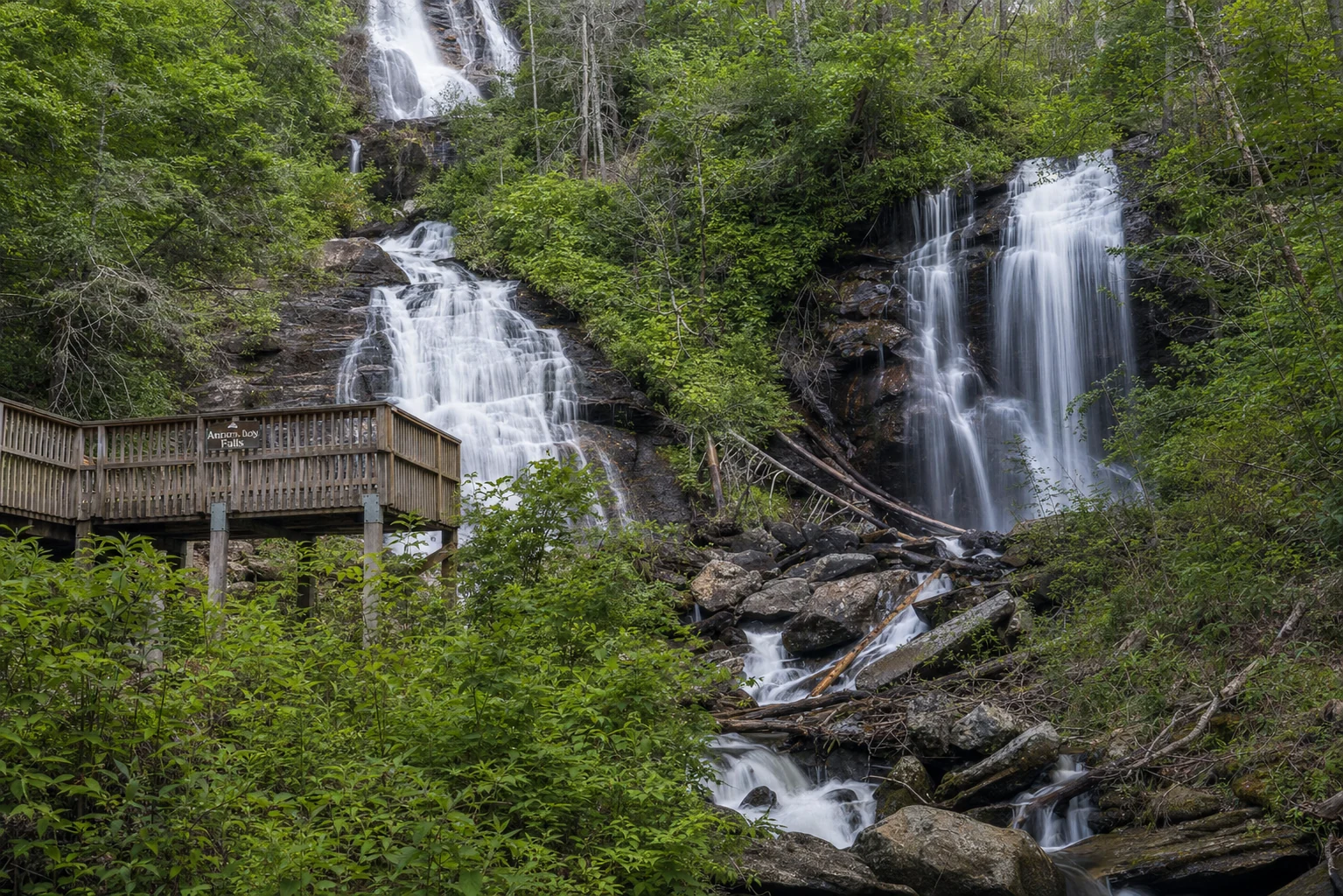
Anna Ruby Falls Trail: A 0.4-mile paved (but steep) path to twin waterfalls. The damp spray creates a microclimate for lush mosses and wildflowers.
Smith Creek Trail: A 4.6-mile trail connecting the falls to Unicoi State Park. This is a prime location for spotting the elusive Pink Lady's Slipper orchid (Cypripedium acaule) in late April/May, often growing under pines and mountain laurel.
Key Flora: Trout Lily, Violets, and Spring Beauty in March. Massive Rhododendron thickets bloom in May/June along the creek.
Smithgall Woods State Park
Best for: Mountain Laurel, river ecology, and guided hikes.
Just west of Helen, this park protects Dukes Creek, a premier trout stream. The history here is rich; it was mined for gold before being reforested.
The Experience:
Laurel Ridge Trail (1.6 mi loop): As the name implies, this trail is a tunnel of Mountain Laurel. In May, the white and pink geometric flowers are spectacular. It also offers views of Mt. Yonah.
Ash Creek Trail (1.5 mi one-way): Requires wading through the creek (bring water shoes). This trail accesses remoter wildflower patches.
Key Flora: Mountain Laurel (May), Florida Torreya (rare), and various violets and trilliums on the lower wetland loop.
Related Imagery from Around Helen